
— Expeditions
Mt Denali
The summit awaits
Very Difficult
21 Days
6,190
Price
€12999
Per Person
Overview
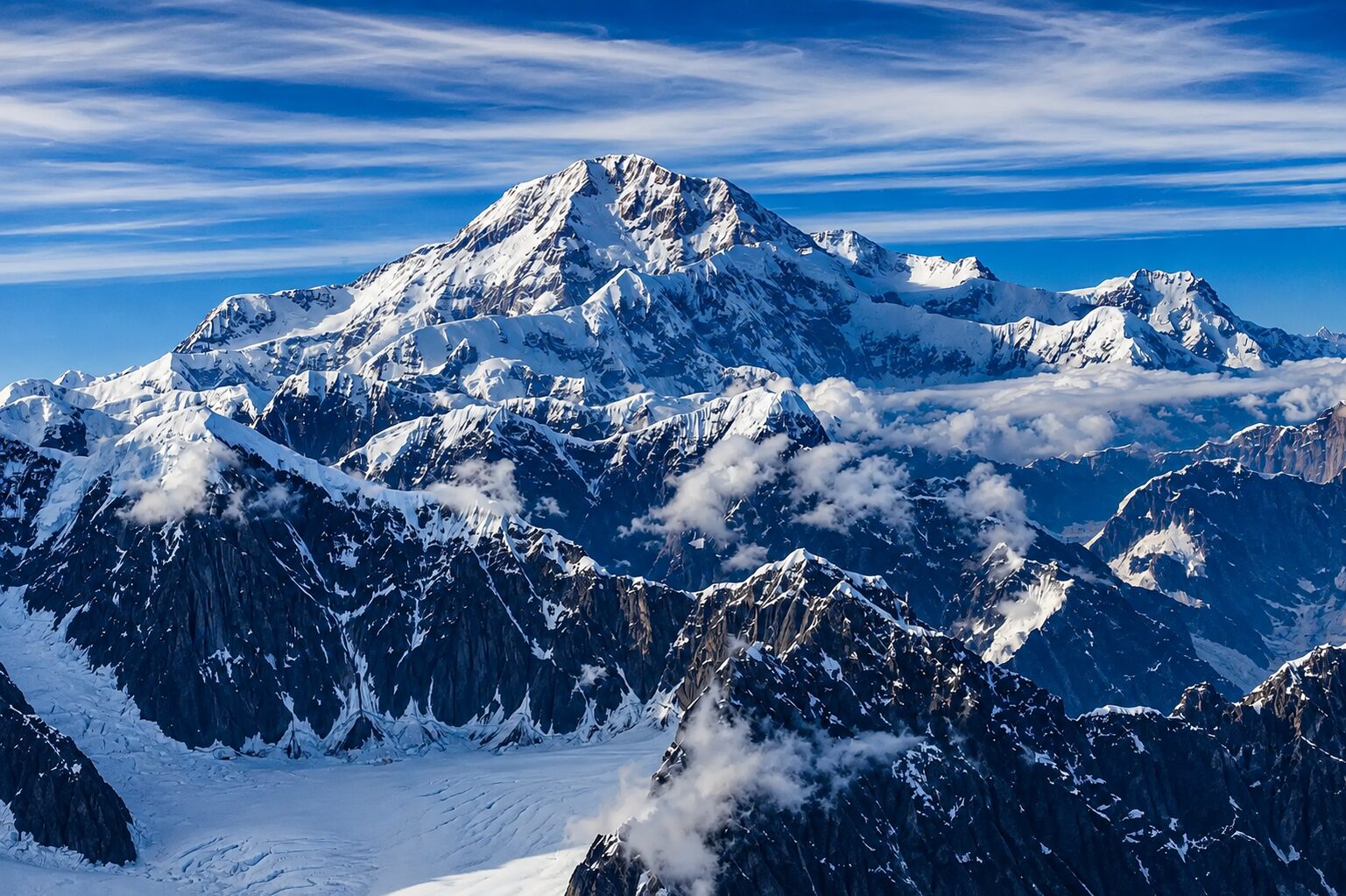
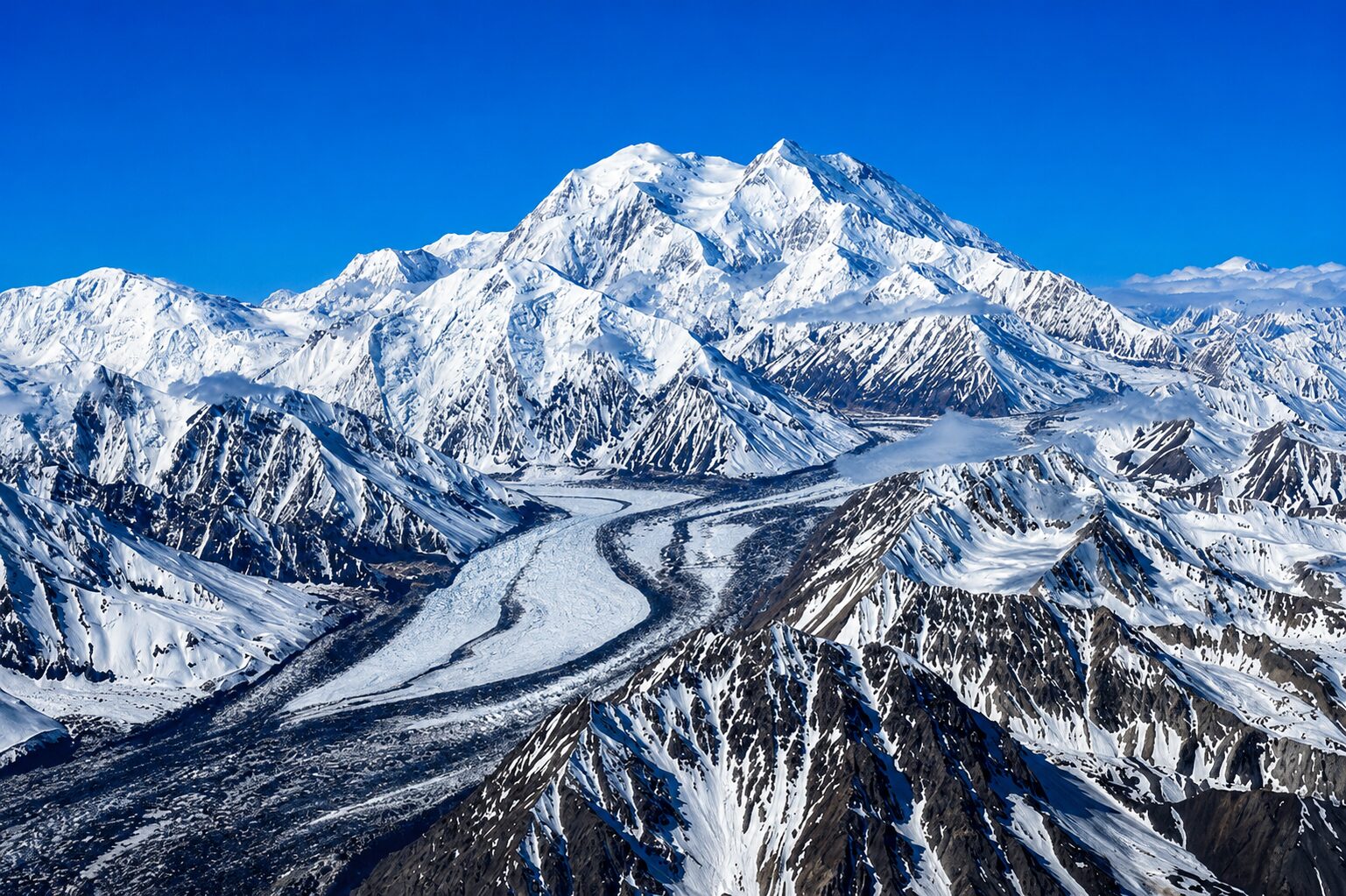
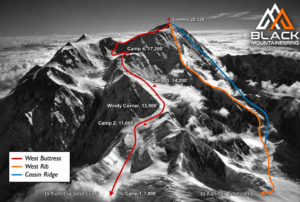
Denali (6,190m), the highest mountain in North America, is one of the world’s great mountaineering challenges. Our 21-day expedition follows the West Buttress route from the Kahiltna Glacier, using progressive camps, load carries and caches to acclimatise and move equipment higher on the mountain.
Denali Overview
Summit: 6,190m
Duration: 21 days, arrival to departure
Grade: Very Difficult
Daily Activity: Typically 8–10 hours
Route: West Buttress via the Kahiltna Glacier
Acclimatisation: Progressive camps, carries and equipment caches
High Camp: Approximately 5,240m
Summit Day: Approximately 14–18 hours, conditions dependent
Team Size: Minimum 4 / Maximum 6 climbers
Guide Ratio: Maximum 2:1 climber-to-guide
Capacity: 6 climbers
Location
Alaska
Duration
21 Days
Route
West Buttress
Grade
Very Difficult
Altitude
6,190
Activity
8-10 hrs
itinerary
Day 0
10am at our Hyatt House in Anchorage, Alaska
There will be a pre-trip meeting for all team members at 10am.
Guides and climbers will meet in the main lobby at the hotel and commence with the gear check and packing procedures.
DAY 1
Anchorage to Talkeetna & Denali Base Camp
Our Denali expedition begins in Anchorage, where we depart by private ground transfer for the approximately 2.5-hour journey north to the historic climbing town of Talkeetna.
On arrival, we check in with the National Park Service Ranger Station for our expedition registration, orientation and final preparations before heading onto the mountain.
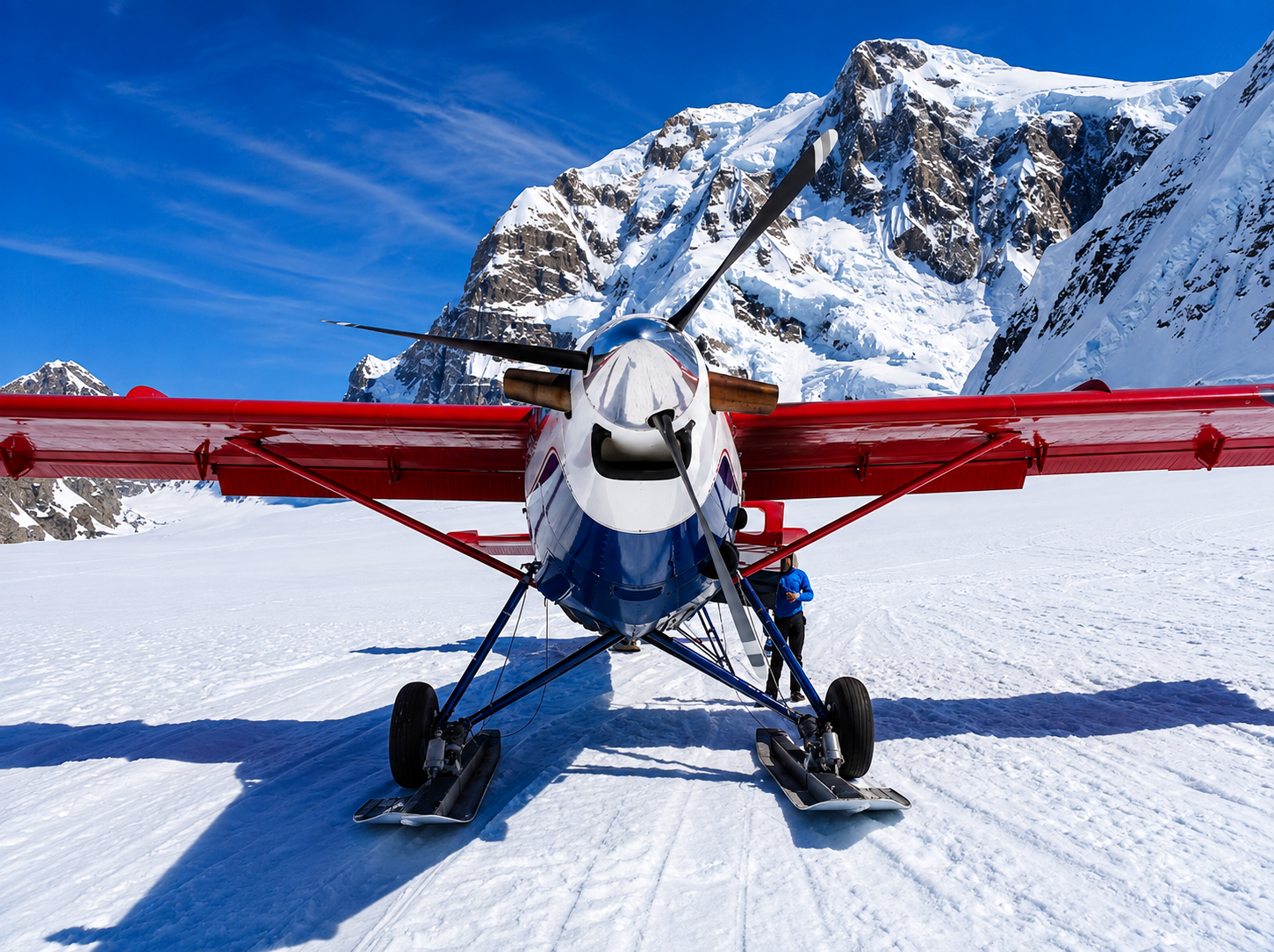
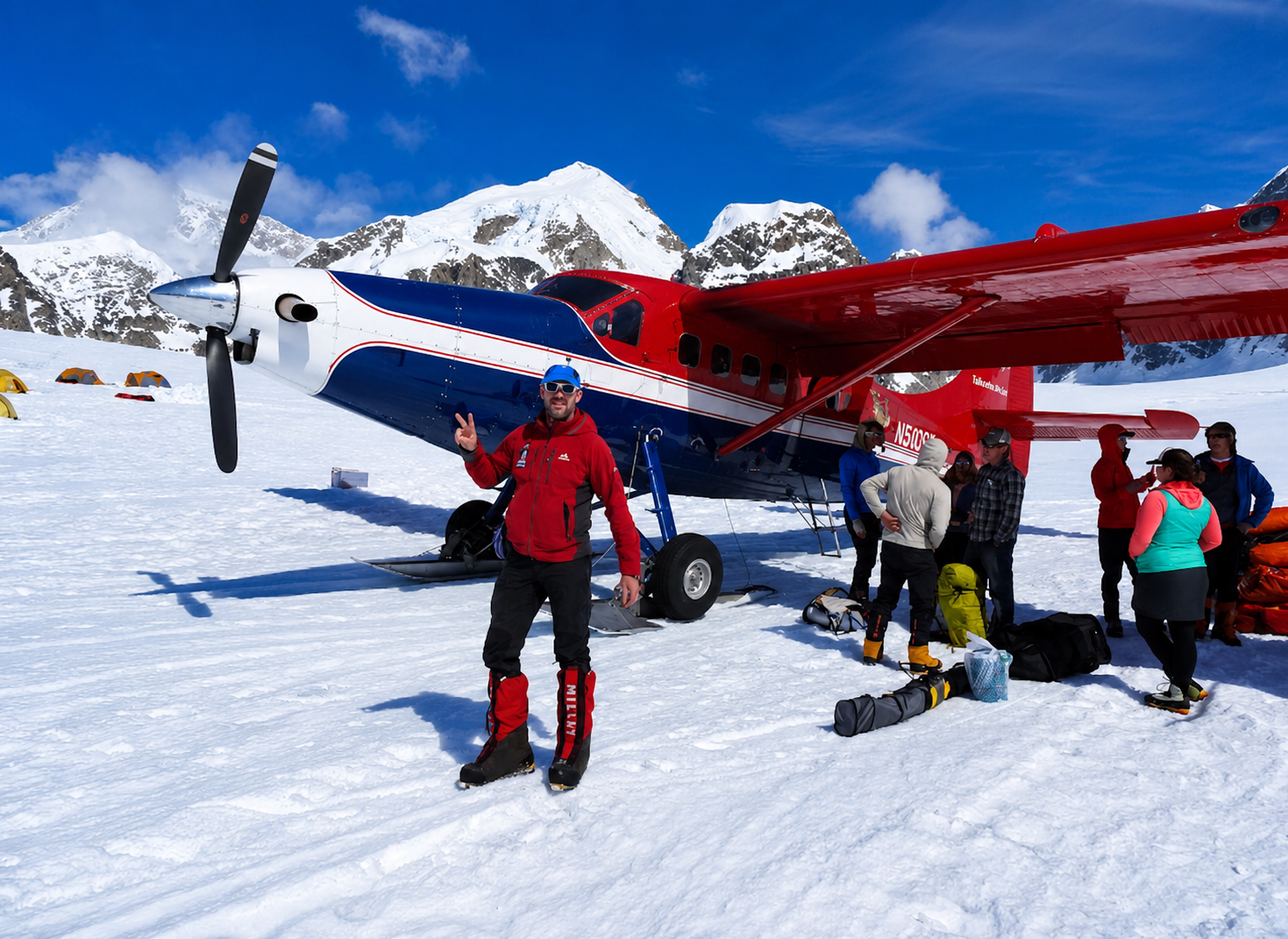
Following the briefing, we complete our final packing and prepare for one of the great experiences of any Denali expedition: flying by ski aircraft into the Alaska Range and landing directly on the Kahiltna Glacier.
We land at Denali Base Camp, 2,194m (7,200ft), on the Southeast Fork of the Kahiltna Glacier. Surrounded by the immense peaks of the Alaska Range, this is where the expedition truly begins.
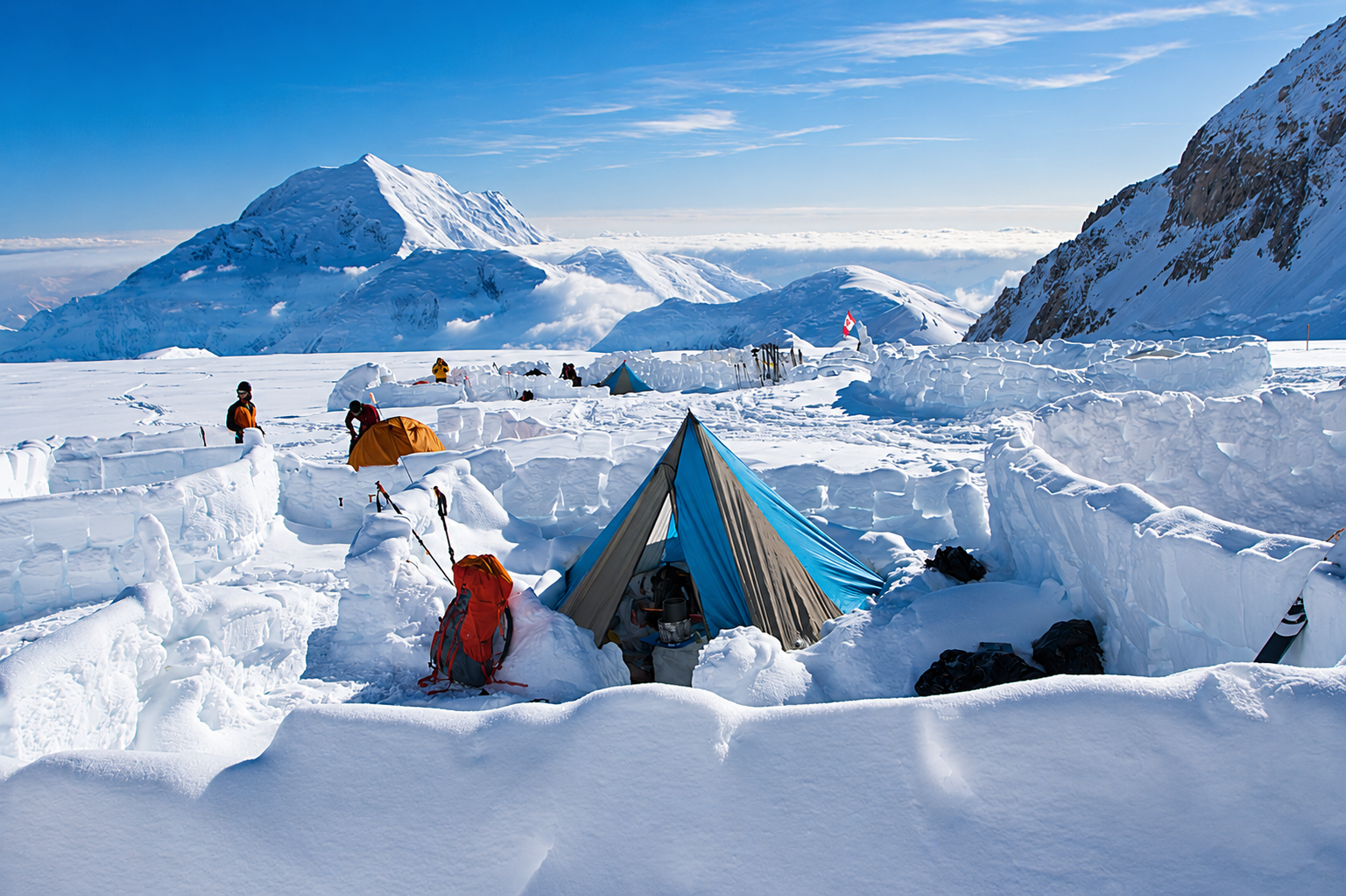
Once established at Base Camp, we introduce the team to expedition life on Denali, including camp building, glacier camp etiquette, cooking procedures and the individual roles and responsibilities required to operate effectively as a team.
Quick Stats
Talkeetna: 109m / 358ft
Denali Base Camp: 2,194m / 7,200ft
Ground Transfer: Approximately 2.5 hours
Overnight: Kahiltna Glacier — Denali Base Camp
DAY 2
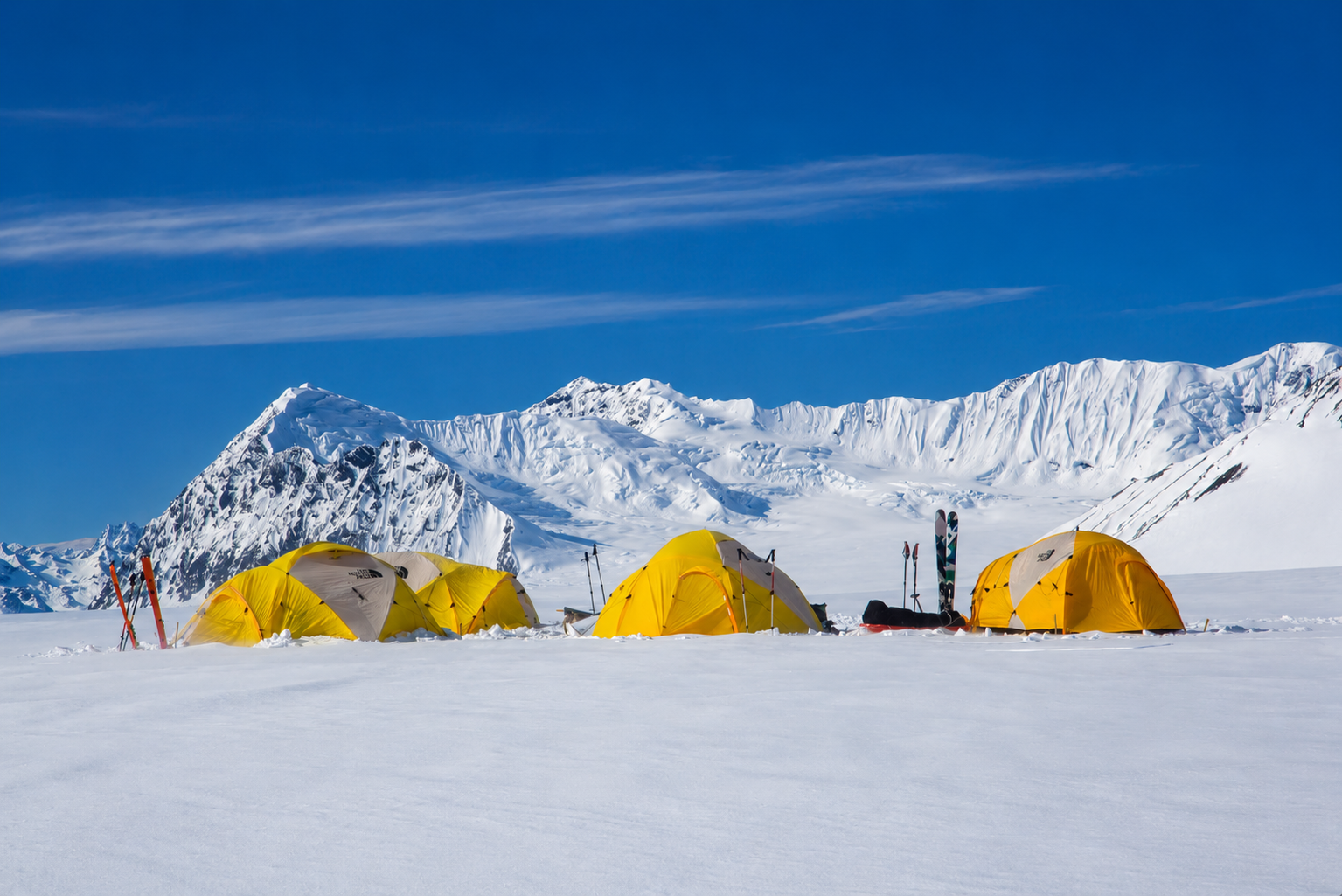
Base Camp to Camp 1
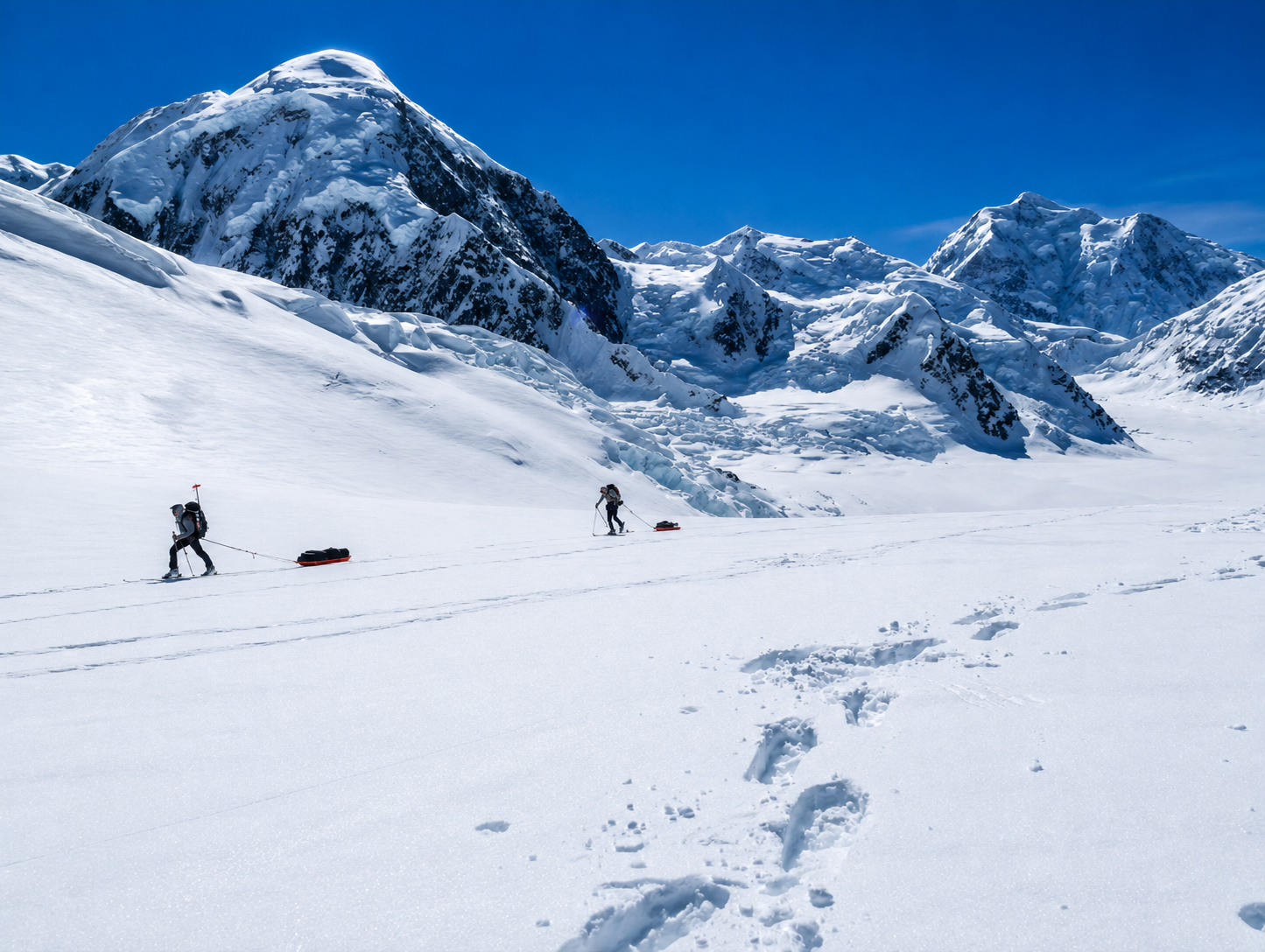
After breakfast at Base Camp, we prepare for our first move up the mountain. The team will rig our sleds, organise our expedition loads and establish our Base Camp cache before setting out across the Kahiltna Glacier.
Leaving Base Camp at 2,194m (7,200ft), we initially descend approximately 400ft down Heartbreak Hill before beginning the gradual journey up the glacier towards Camp 1.
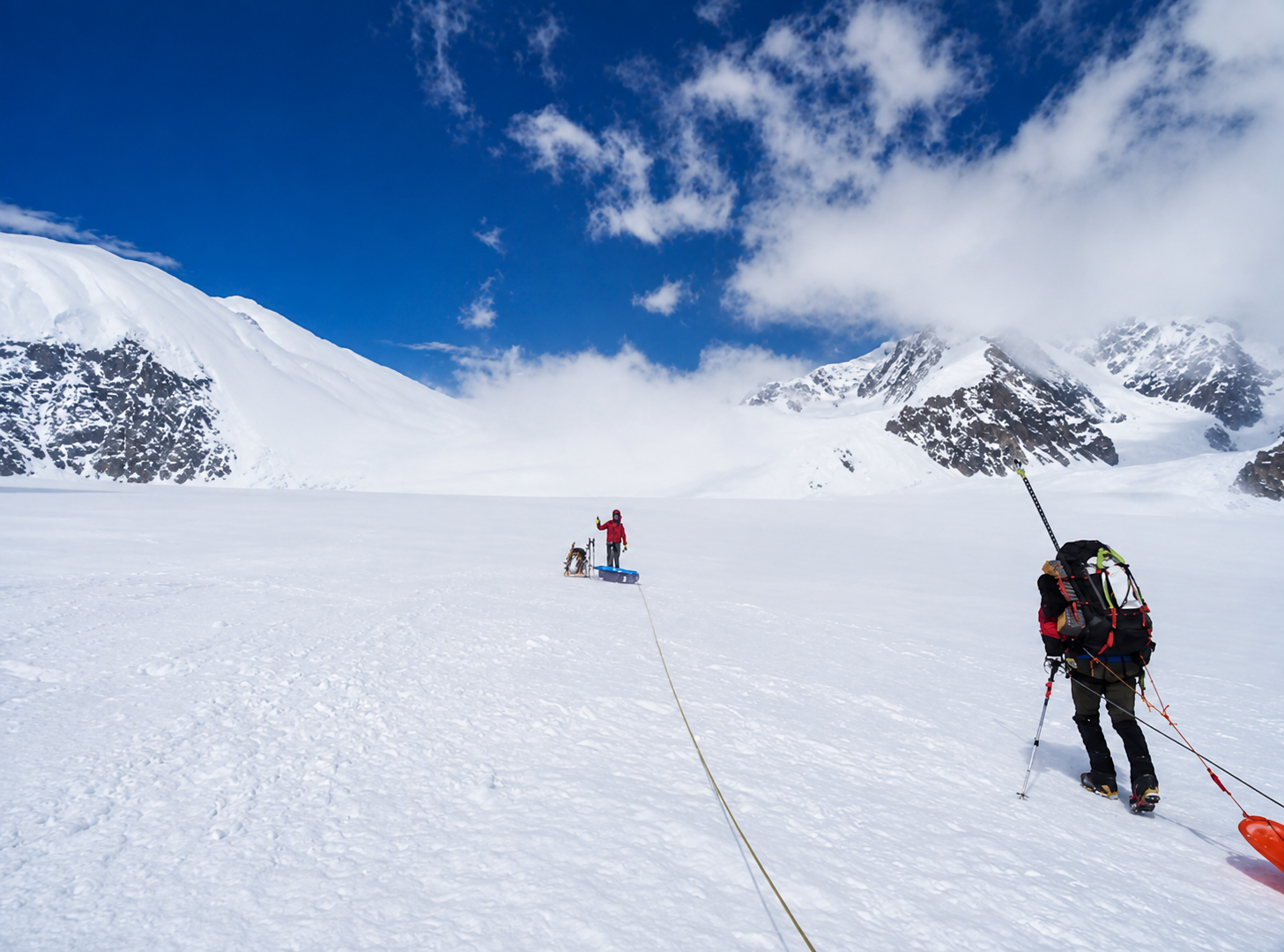
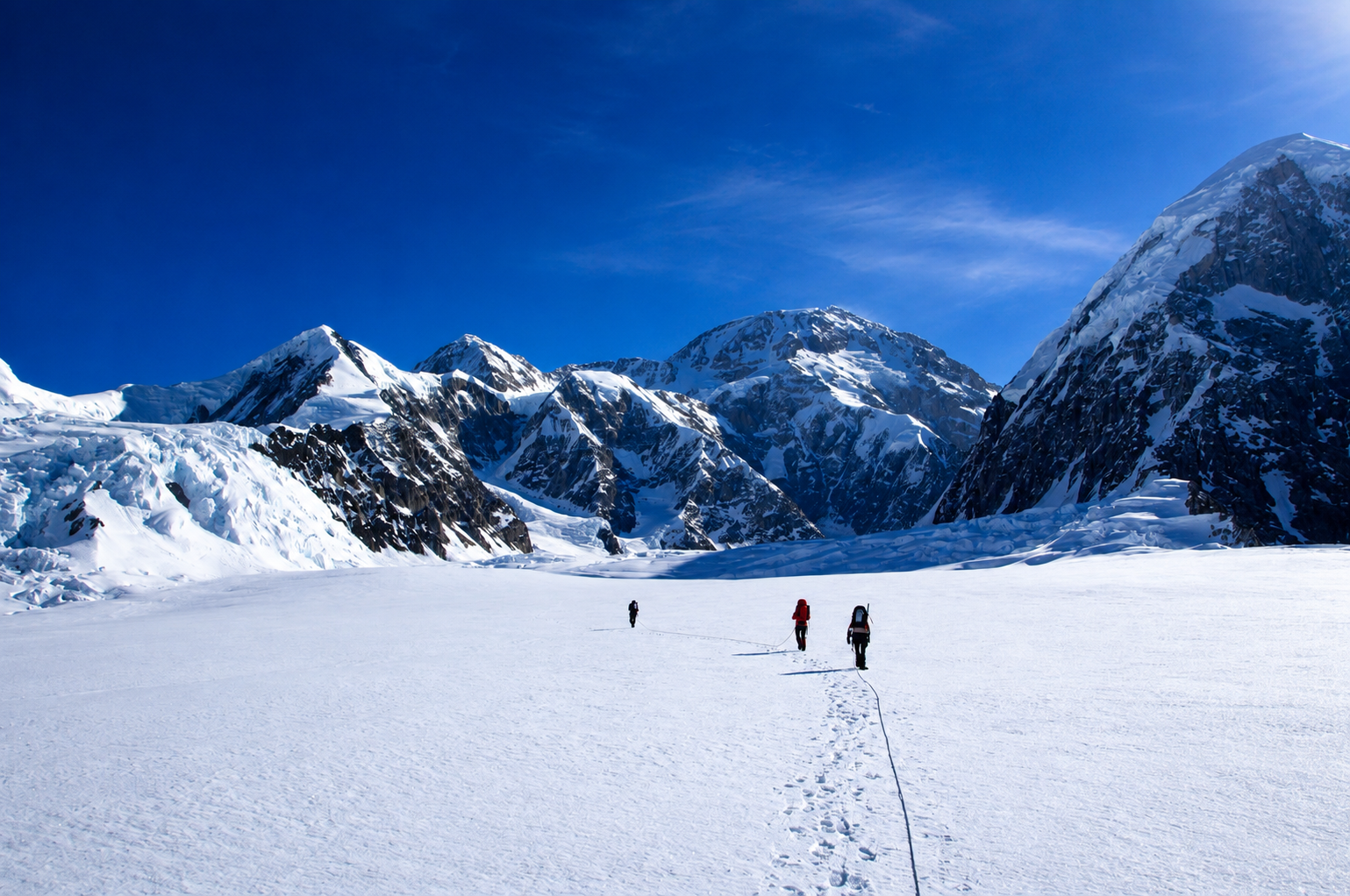
Travelling roped together and hauling our expedition sleds, we make our way approximately 5.5 miles (8.8 km) to Camp 1 at 2,377m (7,800ft), situated below Ski Hill.
On arrival, we establish camp, organise our equipment and settle into our first night higher on Denali.
Quick Stats
Start: Base Camp — 2,194m / 7,200ft
Finish: Camp 1 — 2,377m / 7,800ft
Distance: Approx. 8.8 km / 5.5 miles
Total Elevation Gain: Approx. 305m / 1,000ft
Initial Descent: Approx. 122m / 400ft
Overnight: Camp 1, Kahiltna Glacier
DAY 3
Camp 1 to Cache
Today we begin the important process of carrying and caching expedition loads higher on the mountain.
Leaving Camp 1 at 2,377m (7,800ft), we climb towards Kahiltna Pass, carrying food, fuel and equipment that will be required as the expedition progresses.
Our objective is to establish a cache at approximately 3,048m (10,000ft), just below Camp 2. Once the cache is securely established, we descend back to Camp 1 for another night.
This first carry higher on Denali is an important part of our acclimatisation and expedition strategy, allowing the team to begin adapting to the increasing altitude while progressively moving equipment up the mountain.
Quick Stats
Start/Finish: Camp 1 — 2,377m / 7,800ft
Cache: Approx. 3,048m / 10,000ft
Distance: Approx. 11.3 km / 7 miles round trip
Elevation Gain: Approx. 670m / 2,200ft
Overnight: Camp 1
DAY 4
Camp 1 to Camp 2
Today we leave Camp 1 at 2,377m (7,800ft) and continue our journey higher up the Kahiltna Glacier towards Camp 2.
With our expedition loads and sleds, we retrace yesterday’s route towards our cache before continuing higher. As we gain altitude, the terrain gradually steepens and the scale of the surrounding Alaska Range becomes increasingly impressive.
Our destination is Camp 2 at 3,413m (11,200ft), positioned below the famous Motorcycle Hill. On arrival, we establish camp, organise our equipment and settle in at our new altitude.
This is a significant step in the expedition, taking us above 3,000m and beginning the transition towards the steeper terrain of Denali’s upper mountain.
Quick Stats
Start: Camp 1 — 2,377m / 7,800ft
Finish: Camp 2 — 3,413m / 11,200ft
Distance: Approx. 6.4 km / 4 miles
Elevation Gain: Approx. 1,036m / 3,400ft
Overnight: Camp 2 — 3,413m / 11,200ft
DAY 5
Camp 2 to Lower Cache & Return
Today is an important back-carry and acclimatisation day as we retrieve the equipment, food and supplies cached during our earlier move up the mountain.
Leaving Camp 2 at 3,413m (11,200ft), we descend to our lower cache at approximately 3,109m (10,200ft). After collecting our cached expedition loads, we climb back to Camp 2 with the remaining supplies.
Although shorter than our previous mountain days, the descent and subsequent climb back to camp provide another valuable opportunity for the team to acclimatise, recover and prepare for the journey onto Denali’s steeper upper mountain.
The remainder of the day is spent at Camp 2, organising equipment, refuelling and preparing for the next stage of the expedition.
Quick Stats
Start/Finish: Camp 2 — 3,413m / 11,200ft
Lower Cache: 3,109m / 10,200ft
Distance: Approx. 1.6 km / 1 mile round trip
Elevation Loss & Gain: Approx. 366m / 1,200ft
Overnight: Camp 2 — 3,413m / 11,200ft
DAY 6
Camp 2 to Windy Corner Cache
Today we continue our acclimatisation and load-carrying strategy, moving essential food, fuel and expedition equipment higher up the mountain.
Leaving Camp 2 at 3,413m (11,200ft), we climb above camp and make our way towards the spectacular Windy Corner at approximately 4,145m (13,600ft).
This section takes us onto increasingly higher and more demanding terrain, providing another important opportunity for the team to acclimatise while carrying loads in preparation for our move to the upper mountain.
At Windy Corner, we establish a secure cache before descending back to Camp 2 for recovery and another night at 3,413m.
Quick Stats
Start/Finish: Camp 2 — 3,413m / 11,200ft
High Point/Cache: Windy Corner — 4,145m / 13,600ft
Distance: Approx. 7.2 km / 4.5 miles round trip
Elevation Gain & Loss: Approx. 732m / 2,400ft
Overnight: Camp 2 — 3,413m / 11,200ft
DAY 7
Camp 2 to Camp 3
Today we make another significant move higher on Denali, leaving Camp 2 at 3,413m (11,200ft) and climbing towards Camp 3, commonly known as 14 Camp.
The route continues through increasingly impressive mountain terrain as we gain approximately 914m (3,000ft) and make our way towards our new home at 4,328m (14,200ft).
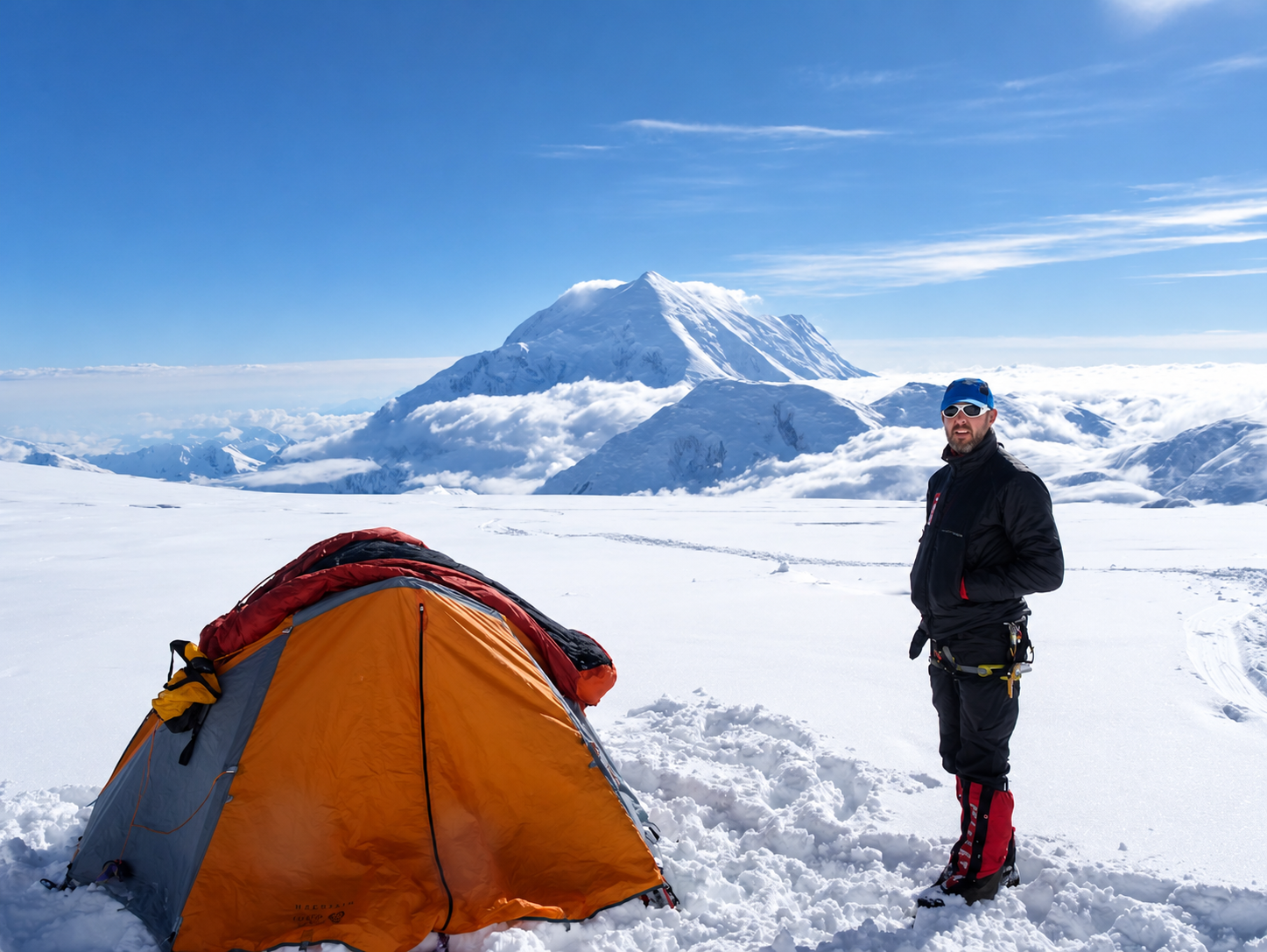
Camp 3 is one of the most spectacular locations on the expedition, surrounded by extraordinary views across the Alaska Range. From camp, we can look towards Mount Hunter and Mount Foraker, with incredible sunsets across the surrounding mountains.
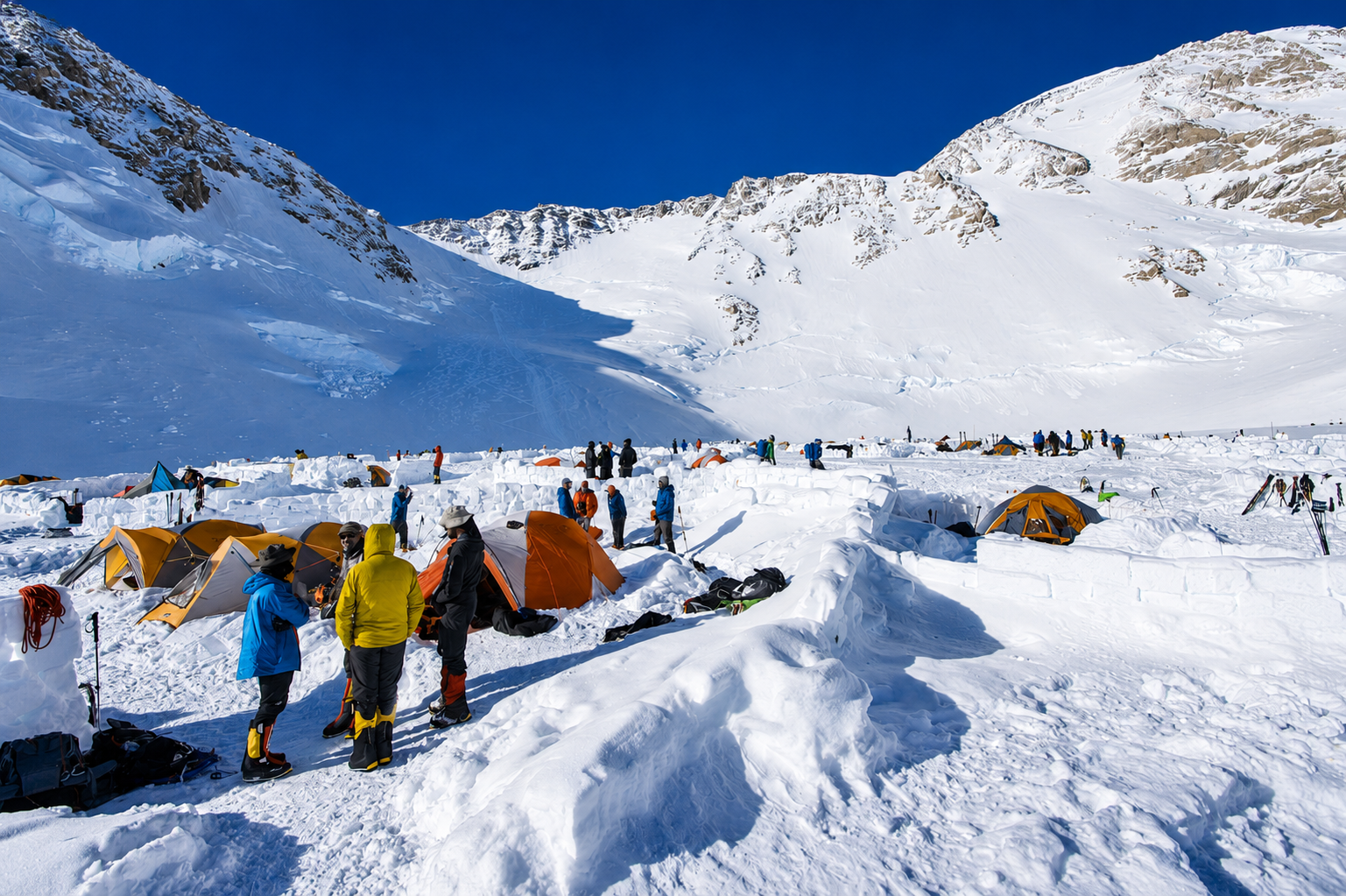
On arrival, we establish camp, organise our equipment and begin settling into life above 4,000m. This will become an important base for the next phase of our acclimatisation and our progression towards Denali’s upper mountain.
Quick Stats
Start: Camp 2 — 3,413m / 11,200ft
Finish: Camp 3 — 4,328m / 14,200ft
Distance: Approx. 4.4 km / 2.75 miles
Elevation Gain: Approx. 914m / 3,000ft
Overnight: Camp 3 — 4,328m / 14,200ft
DAY 8
Camp 3 to Windy Corner Cache & Return
Today we complete another important back-carry, retrieving the food, fuel and expedition equipment previously cached at Windy Corner.
Leaving Camp 3 at 4,328m (14,200ft), we descend to our cache at approximately 4,145m (13,600ft). After collecting our supplies, we carry everything back up to Camp 3.
This is a relatively short mountain day and provides valuable additional time for acclimatisation and recovery at 14 Camp, while ensuring all of our equipment and supplies are now positioned for the next stage of the expedition.
The remainder of the day is spent resting, organising equipment and preparing for our progression onto Denali’s upper mountain.
Quick Stats
Start/Finish: Camp 3 — 4,328m / 14,200ft
Cache: Windy Corner — 4,145m / 13,600ft
Distance: Approx. 1.6 km / 1 mile round trip
Elevation Loss & Gain: Approx. 183m / 600ft
Overnight: Camp 3 — 4,328m / 14,200ft
Day 9
Rest & Skills Day at Camp 3
Today is an important rest and acclimatisation day at Camp 3, giving the team time to recover after our progression to 4,328m (14,200ft) and prepare for the more technical terrain ahead.
Alongside recovery, we use the day for focused skills training. The team will practise ascending fixed lines and safely passing running protection while travelling as a rope team, ensuring everyone is comfortable and efficient with the systems we will use higher on Denali.
This is an important preparation day before progressing onto the steeper terrain above 14 Camp and towards the fixed lines.
Quick Stats
Location: Camp 3 — 4,328m / 14,200ft
Focus: Rest, acclimatisation & fixed-line skills
Training: Fixed-line ascent, rope-team movement & passing running protection
Overnight: Camp 3 — 4,328m / 14,200ft
Day 10
Camp 3 to 16,200ft Cache
Today we move onto one of the most significant and exciting sections of the Denali expedition as we climb from Camp 3 at 4,328m (14,200ft) towards the Headwall and the West Buttress.
Above camp, the route gradually steepens before reaching the fixed lines on The Headwall, which protect approximately 800 vertical feet of 50–55° snow and ice.
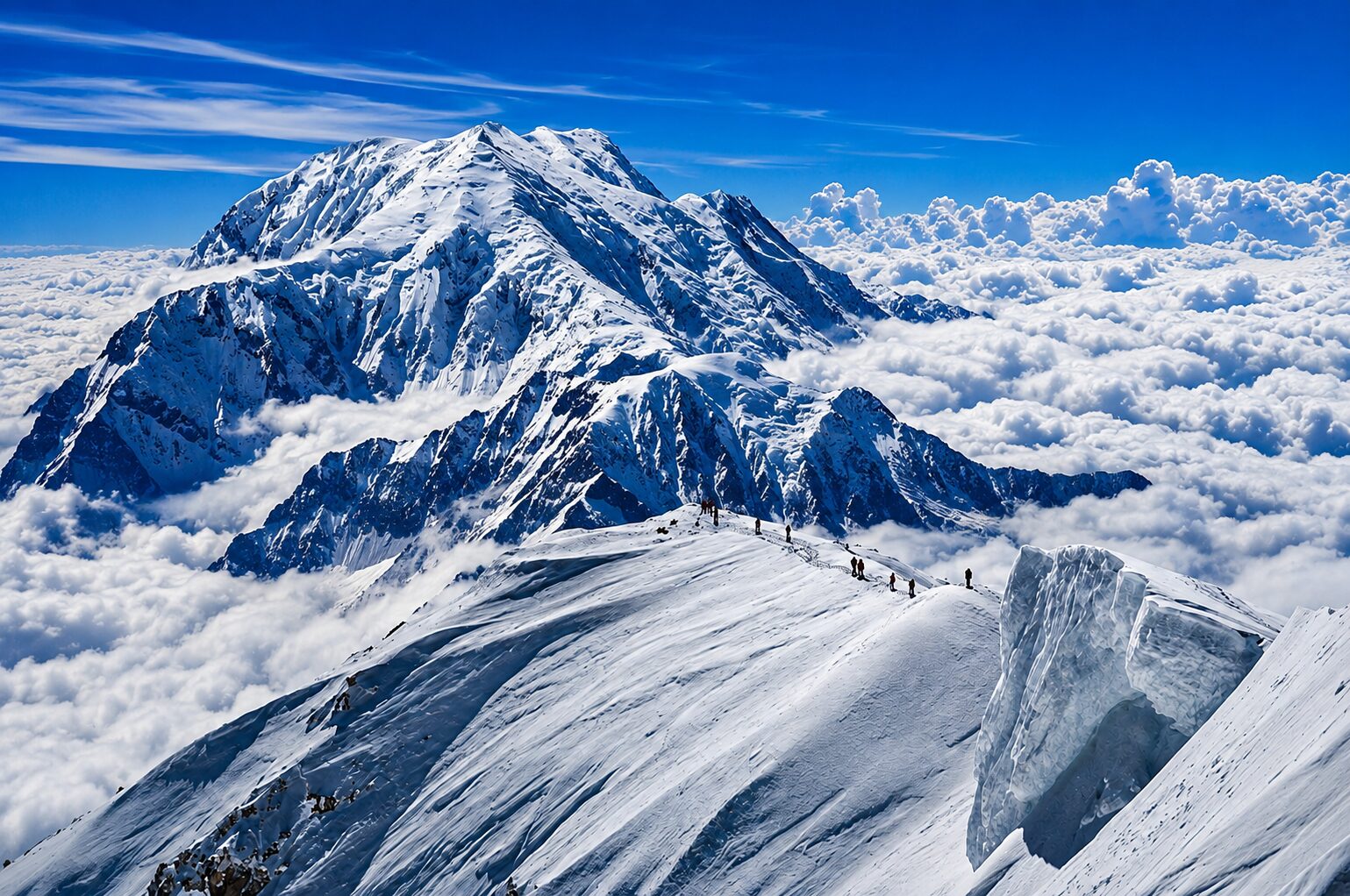
Using our fixed-line systems, we climb the Headwall carrying essential food, fuel and equipment for the upper mountain. At the top, we gain the crest of the spectacular West Buttress, where the character of the route changes dramatically and the views across the Alaska Range open around us.
We establish our cache at approximately 4,937m (16,200ft), above the fixed lines, before descending carefully back to Camp 3.
This is a major acclimatisation day and an important milestone in our progression towards High Camp and the summit of Denali.
Quick Stats
Start/Finish: Camp 3 — 4,328m / 14,200ft
High Point/Cache: 4,937m / 16,200ft
Distance: Approx. 4 km / 2.5 miles round trip
Elevation Gain & Loss: Approx. 610m / 2,000ft
Headwall: Approx. 50–55° snow and ice
Overnight: Camp 3 — 4,328m / 14,200ft
Day 11
Optional Rest Day at Camp 3
Today is an optional rest and acclimatisation day at Camp 3, allowing the team additional time to recover at 4,328m (14,200ft) before progressing higher on Denali.
How we use this day will depend on weather conditions, the team’s recovery and our overall progress on the mountain. If conditions and acclimatisation are good, we may choose to continue with the expedition rather than take the additional rest day.
If used as a rest day, the focus will be on recovery, hydration, nutrition and preparing our personal and expedition equipment for the move towards High Camp.
Quick Stats
Location: Camp 3 — 4,328m / 14,200ft
Focus: Optional rest, recovery & acclimatisation
Overnight: Camp 3 — 4,328m / 14,200ft
Day 12
Camp 3 to High Camp
Today is one of the most demanding and significant days of the expedition as we leave Camp 3 and make our move to High Camp at 5,242m (17,200ft).
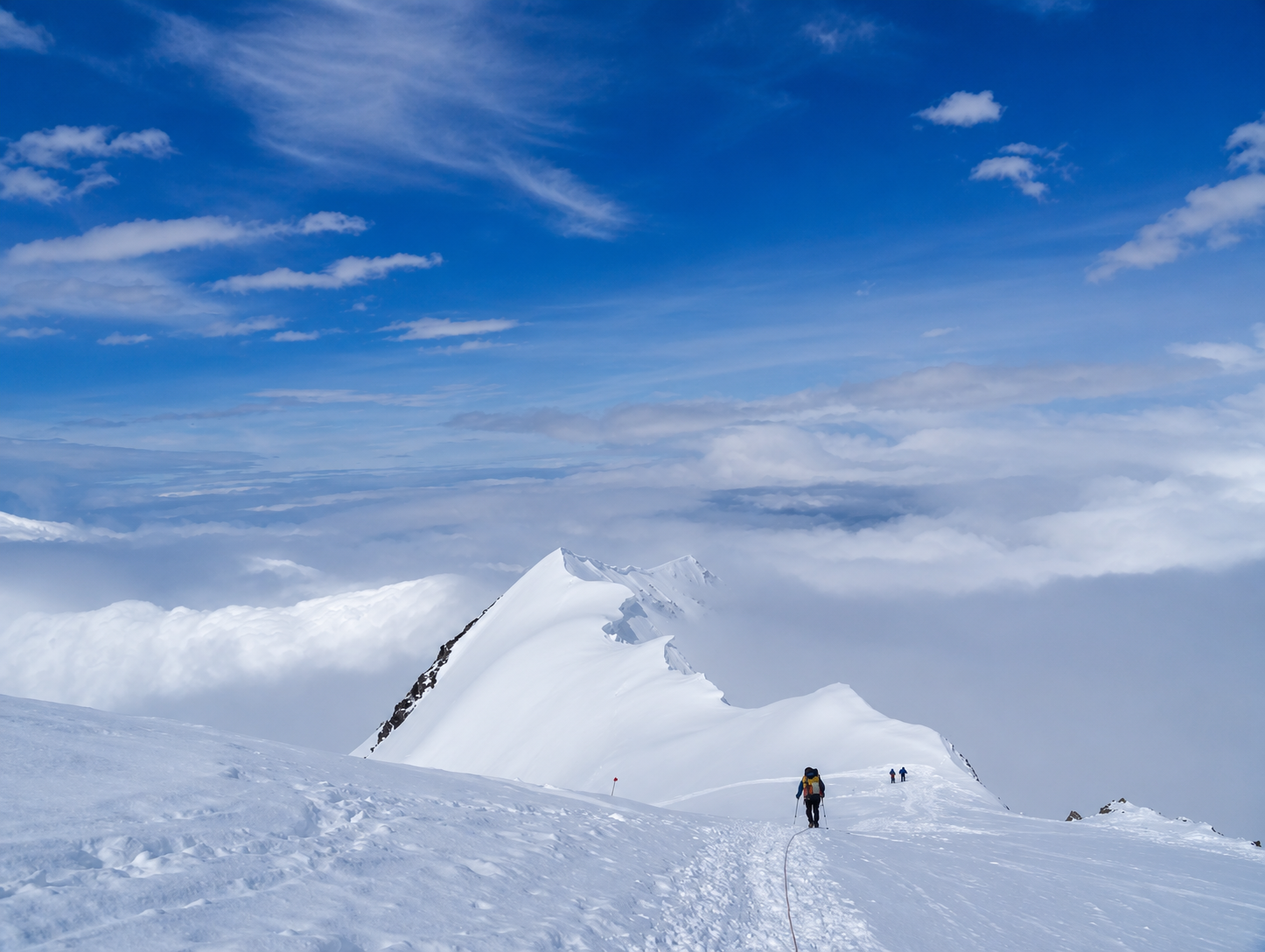
Leaving Camp 3 at 4,328m (14,200ft), we climb back towards the Headwall, ascend the fixed lines and regain the spectacular West Buttress.
From this point onwards, our expedition style changes significantly. We no longer use sleds, meaning all personal and expedition equipment required at High Camp must now be carried in our backpacks.
The combination of heavy packs, increasingly technical terrain and the effects of altitude makes this a long and physically demanding mountain day.
Our route continues along the West Buttress before eventually reaching High Camp at 5,242m (17,200ft). Once there, we establish camp, recover and begin preparing ourselves for the final stage of the expedition and our summit attempt.
Quick Stats
Start: Camp 3 — 4,328m / 14,200ft
Finish: High Camp — 5,242m / 17,200ft
Distance: Approx. 2.8 km / 1.75 miles
Elevation Gain: Approx. 914m / 3,000ft
Load Carry: All equipment carried in backpacks — no sleds
Overnight: High Camp — 5,242m / 17,200ft
Day 13
Optional Rest Day at High Camp
Today is an optional rest and acclimatisation day at High Camp, giving the team an opportunity to recover after the long and demanding move to 5,242m (17,200ft).
For most climbers, this is an important recovery day. The combination of altitude, heavy load carrying and the physical effort required to reach High Camp means additional rest can be extremely valuable before our summit attempt.
The day is focused on rest, hydration, nutrition and recovery, while closely monitoring the weather and preparing our clothing and equipment for summit day.
Our decision on when to make a summit attempt will be based on weather conditions, team recovery, acclimatisation and overall mountain conditions.
Quick Stats
Location: High Camp — 5,242m / 17,200ft
Focus: Rest, recovery & acclimatisation
Preparation: Summit equipment, hydration & nutrition
Overnight: High Camp — 5,242m / 17,200ft
Day 14 -19
Summit Day: High Camp to Denali Summit
Today is the ultimate objective of the expedition as we leave High Camp at 5,242m (17,200ft) and begin our summit attempt on Denali — 6,190m (20,310ft), the highest mountain in North America.
Summit day is the longest and most demanding day of the expedition, typically requiring between 14 and 18 hours round trip. From High Camp, we climb progressively higher into the extreme environment of Denali’s upper mountain, where altitude, cold and wind make every metre hard-earned.
Reaching the summit provides an extraordinary panorama across the vast Alaska Range and marks the culmination of weeks of preparation, load carrying, acclimatisation and teamwork.
However, summit day is entirely dictated by the mountain. High winds, extreme cold and rapidly changing weather can require teams to wait at High Camp for several days before a suitable summit opportunity develops. There is never a guarantee of a summit attempt, and the decision to climb will always be based on conditions and the safety of the team.
Following our summit attempt, we make the long descent back to High Camp for a well-earned rest.
Quick Stats
Start/Finish: High Camp — 5,242m / 17,200ft
Summit: Denali — 6,190m / 20,310ft
Distance: Approx. 8 km / 5 miles round trip
Elevation Gain & Loss: Approx. 950m / 3,120ft
Duration: Approx. 14–18 hours
Overnight: High Camp — 5,242m / 17,200ft
Day 19 -20
High Camp to Camp 3 & Base Camp
With our summit attempt complete, we begin the two-day descent from High Camp back to Denali Base Camp on the Kahiltna Glacier.
On the first day, we leave High Camp at 5,242m (17,200ft) and descend the West Buttress, carefully reversing the route through the fixed-line section before returning to Camp 3 at 4,328m (14,200ft).
The following day, we continue our descent down the mountain, collecting any remaining cached equipment and supplies as we make our way back onto the Kahiltna Glacier.
Although we are descending, these remain long and physically demanding mountain days, with expedition loads, glacier travel and accumulated fatigue requiring concentration right to the end.
The final challenge comes at Heartbreak Hill. After thousands of feet of descent, the last section back to Base Camp turns uphill, requiring approximately 600ft of climbing before we finally arrive at the glacier airstrip.
We aim to reach Base Camp in time for our scheduled ski-plane flight back to Talkeetna, subject to weather and flying conditions.
Quick Stats
Start: High Camp — 5,242m / 17,200ft
Via: Camp 3 — 4,328m / 14,200ft
Finish: Denali Base Camp — 2,194m / 7,200ft
Total Distance: Approx. 22.5 km / 14 miles
Total Elevation Loss: Approx. 2,987m / 9,800ft
Final Climb: Heartbreak Hill — approx. 183m / 600ft
Duration: Two full mountain days
Finish: Denali Base Camp / Kahiltna Glacier Airstrip
Day 21
Base Camp to Talkeetna
Weather permitting, today we say goodbye to the Kahiltna Glacier and the Alaska Range as we board our ski aircraft for the spectacular flight from Denali Base Camp back to Talkeetna.
Flights from the glacier are entirely dependent on suitable weather and visibility. Delays of a day or more are possible, so flexibility remains an important part of the expedition right to the very end.
On arrival in Talkeetna, we unload and organise our expedition equipment before finally enjoying the comforts of town after several weeks on the mountain.
Most climbers choose to spend the night in Talkeetna, enjoying a well-earned meal and celebrating the expedition alongside teammates and fellow climbers.
Accommodation can be arranged on our return, and onward transport or shuttle arrangements can be organised once the team is safely off the mountain and settled in Talkeetna.
Quick Stats
Start: Denali Base Camp — 2,194m / 7,200ft
Finish: Talkeetna — 109m / 358ft
Transport: Ski aircraft from the Kahiltna Glacier
Flight: Weather dependent
Overnight: Talkeetna
Included
Included:
- JBM elite Personalised training plan
- Professional Mountain Guides’ leadership, services, and instruction
- NPS park fee’s
- Airport transfers
- Two nights hotel accommodation in Anchorage
- Group transportation to and from Talkeetna
- Ski plane flights on and off the Kahiltna Glacier
- All food while on the mountain.
- Tents and group cooking equipment
- Group climbing equipment
- Custom expedition sleds
- Snowshoes
Excluded:
- International Flights
- US visa (ESTA)
- Insurance
- Meals off the mountain
- Tips
Available Dates
Denali Expedition — Minimum Requirements
All climbers are expected to meet the following minimum requirements:
- High-Altitude Experience
Have extensive high-mountain experience, including successfully summited a 6000m peak. - Excellent Mountain Fitness
Have a high level of endurance and strength, with the ability to perform on multi day expedition. - Winter & Glacier Experience
Be comfortable in a remote, glaciated mountain environment. - Technical Competence
Be confident and competent using crampons, an ice axe, harness, rope systems and fixed lines, with previous experience moving safely on steep snow and ice. - Winter Skills Training
Have completed a recognised winter skills course
Denali is not an entry-level expedition. Every team member must arrive with the experience, fitness, technical competence and expedition mindset required to operate safely and contribute effectively as part of a self-sufficient team.
Training for Denali
Written by Jason Black — Denali Summiteer & High-Altitude Specialist
Climbing Denali is a serious physical undertaking. At 6,190m, it combines altitude, extreme cold, glacier travel, heavy load carrying and long consecutive days in one of the most demanding mountain environments in the world.
Preparing for Denali is not simply about being fit.
You need the strength to carry heavy loads, the endurance to work for many hours, the resilience to recover and repeat that effort day after day, and the mental discipline to continue performing when you are cold, tired and operating at altitude.
There is no single training programme that works for everyone. Every climber arrives with a different level of fitness, experience and physical ability. Your preparation should therefore be built around your starting point and progressively developed towards the specific demands of Denali.
The principle is simple:
Train specifically for the mountain you are going to climb.
1. When Should I Start Training?
For an expedition of this scale, preparation should begin months rather than weeks before departure.
If you already maintain a strong level of mountain fitness, a structured four-to-five-month training period can provide a solid final build towards Denali. Climbers starting from a lower fitness base should begin considerably earlier.
Your training should progress gradually through:
Base Fitness → Strength → Endurance → Mountain-Specific Training → Peak → Taper
The objective is to reach your highest level of mountain-specific fitness shortly before departure and then reduce the training load enough to arrive in Alaska strong, healthy and recovered.
Do not make the mistake of leaving your hardest training until the final weeks.
You cannot cram expedition fitness.
2. Train for Denali
The best training for climbing mountains is spending time in the mountains.
Denali requires climbers to move for long periods while carrying significant loads, pulling sleds, travelling across snow and glacier terrain and gaining considerable elevation.
Your training needs to reflect those demands. The source training framework specifically highlights Denali’s long days, endurance requirements, sled pulling and prolonged movement over snow as areas where climbers can arrive underprepared.
Your outdoor training should therefore include:
- Long mountain days
- Sustained uphill walking
- Heavy pack carries
- Significant elevation gain
- Consecutive mountain days
- Rough and uneven terrain
- Winter mountain days where appropriate
- Training in your expedition boots
- Long, controlled descents
Running, cycling, rowing and swimming can all contribute to cardiovascular fitness, but they should support your mountain training rather than replace it.
A very fit runner is not automatically a very fit mountaineer.
Your body needs to become conditioned to the exact movement patterns and loads it will experience on Denali.
3. Train with a Pack
This is one of the most important elements of Denali preparation.
On the West Buttress, you are not simply carrying a lightweight summit pack.
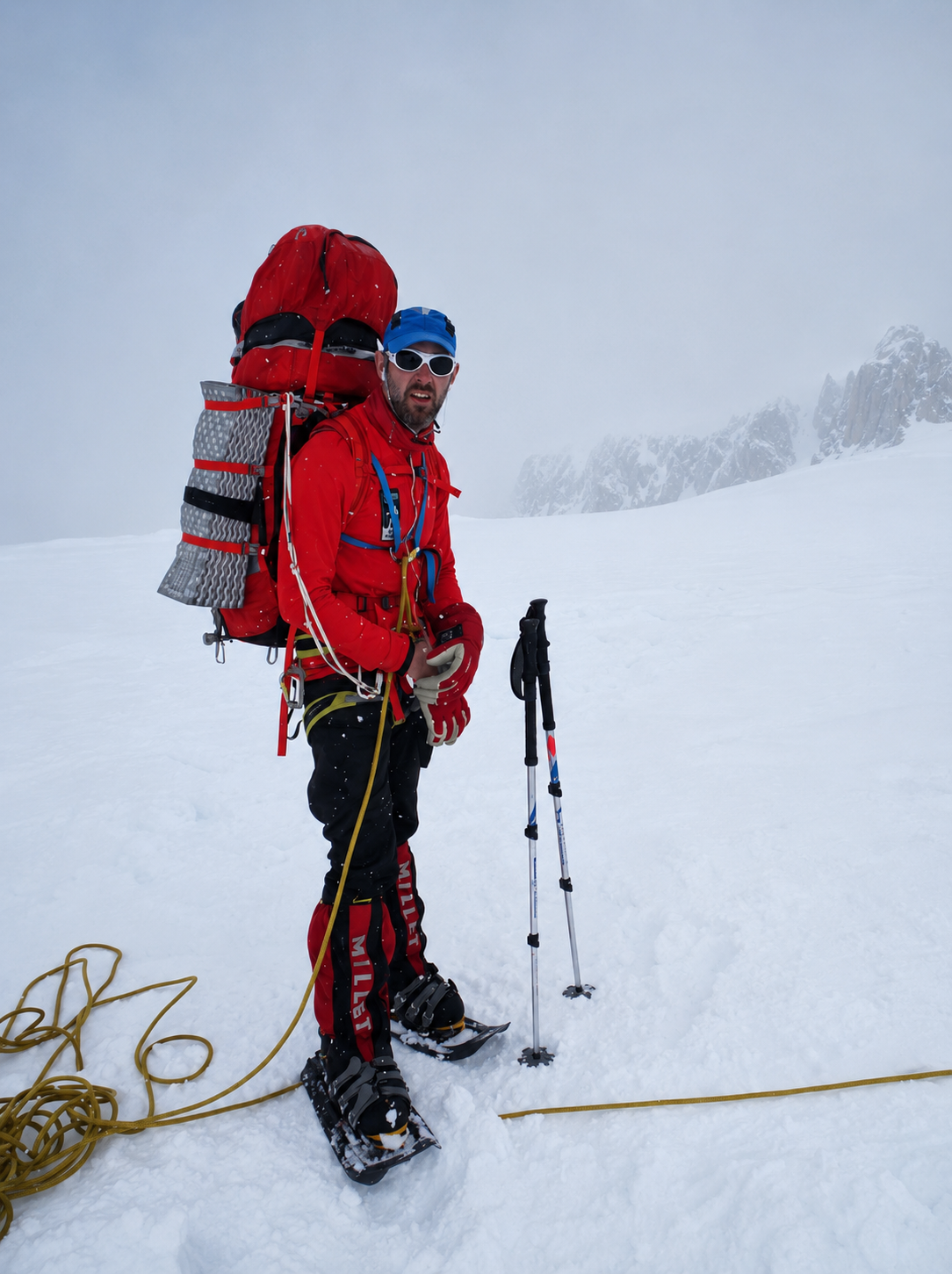
A typical load-carrying day can involve a substantial backpack combined with an expedition sled. The training material uses the example of approximately a 23kg pack while towing a sled carrying considerably more expedition equipment.
Your pack training should be progressive.
Do not immediately load a backpack with 25kg and start climbing hills.
Begin lighter and gradually increase:
Weight → Duration → Elevation → Consecutive Days
Your hips, shoulders, back, knees and feet all need time to adapt.
Towards the latter stages of your programme, you should be comfortable carrying substantial loads uphill for several hours without destroying yourself for the following day’s training.
4. Prepare for Sled Hauling
One of the distinctive physical demands of Denali is hauling expedition equipment by sled.
The movement places additional demands on the:
- Hip flexors
- Glutes
- Quads
- Hamstrings
- Calves
- Lower back
- Core
Your strength and mountain training should specifically develop these areas.
Useful exercises include:
- Walking lunges
- Weighted step-ups
- Squats
- Split squats
- Romanian deadlifts
- Calf raises
- Incline treadmill walking
- Stair climbing with a pack
The goal isn’t bodybuilding.
The goal is developing strong, durable muscles capable of producing moderate effort repeatedly for hours.
5. Build Your Aerobic Engine
Much of Denali is about maintaining a sustainable pace for a very long time.
You need an excellent aerobic base.
Include regular sessions of:
- Uphill hiking
- Incline treadmill
- Stair master
- Trail running
- Cycling
- Rowing
- Swimming
Most endurance work should develop your ability to maintain a steady, controlled effort.
There is certainly a place for harder sessions and intervals, but Denali isn’t about sprinting.
It’s about developing an engine that can keep working.
Hour after hour. Day after day.
6. Strength Training
Mountaineering requires strength, but for Denali our priority is functional strength combined with muscular endurance.
Concentrate on the major muscle groups involved in climbing, load carrying and stabilisation.
Lower Body
- Squats
- Lunges
- Bulgarian split squats
- Step-ups
- Step-downs
- Deadlifts
- Romanian deadlifts
- Calf raises
Core
- Planks
- Side planks
- Leg raises
- Loaded carries
- Anti-rotation exercises
Upper Body
- Pull-ups
- Rows
- Lat pull-downs
- Shoulder exercises
- Farmer’s carries
Upper-body strength matters because you will be managing ropes, fixed lines, packs, sleds and expedition equipment while already physically fatigued.
7. Vertical Training
Elevation gain should become one of your key training measurements.
Find a steep hill, mountain, long staircase, incline treadmill or Stairmaster and progressively increase the amount of vertical ascent you can complete.
The original training framework suggests challenging benchmarks including:
- 1,220m ascent with approximately 18kg
- 915m ascent with approximately 23kg
- 610m ascent with approximately 27kg
It also suggests completing mountain days of 13+ km with 1,220+m of elevation gain.
These are demanding benchmarks rather than starting targets.
Build towards them progressively.
8. Train for Consecutive Days
Being capable of completing one enormous mountain day isn’t enough.
Denali is an expedition.
You need to wake up the following morning and perform again.
As your training progresses, introduce back-to-back mountain days.
For example:
Saturday – Long and slow
Long mountain day with significant ascent and a weighted pack.
Sunday – long and slow
Another endurance mountain day at a controlled pace.
This teaches your body to perform while carrying residual fatigue and gives you valuable experience managing:
- Recovery
- Nutrition
- Hydration
- Foot care
- Pack comfort
- Pacing
- Motivation
The objective isn’t to completely exhaust yourself.
It is to develop the ability to recover and repeat.
9. Train on Snow
Where safely possible, spend time moving in genuine winter mountain conditions.
Denali involves prolonged travel across snow and ice, so experience moving in:
- Mountaineering boots
- Crampons
- Snow
- Glacier-style terrain
- Cold conditions
Snow travel is considerably more tiring than walking along a firm summer trail.
Your body needs to become accustomed to the additional muscular demands.
10. Prepare for the Headwall
Above 14 Camp, Denali becomes progressively steeper.
The Headwall involves approximately 250m vertical of 50–55° snow and ice protected by fixed lines.
You therefore need more than cardiovascular fitness.
Before arriving on Denali you should already be confident and efficient with:
- Crampons
- Harness
- Ascender
- Fixed lines
- Rope systems
- Moving on steep snow and ice
Technical competence saves energy.
The more efficient you are with your equipment, the less physical and mental energy you waste at altitude.
11. Prepare for Summit Day
The hardest day of the expedition for most climbers will be summit day.
From High Camp at 5,242m, the round trip to Denali’s 6,190m summit can take approximately 14–18 hours.
Your training therefore needs to develop the capacity for very long periods of sustained physical effort.
Your longest training days don’t necessarily need to last 18 hours, but you should become comfortable operating for 8–10+ hours in the mountains without falling apart physically or mentally.
By expedition time, a normal mountain day should feel normal.
That is the standard you are trying to create.
12. Recovery
More training is not always better training.
Improvement happens when the body is given sufficient time to adapt to the workload.
Build recovery into your programme through:
- Rest days
- Quality sleep
- Good nutrition
- Hydration
- Mobility
- Appropriate progression
- Easier training weeks
If fatigue continually increases while performance declines, simply adding more training is unlikely to solve the problem.
Consistency beats destruction.
13. Nutrition & Hydration
Use your training months to develop a nutrition and hydration strategy that works for you.
Your long mountain days should teach you:
- What you like eating while moving
- What your stomach tolerates
- How frequently you need to eat
- How much fluid you require
- Which foods provide sustained energy
- What works when you’re tired and don’t feel like eating
Do not arrive in Alaska and start experimenting.
Your training is your testing ground.
14. Mental Preparation
Denali isn’t purely a physical challenge.
There will potentially be:
- Long days
- Heavy loads
- Extreme cold
- Strong winds
- Repetitive camp routines
- Poor weather
- Waiting
- Fatigue
- Uncertainty
You may spend several days at High Camp waiting for a suitable summit opportunity.
Physical preparation gives you more than fitness. It gives you confidence.
When you’re standing at 5,000m in difficult conditions, knowing you have completed months of disciplined preparation matters.
15. Measure Your Progress
Don’t simply train and hope you’re getting fitter.
Keep a training diary and record:
- Distance
- Elevation gain
- Pack weight
- Duration
- Heart-rate data if used
- How you felt
- Nutrition
- Recovery
- Any pain or developing injuries
Keeping records also gives you valuable information for future expeditions. The source material specifically recommends maintaining notes on training, equipment and preparation and reviewing them after each expedition.
Your progress should become measurable.
You should see that the same climb becomes easier, heavier packs become manageable and your recovery between mountain days improves.
Final Training Phase
In the final months, your training should become increasingly Denali-specific.
Prioritise:
Long Days • Heavy Packs • Vertical Gain • Snow Travel • Consecutive Days • Strength • Recovery
Then taper.
Reduce the training load before departure so you don’t arrive in Alaska exhausted from preparing for Alaska.
You want to step onto the Kahiltna Glacier feeling strong, healthy, motivated and ready to work.
Our Denali Standard
Denali is not the mountain to arrive at hoping your fitness will be enough.
Your preparation should give you a reserve.
You should be capable of doing more than the average day requires, because altitude, cold, wind, heavy loads and accumulated fatigue will progressively reduce your performance.
Prepare for the hardest days, not the easiest.
There is no shortcut.
Build the strength. Build the engine. Build the resilience. Then arrive ready to climb.
DENALI EXPEDITION KIT LIST
West Buttress | 6,190m
Denali is one of the most physically demanding and equipment-intensive expeditions in the world. Climbers must be prepared for severe cold, high winds, glacier travel, hauling heavy loads and living independently on the mountain for an extended period.
All mandatory equipment must be expedition quality, fit correctly and have been tested before departure.
SUN PROTECTION
- SPF 50+ sunscreen
- High-SPF lip protection
- Glacier glasses
- Goggles
- Sun hat
- Face / nose protection
HEAD & FACE
- Warm beanie / toque
- Sun hat / baseball cap
- Glacier sunglasses – Category 4 recommended
- Spare glacier sunglasses
- Ski / expedition goggles
- Buff / neck gaiter
- Face mask or balaclava
- Nose / face protection for high UV exposure
HANDS
- Lightweight liner gloves
- Mid-weight working / climbing gloves
- Waterproof expedition gloves
- Expedition mittens
- Spare liner gloves
UPPER BODY – LAYERING SYSTEM
Base Layers
- Lightweight long-sleeve base layer
- Additional base layer
- Lightweight sun shirt
Synthetic or merino wool. No cotton.
Mid Layers
- Active insulation / fleece layer
- Softshell jacket
- Lightweight insulated jacket
Outer Layers
- Waterproof / breathable hardshell jacket
- Expedition-weight down parka with hood
LOWER BODY
- Synthetic / merino underwear
- Lightweight base-layer bottoms
- Expedition-weight base-layer bottoms
- Softshell climbing trousers
- Waterproof hardshell trousers
- Insulated expedition trousers / down trousers
Full-length side zips on insulated trousers are strongly recommended so they can be put on or removed while wearing boots and crampons.
FOOT WEAR
Socks
- 4–6 pairs expedition-quality mountaineering socks
- Liner socks if personally preferred
Mountaineering Boots
- High-altitude double or integrated expedition mountaineering boots suitable for Denali
Examples of the type of boot required include:
- La Sportiva G2
- La Sportiva Olympus Mons
- Scarpa Phantom 6000
- Scarpa Phantom 8000
- Millet Everest Summit GTX
Boots must be compatible with your crampons and thoroughly tested before the expedition.
Additional Footwear
- Expedition overboots if required for your boot system
- Gaiters if not integrated into boots
- Lightweight insulated camp booties
PACKS & EXPEDITION BAGS
- Large internal-frame expedition backpack – approximately 90–100+ litres
- Large expedition duffel – approximately 120–140 litres
- Second duffel / travel bag for equipment left in Anchorage / Talkeetna
- Waterproof stuff sacks / dry bags
- Heavy-duty pack liners
TECHNICAL MOUNTAINEERING EQUIPMENT
- Mountaineering ice axe
- Lightweight climbing harness
- UIAA / CE-approved climbing helmet
- 12-point steel crampons
- Anti-balling plates fitted to crampons
- 2 trekking poles with snow baskets
- Mountaineering snowshoes
- 2 × 60cm sewn slings
- 3 locking carabiners
- 4 non-locking carabiners
- Mechanical ascender
- 2 prusik loops / suitable accessory cord
SLEEP SYSTEM
Sleeping Bag
- Expedition down sleeping bag rated approximately -29°C or colder
Sleeping Mats
Two sleeping mats are required:
- Full-length closed-cell foam mat
- Full-length insulated inflatable sleeping mat
Additional
- Sleeping bag compression / dry sack
- Pillow or stuff-sack pillow – optional
EATING & HYDRATION
- Large insulated mug
- Bowl / insulated food container
- Spoon / spork
- 2–3 × 1-litre wide-mouth water bottles
- Insulated bottle covers / parkas
- Personal flask / thermos – optional
PERSONAL MEDICAL & REPAIR KIT
Personal Medical
- Personal prescription medication
- Blister treatment
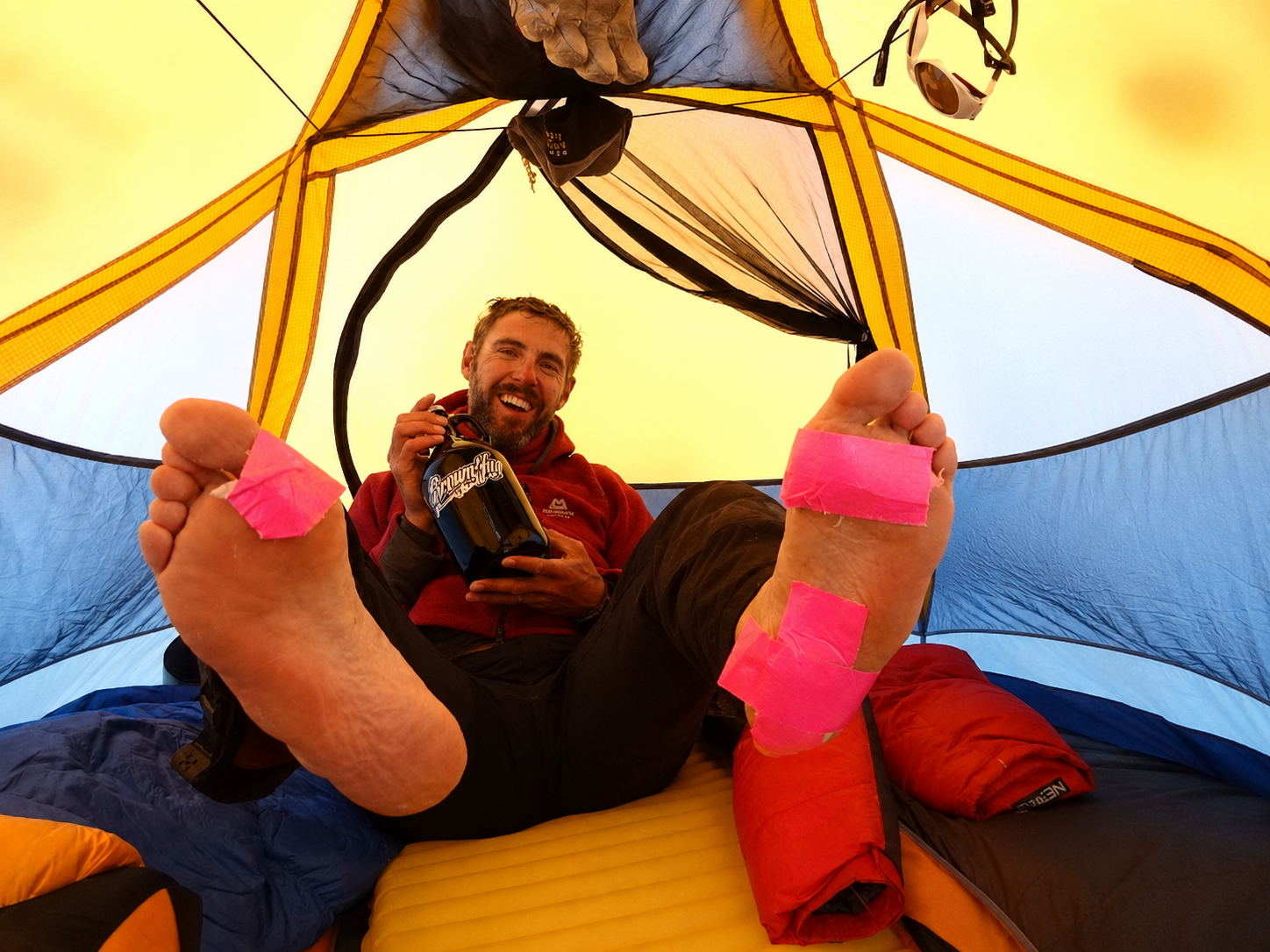
- Compeed / similar
- Personal pain relief
- Personal first-aid supplies
- Any medication specifically advised by your doctor
Repair Kit
- Duct tape
- Therm-a-Rest / sleeping mat repair kit
- Boot repair materials
- Cable ties
- Small sewing kit
- Multi-tool / small knife
PERSONAL & TOILETRIES
- Toothbrush
- Toothpaste
- Hand sanitiser
- Face / body wipes
- Toilet paper as advised
- Pee bottle – minimum 1 litre
- Foot powder / antiperspirant
- Personal hygiene products
- Small quick-dry towel
Female Climbers
- Female urinary device if desired
- Menstrual products / menstrual cup according to personal preference
EXPEDITION ACCESSORIES
- Headtorch
- Spare headtorch or backup light
- Spare batteries
- Power bank
- Charging cables
- Ear plugs
- Camera / phone
- Journal and pen
- Garbage bags
- Personal entertainment for weather/rest days
PERSONAL EXPEDITION SNACKS
- Energy bars
- Gels
- Nuts
- Chocolate
- Sweets
- Electrolytes
- Favourite summit-day snacks
- Personal drink powders
TRAVEL & DOCUMENTS
- Passport
- ESTA / US entry documentation as applicable
- Travel insurance
- High-altitude mountaineering insurance
- Emergency evacuation / rescue cover
- Flight documentation
- Copies of passport and insurance documents
- Emergency contact information
- Expedition documentation supplied by Black Mountaineering
BLACK MOUNTAINEERING EQUIPMENT CHECK
- Expedition boots fit correctly
- Crampons correctly fitted to boots
- Harness fits over full winter clothing
- Backpack fitted and tested under heavy load
- Gloves allow operation of technical equipment
- Sleeping system tested
- Goggles and glacier glasses fit comfortably
- Down parka fits over the complete layering system
- No new or untested critical equipment brought directly to the expedition
SLED HAULING & EXPEDITION EQUIPMENT
Denali is very different from many other high-altitude expeditions.
Climbers are responsible for moving significant amounts of personal and expedition equipment up the mountain.
On the lower glacier, this normally involves a combination of carrying a heavily loaded expedition backpack and hauling equipment in a sled.
PERSONAL HAULING EQUIPMENT
- Large expedition backpack – approximately 90–100+ litres
- Climbing harness suitable for wearing with full winter clothing
- 2 × 60cm sewn slings
- 3 locking carabiners
- 4 non-locking carabiners
- Personal prusik system
- Trekking poles with large snow baskets
- Snowshoes
- Heavy-duty dry bags / stuff sacks for organising equipment
TEAM EXPEDITION EQUIPMENT (provided)
- Expedition sleds
- Sled hauling systems
- Expedition tents
- Cooking equipment
- Stoves and fuel systems
- Group ropes
- Snow and glacier protection equipment
- Group repair equipment
- Communications equipment
- Navigation equipment
- Group medical and emergency equipment
- Snow shovels
- Group food and mountain supplies
- Waste management equipment
PERSONAL EQUIPMENT VS TEAM EQUIPMENT
It is important that every climber understands the difference between personal equipment and team equipment.
YOU CARRY
Your personal clothing, boots, technical climbing equipment, sleeping system, personal food/snacks, water, personal medical supplies and other personal expedition equipment.
WE PROVIDE / COORDINATE
The main group camping, cooking, rope, communication, safety and expedition systems required to operate the team on Denali.
However, team equipment still has to be moved up and down the mountain.
Every climber should expect to carry or haul an allocated share of group equipment, food and fuel as part of the expedition team.
LOAD HAULING
Denali requires a different mindset from a supported Himalayan expedition.
There are no porters carrying your personal expedition equipment up the West Buttress.
Team members should be prepared for:
Heavy backpack + sled + altitude + cold + consecutive mountain days.
As the expedition progresses and the terrain becomes steeper, the way loads are transported changes. Equipment and supplies may also be cached as part of the team’s acclimatisation and mountain strategy.
Load carrying is therefore not simply a fitness requirement. It is a core Denali expedition skill.
Precision • Professionalism • Passion
See more about our payment policy Here
On Booking your expedition our returns policy can be viewed here


For Denali, we strongly recommend carrying two separate forms of insurance, as they provide different types of protection:
1. True Traveller – Travel & Trip Cancellation Insurance
This should cover your general travel requirements, including trip cancellation, interruption, baggage, delays and other travel-related risks. Make sure the policy provides appropriate cancellation cover for the full value of your expedition.
2. Global Rescue – High-Altitude Mountain Rescue
For Denali, we recommend Global Rescue membership specifically for high-altitude mountain rescue and evacuation. Your chosen membership must provide appropriate coverage for mountaineering at Denali’s summit altitude of 6,190 m.
View these as complementary rather than interchangeable: your travel insurance protects the financial and general travel aspects of your expedition, while Global Rescue provides the specialist rescue capability required for a serious incident in a remote, high-altitude mountain environment.
Both policies should be in place before departure. Climbers must carefully check the individual policy terms, altitude limits, mountaineering exclusions and evacuation provisions.