
— Expeditions
Morocco 7 Summits
Seven Highest in Seven Days
Strenuous
7 Days
7 Summits
Price
€1299
Per Person
Overview
Morocco 7 Summits is part of the Global Seven Summit Series, climbing the seven high atlas peaks in just seven days. Available as both a Summer and Winter Series, this unforgettable expedition takes you deep into the Atlas Mountains, through remote Berber villages and spectacular alpine landscapes. Guided by Jason Black and the Black Mountaineering team, every journey is delivered with our core values of Precision, Professionalism, and Passion, creating an authentic mountaineering experience that goes far beyond simply reaching the summit.
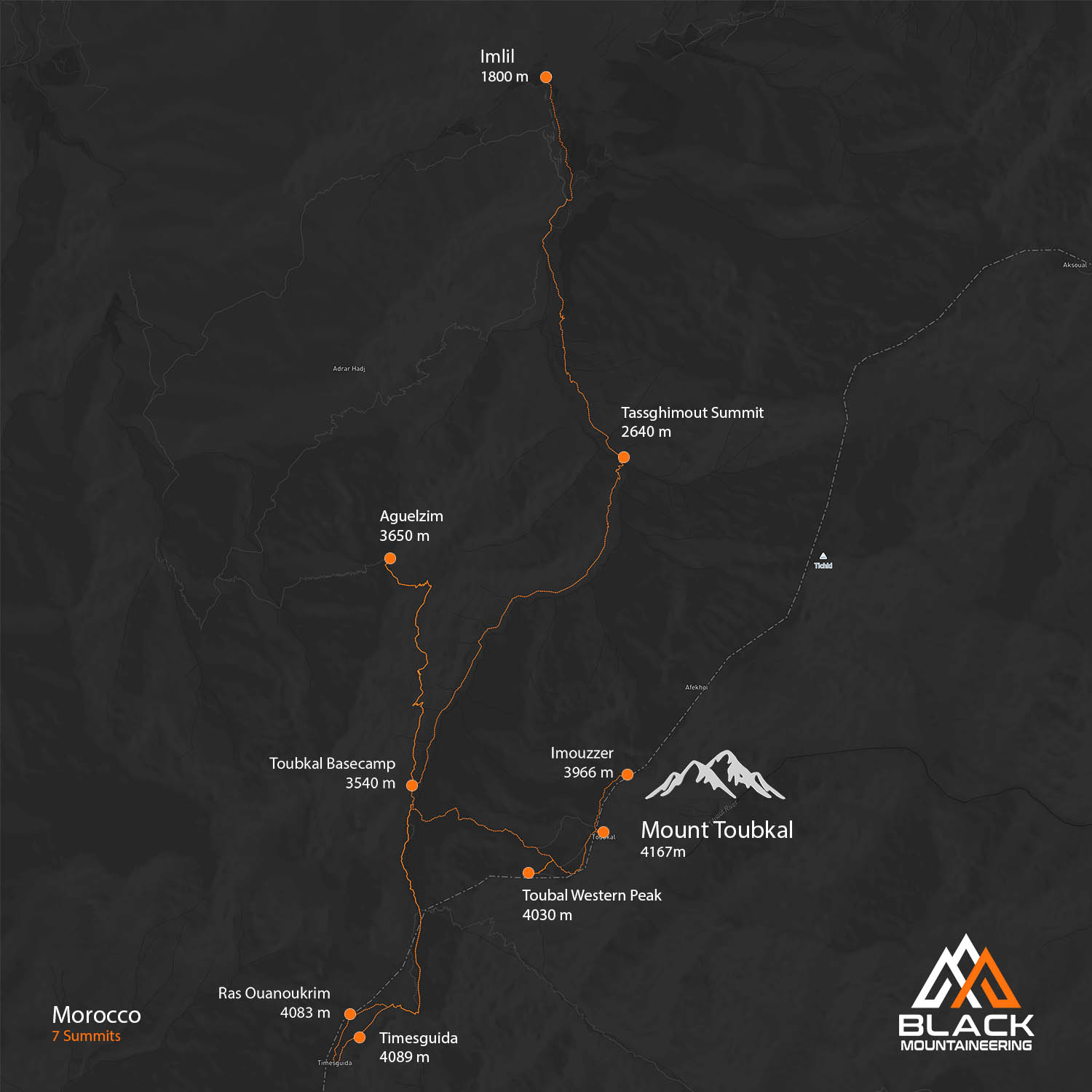
- Mt Tasghimout – 2,640m
- Mt Aguelzim – 3,650m
- Mt Akioud N’bou Imhraz – 4,030m
- Mt Timzguida – 4,089m
- Ras n’Ouanoukrim – 4,083m
- Toubkal West – 4,010m
- Mt Toubkal – 4,167m
Location
Morocco
Duration
7 Days
Route
Multiple
Grade
Strenuous
Altitude
7 Summits
Activity
8 hrs


itinerary
Day 1
Welcome to Morocco and the start of your Morocco 7 Summits Expedition.
Arrive into Marrakech, where our guide team will meet you and transfer you to your traditional riad in the heart of the city. After checking in, you’ll have time to settle in, check your equipment, and meet the rest of the team.
In the evening, we’ll enjoy a traditional Moroccan welcome dinner and expedition briefing as we prepare for the adventure ahead.
Highlights
- Arrival in Marrakech
- Equipment check
- Welcome dinner & expedition briefing
Overnight: Traditional Riad Omar, in the heart of Marrakech.
Day 2
After breakfast, we leave Marrakech and drive for approximately 1.5–2 hours to the mountain village of Imlil, where our expedition on foot begins.
Today’s acclimatisation hike takes us to the summit of Mt Tassghimout (2,640m) before descending to Azib Tamsoult (2,250m), where we settle into our expedition base camp for the night.
Drive: 1.5–2 hours
Trek: Approximately 5 hours
Ascent: +900m
Descent: –390m
Route: Imlil → Mt Tassghimout (2,640m) → Azib Tamsoult (2,250m)
Overnight: Expedition Base Camp
Day 3
Today we continue our journey deeper into the High Atlas Mountains with the ascent of Mt Aguelzim (3,650m). A steady climb rewards us with spectacular panoramic views across the surrounding peaks before we descend the far side to our expedition base camp.
This important day of acclimatisation prepares the team for the higher summits that lie ahead.
Trek: Approximately 7 hours
Ascent: +1,400m
Descent: –400m
Route: Expedition Base Camp → Mt Aguelzim (3,650m) → Expedition Base Camp
Overnight: Expedition Base Camp
Day 4
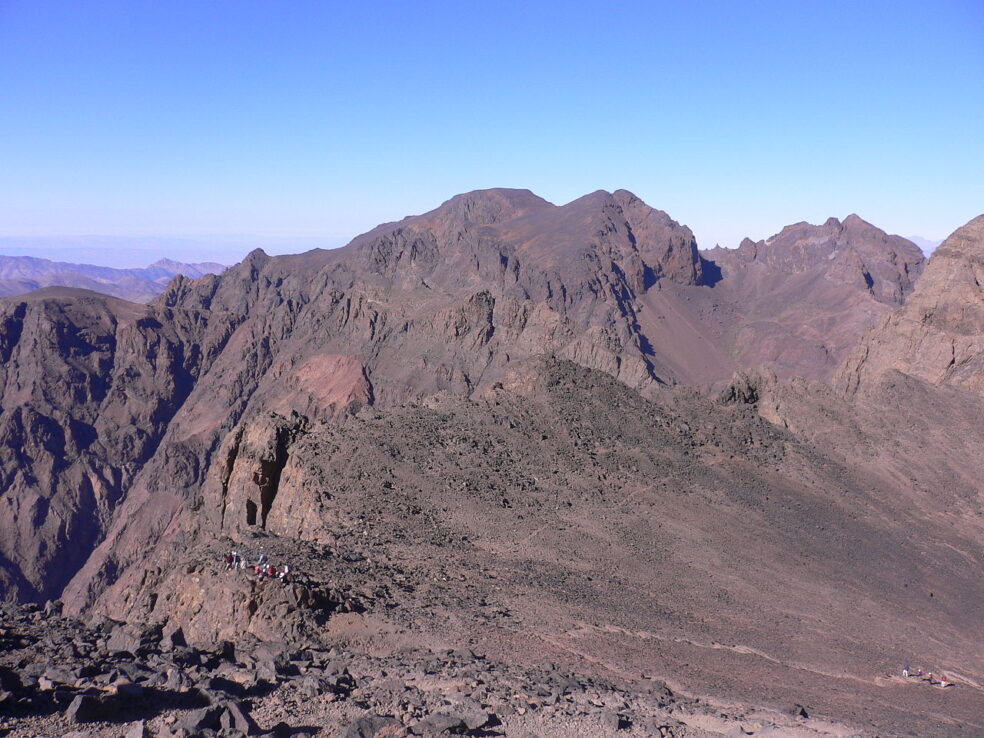
Today is one of the highlights of the expedition. Setting off before dawn, we make an early alpine ascent to Toubkal West (4,010m) before continuing to the summit of Jebel Toubkal (4,167m)—the highest mountain in North Africa.
After taking time to celebrate on the summit and enjoy breathtaking views across the High Atlas Mountains, we descend to our expedition base camp for a well-earned rest.
Trek: Approximately 8 hours
Ascent: +1,100m
Descent: –1,100m
Route: Expedition Base Camp → Toubkal West (4,010m) → Jebel Toubkal (4,167m) → Expedition Base Camp
Overnight: Expedition Base Camp
Day 5
Today you’ll conquer two of the High Atlas Mountains’ finest 4,000-metre summits. Leaving camp early, we make our way to the twin peaks of Timzguida (4,089m) and Ras n’Ouanoukrim (4,083m), where spectacular views stretch across the rugged Atlas range and towards the Sahara on a clear day.
This is a rewarding mountain day that showcases the wild beauty and remote character of Morocco’s highest mountains.
Trek: Approximately 8–10 hours
Ascent: +1,050m
Descent: –1,050m
Route: Expedition Base Camp → Timzguida (4,089m) → Ras n’Ouanoukrim (4,083m) → Expedition Base Camp
Overnight: Expedition Base Camp
Day 6
Your final summit begins before dawn as we set off by headtorch for the ascent of Mt Akioud N’bou Imhraz (4,030m), one of the highest peaks in North Africa. Reaching the summit at sunrise, you’ll enjoy spectacular views across the High Atlas Mountains—a fitting finale to an incredible week in the mountains.
After descending, we’ll return to Expedition Base Camp for a well-earned homemade breakfast before trekking approximately 3 hours down to the traditional Berber village of Aremd, where you’ll experience the warmth, hospitality, and rich culture of Morocco’s mountain communities.
The afternoon is yours to relax, wander through the village, or simply soak up the atmosphere before enjoying a traditional Moroccan celebration dinner with your fellow climbers.
Trek: Approximately 8 hours
Ascent: +1,000m
Descent: –2,100m (approx.)
Route: Expedition Base Camp → Mt Akioud N’bou Imhraz (4,030m) → Aremd
Overnight: Traditional Berber Guesthouse, Aremd
Day 7
After breakfast, we depart Aremd and transfer back to Marrakech, arriving at approximately 3:00 pm.
The afternoon is free to explore the vibrant souks of Marrakech, where you can shop for traditional Moroccan gifts, spices, leather goods, and handcrafted souvenirs.
In the evening, we’ll come together for a home cooked dinner, where you’ll receive your official Seven Summit Series Morocco 7 Summits Medallion as we celebrate an unforgettable week in the High Atlas Mountains.
Day 8
After breakfast, it’s time to say goodbye to Morocco and an unforgettable week in the High Atlas Mountains.
Depending on your flight time, you may have the opportunity for a final stroll through the streets of Marrakech, enjoy a traditional Moroccan coffee, or simply relax at your riad before departure.
At the appropriate time, our Black Mountaineering private expedition transfer will take you to Marrakech Airport for your onward flight home.
We hope you leave Morocco not only with seven summits conquered, but with lifelong memories, new friendships, and a deeper connection to one of the world’s most remarkable mountain landscapes.
Included
What’s Included
- Welcome dinner in Marrakech
- Elite Black Mountaineering expedition guiding team
- Private expedition cook team
- Fully supported porter team
- 3★ Marrakech Riad accommodation (shared basis) with breakfast
- All airport and expedition transfers throughout the itinerary
- All mountain meals (breakfast, lunch, and dinner)
- Celebration dinner in Marrakech
- Official Global Seven Summit Series – Morocco Medallion and presentation box
What’s Not Included
- International flights to/from Morocco
- 80-litre expedition duffle bag
- Personal travel insurance
- Guide gratuities – €100
Optional Extras
- Single room supplement – €80 per night
- Double or twin room upgrade – €100 per night
- Sunrise Hot Air Balloon over Marrakech – €175 per person
- Private Marrakech cultural tour with local guide – €100 per group
- Private airport transfer outside the advertised itinerary – €50 per transfer
Available Dates
How Fit Do You Need to Be to Complete the Morroco 7 Summits Challenge?
The Morocco 7 Summits Challenge is a fun hut to hut multi-day trekking challenge, carrying 5-7 kg of all you own personal equipment, and requires a combination of cardio fitness, strength, and mental toughness.
📌 Physical Requirements for Morocco 7 Summits Challenge
1. Endurance & Cardiovascular Fitness
- You’ll be trekking for multiple days, often 6–10 hours per day.
- You’ll be carrying a 5-7kg backpack
- Some routes involve long ascents of 1,000m+ in a single day.
✅ Training Recommendations:
- Hike 15–25 km (6-8hrs) with a 5-7 kg pack at least once a week.
- Stair climbing (45 min with a 10 kg pack).
- Running, cycling, or swimming (3–4 times a week, 45–60 min per session).
- Hyrox or Some form of high intensity fitness gym class
2. Strength & Load-Carrying Ability
- Expect to carry a 10–15 kg backpack for multiple days.
- Some summits involve steep, rocky ascents requiring strong legs & core stability.
- You may need to navigate boulder fields and exposed ridges.
✅ Training Recommendations:
- Squats, lunges, deadlifts (for leg power).
- Step-ups (50 cm box) with a weighted pack.
- Farmer’s carry (15 kg per hand) for grip & pack strength.
- Planks & core exercises (for stability on uneven terrain).
✅ Preparation Recommendations:
- Follow our 12 week training plan
- Join local training classes
- Increase exposure to long days on the hills
3. Technical Skills & Terrain Adaptation
✅ Uphill Technique
- Pacing & Breathing: Adopt a slow, “all-day” pace that allows you to breathe easily through your nose. If you are working too hard, implement the Rest Step by momentarily locking your trailing leg to shift your weight onto your bone structure rather than your thigh muscles.
- Switchbacking: On very steep grades, use switchbacks (zigzagging) to lower the gradient rather than attacking straight up.
- Pole Adjustment: Shorten your poles by 5-10 cm so your elbows don’t overreach, keeping your forearms parallel to the ground to maintain proper balance.
✅ Downhill Technique
- Posture & Impact: Many injuries happen on the descent. Loosen your hip belt slightly and bend your knees to absorb shock. Keep your weight centered directly over your feet, leaning slightly backward if the slope is dangerously steep.
- Pole Adjustment: Lengthen your poles by 5-10 cm to reduce strain on your knees and thighs, providing two extra points of contact ahead of your body.
- Foot Placement: Take short, light, and quick steps to reduce impact and maintain agility. Avoid the temptation to take long, leaping strides.
✅ Technical Terrain Adaptation
- Scree & Boulders: Step flat-footed to maximize your boot’s rubber traction. If dealing with loose scree, aim for embedded rocks rather than the loose gravel. Test each rock before shifting your full weight onto it.
- Scrambling: Maintain three points of contact at all times (e.g., two feet and one hand, or two hands and one foot). Move deliberately, one limb at a time, and keep your center of gravity low and close to the rock face.
4. Mental Toughness
- Some summits will push you into exhaustion and cold conditions.
- The multi-day aspect makes recovery crucial—fatigue builds up over time.
- Expect early morning summit pushes (3 AM starts) and long descents.
✅ Mental Training:
- Train in harsh conditions (rain, wind, extreme cold).
- Hike back-to-back long days (to simulate multi-day fatigue).
- Train early mornings to prepare for pre-dawn summit attempts.
📍 Minimum Fitness Benchmarks for Morocco 7 Summits Challenge
You should be able to handle :
✅ Hike 1,000m+ elevation gain with a 5-7 kg pack
✅ Run 10 km in 60 minutes (optional).
✅ Climb stairs for 45 min with a 10 kg pack.
✅ Handle 6–10 hrs trekking days back-to-back.
⛏ Who Should NOT Attempt the Challenge?
🚫 If you have an Injuries-knees, back, foot.
🚫 If you can not carry 5-7 kg for 6-8hrs
🚫 If you cannot walk uphill moderate pace for 6-8hrs.
🚫 If you lack mental resilience for extreme weather and exhaustion.
Final Thoughts
The Morocco 7 Summits Challenge is a fun trip.
If you are fit and have solid endurance with strong legs, a great smile and energy, you’ll be well-prepared.
12-Week Training Plan for the Morocco 7 Summits Challenge
This structured training plan is designed to prepare you for multi-day endurance trekking, high-altitude climbing, and challenging terrain. The focus is on cardiovascular fitness, strength, stamina, altitude adaptation, and mental resilience.
📌 Weekly Training Schedule Overview
|
Day |
Activity |
|
Monday |
Strength Training + Stair Climb with Pack |
|
Tuesday |
Cardio (Running/Cycling) + Core |
|
Wednesday |
Weighted Hike (12–18 km) |
|
Thursday |
Strength + Endurance (Step-ups, Scrambling Practice) |
|
Friday |
Rest or Light Recovery (Yoga, Stretching) |
|
Saturday |
Long Hike (15–25 km, 1,000–1,500m ascent) |
|
Sunday |
Technical Skills + Active Recovery (Swimming, Cycling) |
🏋️♂️ Phase 1 (Weeks 1–4): Building a Strong Base
Goal: Develop cardio endurance, leg strength, and hiking ability.
✅ Hiking & Trekking
- 10–12 km (6–8 miles) with a 5–10 kg pack.
- 600–800m elevation gain.
- 3–5 hours duration.
- Train slow and steady pacing (important for multi-day treks).
✅ Strength Training (2x per week)
- Squats – 3 sets of 12 reps.
- Lunges – 3 sets of 10 reps per leg.
- Step-ups (50 cm box) – 3 sets of 12 reps per leg with a weighted pack.
- Planks – 3 x 1 min (for core strength & balance).
- Pull-ups – 3 sets of 6 (for scrambling & upper body endurance).
✅ Cardio Training
- 45–60 min runs or cycling/swimming at a moderate pace.
- Stair climbing (30 min with a 5-7 kg pack).
- Rowing (for upper body endurance and lung capacity).
✅ Technical Skills & Terrain Familiarisation
- If possible, hike on rocky, uneven terrain.
- Practice scrambling movements (use hands on rocky terrain).
- Use trekking poles efficiently.
🏔 Phase 2 (Weeks 5–8): Strength, Altitude & Endurance Boost
Goal: Increase hiking difficulty, endurance, and pack weight.
✅ Hiking & Trekking
- 12–18 km (7–11 miles) with a 10–12 kg pack.
- 800–1,200m elevation gain.
- 6+ hours duration.
- Back-to-back hikes on weekends to simulate fatigue.
✅ Strength & Stability (2x per week)
- Step-ups (50 cm box) with a 12 kg pack – 3 sets of 15 reps per leg.
- Deadlifts – 3 sets of 8 reps (for lower back strength).
- Farmer’s Carry (15 kg per hand) – 3 sets of 30m (for grip & backpack strength).
- Planks & Hanging Leg Raises (for core & stability).
✅ Cardio & Endurance
- 60 min continuous run, cycling, or swimming.
- Interval running (5x 3 min fast, 3 min slow).
- Rowing or stair climbing for 40 min with 8 kg pack.
🏆 Phase 3 (Weeks 9–12): Peak Performance & Multi-Day Trek Simulation
Goal: Simulate multi-day trekking, maximise endurance, and test gear & nutrition strategies.
✅ Hiking (Most Important)
- 15–25 km (10–15 miles) with a 12–15 kg pack.
- 1,200–1,500m elevation gain.
- Back-to-back hikes (Saturday & Sunday) – 8+ hours each day.
- Summit a local peak if possible (to simulate fatigue & altitude).
✅ Final Strength & Endurance Training
- Stair Climbing (45–60 min with 12 kg pack).
- Bulgarian Split Squats – 3 sets of 12 per leg.
- Planks & Hanging Leg Raises – 3 sets of 1 min.
✅ Technical & Mental Training
- Scrambling on rocky terrain (if possible).
- Long hikes starting at 3 AM to simulate early summit starts.
- Train in extreme conditions (cold, wind, rain, altitude exposure).
✅ Recovery & Injury Prevention
- Cold showers & ice baths to prepare for extreme temperatures.
- Stretching & foam rolling to prevent muscle tightness.
📍Final 2 Weeks (Taper & Recovery)
🔹 Reduce heavy training (Taper).
🔹 Focus on mobility, stretching, and rest.
🔹 Test your full gear & pack during a light hike.
🔹 Hydration & nutrition strategy practice.
💡 Key Training Tips
✔ Train in your boots & backpack early (no last-minute surprises).
✔ Use trekking poles to protect knees on long descents.
✔ Practice slow, steady breathing at altitude.
✔ Train with varied terrain (loose rock, scree, snow if possible).
✔ Hydration & nutrition practice – Know what fuels you best.
✔ Recovery matters! – Foam roll, stretch, and prioritise sleep.
🚀 Are You Ready for the Morocco 7 Summits Challenge?
✅ Can you hike 1,500m+ with a 5-7 kg pack?
✅ Can you handle 8–10 hour hikes back-to-back?
✅ Have you trained in cold, high-wind conditions?
✅ Are you comfortable with scrambling & rocky terrain?
If you check all the boxes, you’re ready for North Africa’s ultimate trekking challenge!
Would you like customised adjustments based on your current fitness level? Let me know!
Bags
80 litre Trekking Duffle Bag
36ltr day back
Clothing
3 x Underwear
4 x Short Sleeve t-shirt
1 x Fleece.
1 x Hiking Shorts
1 x Hiking Trousers.
1 x Lite weight puff Jacket.
1 x Waterproof Shell Jacket
1 x Waterproof Shell Trousers.
Headwear
1 x Ball cap
1 x Woollen hat
1 x Sunglasses.
1 x Head torch & charging lead
Hands
1x Fleece gloves
Footwear
3 x Trekking socks.
1 x Hiking boots.
1 x Trail runners
1 x Sliders / sandals.
Camp Sleeping
Camp mattress are provided.
1 x summer sleeping bag
1 x Pillow case
Camp Clothing
1 x Tracksuit / Shorts
1 x Sliders / sandals.
Swimwear for pools
Eating/Drinking
4 x Energy Bars (backup)
2 x Haribos
1 x tube Hydration tabs
2 x 1-litre drink bottles
Electrical
“No power on mountain”
Phone / charging cables
Country relevant plug
Power Bank required
Other
Passport
Cash \ visa
Insurance details
Trekking poles
Ear plugs
Sunscreen and lip balm.
Toiletries, including toilet paper.
Small trekking Towel.
Small Lock for your Duffle Bag.
Antibacterial hand gel.
Personal Medicines
Paracetamol (Headache)
Ibuprofen (Joint pain)
Course of Antibiotics (ears throat Chest)
Domerid (Anti sickness)
Imodium (Diorea)
Dulcolax (Constipation)
Antiseptic Wipes
Adhesive Plasters
Blister Packs (Compeed)
Insect Repellent
Personal first aid kit
See more about our payment policy Here
On Booking your expedition our returns policy can be viewed here

Participants must have travel insurance that covers:
- Medical Expenses €10,000,000
- Baggage (optional) €3,000
- Trip Cancellation €9,000
- Personal Liability €2,000,000
- Trekking up to 4,500 metres
Bring your policy details in the event required.
We strongly recommend True Traveler.