
— Expeditions
Wales 7 Summits
Four days – Seven summits – One legendary Welsh odyssey.
Strenuous
4 Days
7 Summits
Price
€749
Per Person
Overview
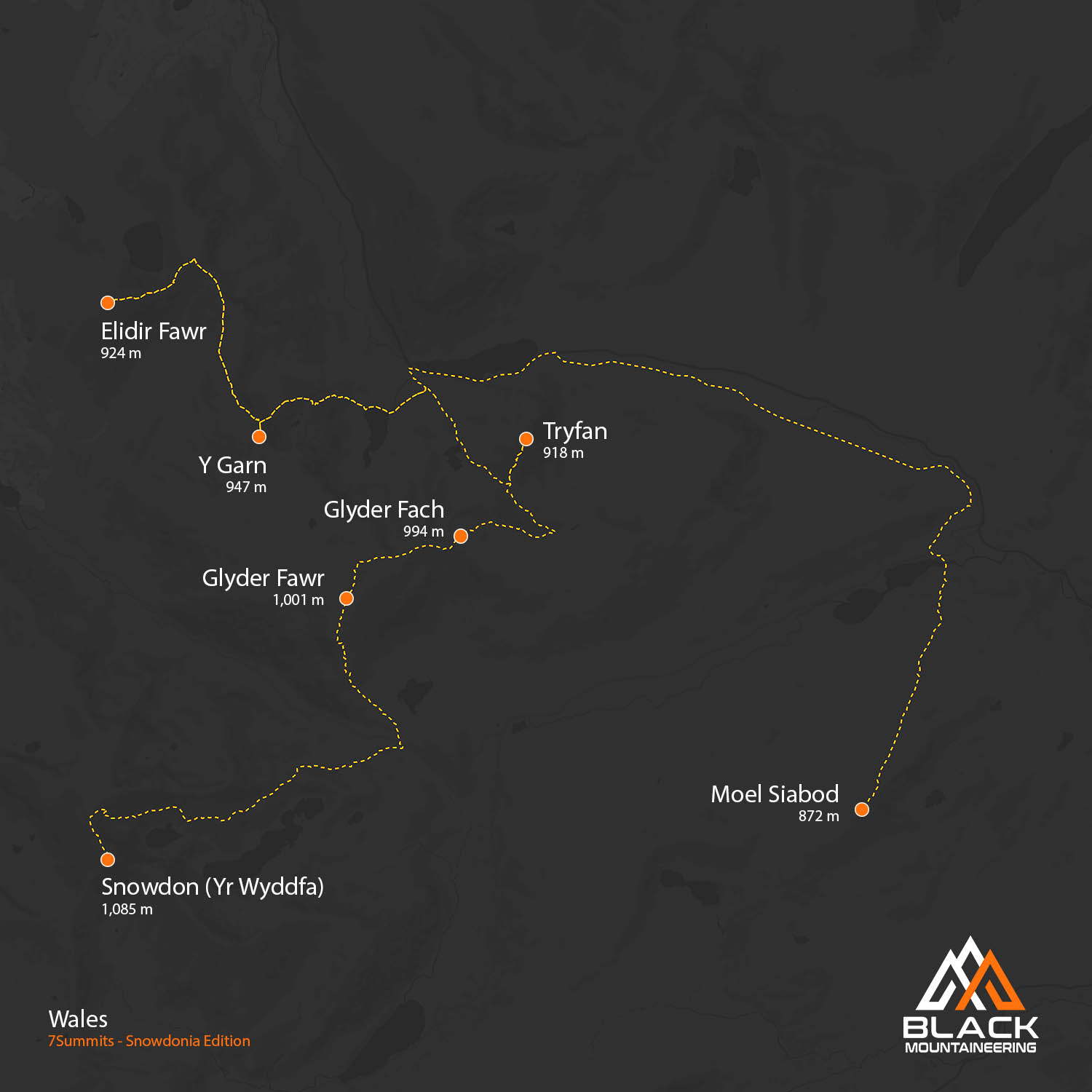
Wales 7 Summits – Snowdonia is part of the Global Seven Summit Series. Join us for an unforgettable four-day expedition as you conquer seven of Wales’ most iconic peaks. From the legendary scramble of Tryfan and the rugged Glyders to the summit of Yr Wyddfa (Snowdon) and the remote beauty of Moel Siabod, you’ll experience the very best of Snowdonia’s spectacular mountain landscape. Led by Jason Black and the Black Mountaineering team, this is a premium mountaineering adventure built on Precision, Professionalism, and Passion.
The Iconic Welsh Seven Summits
- Snowdon/Yr Wyddfa – The “burial place of giants”
- Glyder Fawr – The “great pile”
- Glyder Fach – Cantilever Stone
- Y Garn – The “cairn”
- Elidir Fawr – The “great slope”
- Tryfan – Three-pointed peak
- Moel Siabod – The “hill of saplings”
Location
Wales
Duration
4 Days
Route
Snowdonia Edition
Grade
Strenuous
Altitude
7 Summits
Activity
8 Hours



itinerary
Day 1 - Friday
Departure date.
12:00 am – Meet Bus Irish ferries Dublin Port
Parking – Long–term parking rate: €50.00 per 7 days
Address Parking at Terminal 1 (Irish Ferries)
You can not prebook parking at Dublin port
Parking is payed for on arrival – parking details Here
12:30 am – Board Irish ferries ship
01:15 am – Irish Ferry to Holyhead (duration: 3h 35min)
We have provided breakfast on board ship 4am.
(please get breakfast voucher from lead guide)
04:45 am – Arrive Holyhead
05:00 am – Depart for hike trailhead (1h 20min | 84 km)
07:00 am – Begin hike – please ensure you have own snacks for the hike
Hike: Tryfan → Glyder Fach → Glyder Fawr
- Start Point: Ogwen Cottage Car Park (SH 649 602)
- Finish Point: Pen-y-Pass Car Park (SH 647 556)
- Distance: 12 km
- Ascent: 1,100 m
- Time on trail: 6 hours
- Summits: Tryfan, Glyder Fach, Glyder Fawr
16:45 pm – Transfer to team Accommodation (30 min | 22 km)
18:00 pm – Dinner and welcome briefing
Included:
Bus – Sailing & Breakfast on board boat – Guiding – Accommodation – two course evening dinner
Day 2
Snowdon, Y Garn, Elidir Fawr
07:00 am – Breakfast
08:00 am – Transfer to Pen-y-Pass (25 min | 18 km)
Hike: Snowdon Horseshoe + Y Garn & Elidir Fawr
- Start Point: Pen-y-Pass Car Park (SH 647 556)
- Finish Point: Llanberis Car Park (SH 582 599)
- Route: Pyg Track → Snowdon summit → Garnedd Ugain → descent to Nant Peris → Y Garn → Elidir Fawr → descent to Llanberis
- Distance: 18 km
- Ascent: 1,400 m
- Time on trail: 8–9 hours
- Summits: Snowdon, Y Garn, Elidir Fawr
17:30 pm – Transfer back to hotel (30 min | 22 km)
18:00 pm – Dinner and recovery
Included :
Bus – Guiding – Accommodation – Breakfast – Pack lunch – two course evening dinner
Day 3
Moel Siabod (Final Summit)
08:30 am – Breakfast
09:30 am – Transfer to Pont Cyfyng Car Park near Capel Curig (15 min | 11 km)
Hike: Moel Siabod via Daear Ddu Ridge (optional scramble)
- Start/Finish: Pont Cyfyng Car Park (SH 733 572)
- Route: Forest trail → Daear Ddu Ridge → Moel Siabod summit → descent via south ridge
- Distance: 10 km
- Ascent: 720 m
- Time on trail: 5 hours
- Summit: Moel Siabod (7 of 7 complete)
15:00 pm – Return to Betws-y-Coed (15 min)
17:00 pm – Presentation medals and certificates
18:00 pm – Celebration dinner
Included:
Bus – Guiding – Accommodation – Breakfast – Pack lunch – two course evening dinner
Day 4 - Monday
Return to Dublin
08:00 am – Breakfast
09:00 am – Depart Dolgellau for Holyhead
(2h 15min | 135 km, including rest stop)
12:00 pm – Arrive at Holyhead Ferry Terminal
13:15 pm – Stena Line Ferry to Dublin (duration: 3h 45min)
18:30 pm – Arrive at Dublin Port
Included:
Bus – Sailing – Guiding – Breakfast.
Included
Included:
-
33 seater Luxury bus transport.
-
Stena line ferry and breakfast on board day one.
-
4 x Professional mountain guides
-
Fully planned 7-summit itinerary and on-mountain instruction
-
Accommodation in our BM Welsh bunkhouse – no bedding provided.
- Food as per itinerary
-
Group ground transport provided by an independently contracted Northern Ireland–based coach operator
-
Ferry crossings and coach travel operated and contracted by the third-party transport provider under their own licences
-
All mountain permits and local access arrangements where applicable
- SSS Welsh Medallion and presentation box of achievement at the end of the trip
Excluded:
- Port parking
- Bedding
- Hut Towels
Rooming Notes
This Welsh Bunkhouse accommodation has comfortable shared dorms by gender, all with secure under-bed storage, USB power sockets and bedside lighting.
WiFi is free for all guests and other facilities include, a well-equipped self-catering kitchen, an open-plan living space with log-burning stove and panoramic mountain views, large deck, drying room and laundry facilities.
The Bunkhouse accommodation has bunk beds, mattress and pillows are provided.
There is no bedding or no towel provided
Please bring pillow case, bedding and a Towel.
(summer sleeping bag or Liner)
Amenities on Site
- Guest Kitchen
- Free Wifi
- Lounge Area
- Free Tea and Coffee in Guest Kitchen
- Laundry Room
- Drying Room
Available Dates
How Fit Do You Need to Be to Complete the Wales 7 Summits Challenge?
The Wales 7 Summits Challenge is a fun multi-day trekking challenge, carrying 5kg of all you own personal equipment, and requires a combination of cardio fitness, strength, and mental toughness.
📌 Physical Requirements for Wales 7 Summits Challenge
1. Endurance & Cardiovascular Fitness
- You’ll be trekking for multiple days, often 6–10 hours per day.
- You’ll be carrying a 5kg backpack
- Some routes involve long ascents of 1,000m+ in a single day.
✅ Training Recommendations:
- Hike 15–25 km (6-8hrs) with a 5-7 kg pack at least once a week.
- Stair climbing (45 min with a 5-7 kg pack).
- Running, cycling, or swimming (3–4 times a week, 45–60 min per session).
- Hyrox or Some form of high intensity fitness gym class
2. Strength & Load-Carrying Ability
- Expect to carry a 5-7 kg backpack for multiple days.
- Some summits involve steep, rocky ascents requiring strong legs & core stability.
- You may need to navigate boulder fields and exposed ridges.
✅ Training Recommendations:
- Squats, lunges, deadlifts (for leg power).
- Step-ups (50 cm box) with a weighted pack.
- Farmer’s carry (15 kg per hand) for grip & pack strength.
- Planks & core exercises (for stability on uneven terrain).
✅ Preparation Recommendations:
- Follow our 12 week training plan
- Join local training classes
- Increase exposure to long days on the hills
3. Technical Skills & Terrain Adaptation
✅ Uphill Technique
- Pacing & Breathing: Adopt a slow, “all-day” pace that allows you to breathe easily through your nose. If you are working too hard, implement the Rest Step by momentarily locking your trailing leg to shift your weight onto your bone structure rather than your thigh muscles.
- Switchbacking: On very steep grades, use switchbacks (zigzagging) to lower the gradient rather than attacking straight up.
- Pole Adjustment: Shorten your poles by 5-10 cm so your elbows don’t overreach, keeping your forearms parallel to the ground to maintain proper balance.
✅ Downhill Technique
- Posture & Impact: Many injuries happen on the descent. Loosen your hip belt slightly and bend your knees to absorb shock. Keep your weight centered directly over your feet, leaning slightly backward if the slope is dangerously steep.
- Pole Adjustment: Lengthen your poles by 5-10 cm to reduce strain on your knees and thighs, providing two extra points of contact ahead of your body.
- Foot Placement: Take short, light, and quick steps to reduce impact and maintain agility. Avoid the temptation to take long, leaping strides.
✅ Technical Terrain Adaptation
- River Crossings: Sometimes we may just need to cross low lever rivers. Keep your boots on to protect your feet from submerged branches or rocks. Unclip your backpack’s hip and chest straps so you can easily escape your pack if you fall. Face upstream and use poles to plant wide and create a stable triangle.
- Scree & Boulders: Step flat-footed to maximize your boot’s rubber traction. If dealing with loose scree, aim for embedded rocks rather than the loose gravel. Test each rock before shifting your full weight onto it.
- Scrambling: Maintain three points of contact at all times (e.g., two feet and one hand, or two hands and one foot). Move deliberately, one limb at a time, and keep your center of gravity low and close to the rock face.
4. Mental Toughness
- Some summits will push you into exhaustion and cold conditions.
- The multi-day aspect makes recovery crucial—fatigue builds up over time.
- Expect early morning summit pushes (3 AM starts) and long descents.
✅ Mental Training:
- Train in harsh conditions (rain, wind, extreme cold).
- Hike back-to-back long days (to simulate multi-day fatigue).
- Train early mornings to prepare for pre-dawn summit attempts.
📍 Minimum Fitness Benchmarks for Wales 7 Summits Challenge
You should be able to handle :
✅ Hike 1,000m+ elevation gain with a 5-7 kg pack (6–8 hrs).
✅ Run 10 km in 60 minutes (optional).
✅ Climb stairs for 45 min with a 5-7 kg pack.
✅ Handle 6–8 hrs trekking days back-to-back
⛏ Who Should NOT Attempt the Challenge?
🚫 If you have an Injuries-knees, back, foot.
🚫 If you can not carry 5-7kg for 6-8hrs
🚫 If you cannot walk uphill moderate pace for 6-8hrs.
🚫 If you lack mental resilience for extreme weather and exhaustion.
Final Thoughts
The Wales 7 Summits Challenge is a fun trip.
If you are fit and have solid endurance with strong legs, a great smile and energy, you’ll be well-prepared.
12-Week Training Plan for the Wales 7 Summits Challenge
This structured training plan is designed to prepare you for multi-day endurance trekking, high-altitude climbing, and challenging terrain. The focus is on cardiovascular fitness, strength, stamina, altitude adaptation, and mental resilience.
📌 Weekly Training Schedule Overview
|
Day |
Activity |
|
Monday |
Strength Training + Stair Climb with Pack |
|
Tuesday |
Cardio (Running/Cycling) + Core |
|
Wednesday |
Weighted Hike (12–18 km) |
|
Thursday |
Strength + Endurance (Step-ups, Scrambling Practice) |
|
Friday |
Rest or Light Recovery (Yoga, Stretching) |
|
Saturday |
Long Hike (15–25 km, 1,000–1,500m ascent) |
|
Sunday |
Technical Skills + Active Recovery (Swimming, Cycling) |
🏋️♂️ Phase 1 (Weeks 1–4): Building a Strong Base
Goal: Develop cardio endurance, leg strength, and hiking ability.
✅ Hiking & Trekking
- 10–12 km (6–8 miles) with a 5–10 kg pack.
- 600–800m elevation gain.
- 3–5 hours duration.
- Train slow and steady pacing (important for multi-day treks).
✅ Strength Training (2x per week)
- Squats – 3 sets of 12 reps.
- Lunges – 3 sets of 10 reps per leg.
- Step-ups (50 cm box) – 3 sets of 12 reps per leg with a weighted pack.
- Planks – 3 x 1 min (for core strength & balance).
- Pull-ups – 3 sets of 6 (for scrambling & upper body endurance).
✅ Cardio Training
- 45–60 min runs or cycling/swimming at a moderate pace.
- Stair climbing (30 min with a 5 kg pack).
- Rowing (for upper body endurance and lung capacity).
✅ Technical Skills & Terrain Familiarisation
- If possible, hike on rocky, uneven terrain.
- Practice scrambling movements (use hands on rocky terrain).
- Use trekking poles efficiently.
🏔 Phase 2 (Weeks 5–8): Strength, Altitude & Endurance Boost
Goal: Increase hiking difficulty, endurance, and pack weight.
✅ Hiking & Trekking
- 12–18 km (7–11 miles) with a 10–12 kg pack.
- 800–1,200m elevation gain.
- 6+ hours duration.
- Back-to-back hikes on weekends to simulate fatigue.
✅ Strength & Stability (2x per week)
- Step-ups (50 cm box) with a 12 kg pack – 3 sets of 15 reps per leg.
- Deadlifts – 3 sets of 8 reps (for lower back strength).
- Farmer’s Carry (15 kg per hand) – 3 sets of 30m (for grip & backpack strength).
- Planks & Hanging Leg Raises (for core & stability).
✅ Cardio & Endurance
- 60 min continuous run, cycling, or swimming.
- Interval running (5x 3 min fast, 3 min slow).
- Rowing or stair climbing for 40 min with 8 kg pack.
🏆 Phase 3 (Weeks 9–12): Peak Performance & Multi-Day Trek Simulation
Goal: Simulate multi-day trekking, maximise endurance, and test gear & nutrition strategies.
✅ Hiking (Most Important)
- 15–25 km (10–15 miles) with a 12–15 kg pack.
- 1,200–1,500m elevation gain.
- Back-to-back hikes (Saturday & Sunday) – 8+ hours each day.
- Summit a local peak if possible (to simulate fatigue & altitude).
✅ Final Strength & Endurance Training
- Stair Climbing (45–60 min with 12 kg pack).
- Bulgarian Split Squats – 3 sets of 12 per leg.
- Planks & Hanging Leg Raises – 3 sets of 1 min.
✅ Technical & Mental Training
- Scrambling on rocky terrain (if possible).
- Long hikes starting at 3 AM to simulate early summit starts.
- Train in extreme conditions (cold, wind, rain, altitude exposure).
✅ Recovery & Injury Prevention
- Cold showers & ice baths to prepare for extreme temperatures.
- Stretching & foam rolling to prevent muscle tightness.
📍Final 2 Weeks (Taper & Recovery)
🔹 Reduce heavy training (Taper).
🔹 Focus on mobility, stretching, and rest.
🔹 Test your full gear & pack during a light hike.
🔹 Hydration & nutrition strategy practice.
💡 Key Training Tips
✔ Train in your boots & backpack early (no last-minute surprises).
✔ Use trekking poles to protect knees on long descents.
✔ Practice slow, steady breathing at altitude.
✔ Train with varied terrain (loose rock, scree, snow if possible).
✔ Hydration & nutrition practice – Know what fuels you best.
✔ Recovery matters! – Foam roll, stretch, and prioritise sleep.
🚀 Are You Ready for the Wales 7 Summits Challenge?
✅ Can you hike 1,500m+ with a 5-7 kg pack?
✅ Can you handle 8–10 hour hikes back-to-back?
✅ Have you trained in cold, high-wind conditions?
✅ Are you comfortable with scrambling & rocky terrain?
Bunkhouse sleeping
Bunk bed, mattress and pillow is provided.
There is no bedding or no towel provided
• Pillow case and summer sleeping bag or Liner
• 2 x Towel is required.
• Personal wash kit – shampoo
Footwear
• Robust hiking boots with good tread (well broken-in)
No trainers on hill on this trip.
• 3 x Hiking Socks
Hike Clothing
• 80ltr Trekking duffle bag
• 36ltr day back
• Gortex Waterproof jacket
• Gortex Waterproof trousers
• 3 x Tech T- Shirt
• 2 x Mid-layer (fleece)
• 2 x Woollen Hat
• 1 x Ball cap
• 2 x Buff
• 2 x Pairs of gloves (one spare dry pair)
• 2 x Hiking trousers (no jeans/cotton)
• 1 x lite puff jacket
• Sunglasses
Hut Clothing
• Tracksuit / Shorts
• Gym shoes / sliders
• Personal wash kit
Safety
• Head torch & charge
• Personal first-aid
• Blister kit – compeed
• Emergency bivvy/survival bag and whistle
• Fully charged phone in waterproof pouch
• Power bank & cables (sos)
Navigation (optional)
• Map of region (OS Landranger 41/50 or Harvey maps)
Other
• 1 x Gaiters (optional)
• 2 x 1 litre water bottles or bladder
• Midges spray or net (mandatory)
• 6 x Bounty bar – 3 x Jelly babies – 3 x Wine gums etc
• 1 x Small Sunscreen F50
• 1 x lip balm
• Personal meds
• Stg Cash/Card for meals
• Travel towel
• Passport – for Uk boat travel
Seasonal/route-specific notes
• Wales can be cold & wet on ridges, pack advice.
• Light scrambling and sustained rocky terrain on steep ground, good boots essential.
Weather and Contingencies
Welsh mountain weather is highly changeable. Guides may adjust routes, order of days, turn-around times, or choose safer alternatives if wind/visibility or difficult conditions require it.
See more about our payment policy Here
On Booking your expedition our returns policy can be viewed here
Participants must carry travel insurance that covers trip cancelation and medical cover while hillwalking (non-technical) up to 1,400 m in the UK.
It is so important to purchase your insurance immediately once you book your trip to protect you from unforeseen situations like having to cancel due to injury or other.
We recommend True Traveler. Bring your policy details in the event it is required.