
— Expeditions
Himlung Himal
The Ultimate 7,000m Expedition. The First True Step Towards Everest.
Hard
29 Days
7126
Price
€7499
Per Person
Overview
For aspiring Everest climbers, Himlung Himal (7,126m) is one of Nepal’s most respected 7,000m proving grounds and an ideal progression towards Everest. Led by Jason Black, Everest and K2 summiteer, alongside our elite Sherpa climbing team, we focus on small teams, intelligent acclimatisation, meticulous planning and uncompromising safety. Pure. Remote. Professional. 7,000 metres done right, and the perfect foundation for Everest.
Location
Nepal
Duration
29 Days
Route
South West
Grade
Hard
Altitude
7126
Activity
Approx 5-10 hrs

itinerary
Day 1
Welcome to Nepal and the start of your Himlung Himal Expedition.
Upon arrival at Tribhuvan International Airport, you’ll be met by the Black Mountaineering expedition team and transferred to your hotel in the heart of Kathmandu. The remainder of the day is yours to relax, recover from your journey, and settle into the rhythm of the Himalaya.
In the evening, we’ll meet for a welcome briefing, expedition overview, and team introductions before enjoying our first dinner together.
Elevation: 1,400m
Overnight: Hotel, Kathmandu
Day 2
Today is dedicated to preparing for the expedition ahead. Following breakfast, we’ll conduct a comprehensive expedition briefing, complete all official permit formalities, and carry out a thorough equipment check to ensure every climber is fully prepared.
There will also be time to purchase or hire any last-minute equipment before we leave the city and begin our journey into the Himalaya.
Overnight: Hotel, Kathmandu (1,350m)
Day 3
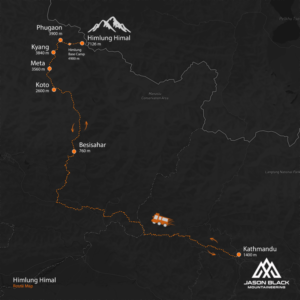
Drive From Kathmandu To Besisahar.
After an early breakfast, we depart Kathmandu and begin our scenic drive into the Himalayan foothills. Travelling through traditional villages, terraced farmland, and alongside fast-flowing mountain rivers, we make our way to Besisahar, the gateway to the Annapurna and Manaslu regions.
This is the first stage of our journey towards the remote Nar Phu Valley and Himlung Himal, offering a fascinating introduction to rural Nepal.
Overnight: Lodge, Besisahar (760m)
Day 4
Drive to Koto.
Today we continue deeper into the Himalaya, following the spectacular Marsyangdi Valley on a dramatic mountain road. Passing traditional villages, waterfalls, forests, and towering peaks, we arrive at the remote village of Koto, the gateway to the Nar Phu Valley.
This marks the beginning of our journey away from the popular trekking routes and into one of Nepal’s most isolated mountain regions.
Overnight: Lodge, Koto (2,600m)
Day 5
Trek To Kyang
Leaving Koto, we enter the restricted Nar Phu Valley, crossing suspension bridges and following a spectacular trail through dense pine forests, narrow gorges, and dramatic cliffs. As the valley opens, the landscapes become increasingly wild and remote, offering our first true taste of expedition life.
By afternoon, we arrive at the traditional Tibetan-influenced village of Meta, where we’ll spend the night as we continue our gradual acclimatisation.
Overnight: Lodge, Meta (3,560m)
Day 6
Trek to Kyang.
Today’s trail leads deeper into the remote Nar Phu Valley, following ancient yak trails through a rugged Himalayan landscape. Passing traditional stone settlements, prayer walls, and wide alpine valleys, you’ll experience one of Nepal’s most untouched trekking regions.
By late afternoon, we arrive at the small village of Kyang, where we continue our gradual acclimatisation before moving higher into the mountains.
Overnight: Lodge, Kyang (3,840m)
Day 7
Trek to Phu Gaun.
Today’s journey takes us through the upper reaches of the remote Nar Phu Valley, where the landscape becomes increasingly barren, dramatic, and unmistakably Tibetan in character. Crossing ancient trails, passing centuries-old chortens and traditional stone villages, we arrive at the fascinating walled settlement of Phu Gaun, one of Nepal’s most isolated Himalayan communities.
The afternoon provides an excellent opportunity to explore this unique village, visit its ancient monastery, and continue our gradual acclimatisation before the expedition moves higher into the mountains.
Overnight: Lodge, Phu Gaun (3,900m)
Day 8
Rest & Acclimatisation Day in Phu Gaun. Today is dedicated to acclimatisation, allowing your body to adapt to the increasing altitude while exploring one of the Himalaya’s most fascinating mountain villages. We’ll take a short acclimatisation hike above the village before returning to rest, following the proven principle of “climb high, sleep low.”
This important day significantly improves our chances of a safe and successful expedition as we prepare to move towards Himlung Himal Base Camp.
Overnight: Lodge, Phu Gaun (3,900m)
Days 9
Trek to Himlung Himal Base Camp.
Today we leave the villages behind and enter the true expedition environment. The trail climbs steadily through glacial terrain and high alpine landscapes before arriving at Himlung Himal Base Camp, our home for the coming weeks.
Surrounded by towering Himalayan peaks, Base Camp is where our climbing preparations begin. Over the coming days, we’ll establish our expedition routine, review climbing systems, and prepare for our rotations on the mountain.
Overnight: Himlung Himal Base Camp (4,900m)
Days 10 to 20
Climbing Period — Himlung Himal (7,126m).
Over the next 10 days, we’ll follow a carefully planned acclimatisation and climbing schedule, completing a series of rotations through the high camps before making our summit attempt when weather and mountain conditions provide the optimum window.
Our strategy is built around patience, intelligent decision-making, and flexibility. Throughout the expedition, our elite Sherpa climbing team and expedition leader will continuously monitor weather forecasts, route conditions, and the wellbeing of every climber to maximise both safety and summit success.
Standing on the summit of Himlung Himal (7,126m) is the culmination of weeks of preparation, teamwork, and determination—an unforgettable achievement on one of Nepal’s finest 7,000-metre peaks.
Overnight: High Camps & Himlung Himal Base Camp
Day 21
Return from Himlung Himal Base Camp.
Following the climbing period, you have two options for your journey back to Kathmandu.
Option 1 – Helicopter to Kathmandu
Subject to weather conditions, you may choose to take a spectacular helicopter flight directly from Himlung Himal Base Camp to Kathmandu. This optional upgrade offers breathtaking aerial views of the Himalaya and significantly reduces the return journey. (Additional cost – please enquire with Jason.)
Day 22 – Rest day in Kathmandu
Day 23 – Depart kathmandu for home
Option 2 – Continue with the Expedition Itinerary
For those following the standard itinerary, we begin our trek back through the beautiful Nar Phu Valley, descending to the traditional village of Phu Gaun.
Overnight: Lodge, Phu Gaun (4,200m)
Day 22
Trek back to Meta.
Retracing our steps through the spectacular Nar Phu Valley, we descend through dramatic mountain landscapes, ancient Tibetan settlements, and deep river gorges. With the hard work of the expedition behind us, today is an opportunity to reflect on an incredible journey while enjoying the peaceful beauty of one of Nepal’s most remote regions.
Overnight: Lodge, Meta (3,560m)
Day 23
Trek back to Koto.
Today’s descent marks our final day on the trail as we leave the remote Nar Phu Valley behind. Following forest paths, suspension bridges, and the winding river below, we return to the village of Koto, where a comfortable lodge and a well-earned rest await.
Overnight: Lodge, Koto (2,600m)
Day 24
Drive to Besisahar & continue to Kathmandu.
After breakfast, we depart Koto and begin our scenic drive back through the Himalayan foothills to Besisahar, before continuing on to Kathmandu. Arriving back in the capital, you’ll have time to relax, enjoy a hot shower, and celebrate the successful completion of your Himlung Himal expedition.
Overnight: Hotel, Kathmandu (1,400m)
Day 25
Leisure day in Kathmandu.
Today is yours to relax and enjoy the vibrant atmosphere of Nepal’s capital. Explore the bustling streets of Thamel, visit ancient temples and UNESCO World Heritage Sites, pick up souvenirs, or simply unwind after your Himalayan adventure.
In the evening, we’ll come together for a special Black Mountaineering Celebration Dinner, where we reflect on an unforgettable expedition and celebrate the achievements of the team.
Overnight: Hotel, Kathmandu (1,400m)
Day 26
Final departure home.
After breakfast, our expedition team will transfer you to Tribhuvan International Airport for your onward flight home.
As you leave Nepal, you’ll take with you far more than a successful expedition—memories of the Himalaya, lifelong friendships, and the achievement of standing atop Himlung Himal (7,126m), one of the world’s great 7,000-metre peaks.
Day 27 - 28
Contingency day. A contingency day is built into the itinerary to provide flexibility in the event of adverse weather, mountain conditions, or any unforeseen delays during the expedition.
If not required, this day may be used for additional rest and recovery, further acclimatisation, or an earlier return to Kathmandu, depending on the progress of the expedition.
Our priority is always to maximise the opportunity for a safe and successful summit while maintaining the flexibility that every Himalayan expedition demands.
Included
What’s Included
- Airport transfers for all international and domestic flights as per the itinerary
- 4 nights hotel accommodation in Kathmandu (bed & breakfast)
- Welcome and celebration dinner in a traditional Nepalese restaurant
- All domestic ground and internal flight logistics for the expedition
- Himlung Himal (7,126m) climbing permit
- Nepal Government Liaison Officer
- Summit route fixing fees
- Environmental and garbage management fees
- Medical and helicopter rescue insurance for all Nepalese expedition staff
- Elite Black Mountaineering Expedition Leader
- Highly experienced climbing guide and elite Sherpa climbing team
- Fully supported Base Camp with professional cook and kitchen staff
- Freshly prepared breakfasts, lunches and dinners throughout the expedition
- Personal baggage allowance of 45kg
- Individual Base Camp tent, mattress and pillow
- Fully equipped Base Camp including dining tent, kitchen, toilets, shower tent, tables, chairs and heating
- Walkie-talkie communications between Base Camp and the mountain
- Satellite phone available for emergency use
- Daily professional weather forecasting throughout the expedition
- Backup oxygen bottles, masks and regulators (chargeable if used)
- Comprehensive first aid and medical kit
- Black Mountaineering 120L Expedition Duffle Bag
- Government taxes and company service charges
- Official Himlung Himal (7,126m) Summit Certificate
What’s Not Included
- Nepal entry visa
- International flights
- Drone permits and special filming permits
- Lunches and dinners in Kathmandu (excluding the welcome and celebration dinners)
- Personal travel insurance
- High-altitude medical and helicopter rescue insurance (minimum USD $50,000 cover required)
- Personal climbing equipment and clothing
- Personal expenses, snacks and beverages
- Personal laundry, charging fees and communications
- Summit bonus and gratuities for the climbing team
(USD $700 per climbing guide and USD $250 for kitchen staff, payable in cash at Base Camp. Porter tips are additional.) - Any items not specifically listed under What’s Included
Available Dates
How Fit Do You Need to Be to Climb Himlung Himal (7,126m)?
Climbing Himlung Himal (7,126m) is a demanding high-altitude expedition, requiring excellent endurance, strength, technical mountaineering skills, and the ability to function at extreme altitude. It is considered a non-technical peak, but due to its long duration, extreme cold, and high-altitude exposure, it demands serious physical and mental preparation.
📌 Physical Requirements for Himlung Himal Expedition
1. High-Endurance & Cardiovascular Fitness
- The expedition takes 20+ days, requiring multiple long summit rotations (6–10 hrs/day) at high altitude.
- The summit day is 12–16+ hours long, gaining over 1,000m in freezing temperatures (-30°C to -40°C).
- Oxygen levels at the summit are only ~40% of sea level, making efficient oxygen use crucial.
✅ Training Recommendations:
- Hike 15–25 km (9–15 miles) with a 20 kg pack at least once a week.
- Stair climbing (45–60 min with a 15 kg pack).
- Running, cycling, or swimming (3–5 times a week, 45–90 min per session).
2. Strength & Load-Carrying Ability
- You’ll be carrying a 15–20 kg pack between high camps.
- The summit push involves steep glacier sections and deep snow, requiring strong legs, core, and upper body.
- Technical climbing sections may require rope work and using an ice axe for self-arrest.
✅ Training Recommendations:
- Squats, lunges, deadlifts (for leg power).
- Step-ups (50 cm box) with a 15 kg pack.
- Planks & core exercises (for stability on uneven terrain).
- Farmer’s carry (15 kg per hand) for grip & pack strength.
- Pull-ups & dead hangs (for climbing and rope work).
3. High-Altitude Acclimatisation
- The climb involves sleeping at 6,000m+ for multiple nights, where AMS (Acute Mountain Sickness) is a major risk.
- Oxygen saturation drops significantly, and even strong climbers struggle with fatigue and low energy levels.
- A pre-acclimatisation climb (such as Mera Peak, Island Peak, or Aconcagua) is highly recommended.
✅ Preparation Recommendations:
- Train at altitude (above 4,000m) before the expedition if possible.
- Use a hypoxic tent or altitude training mask to simulate low oxygen levels.
- Practice slow breathing techniques and oxygen efficiency training.
4. Technical Mountaineering Skills
- Himlung has steep snow slopes (40–50 degrees), crevasses, and fixed rope sections.
- You need experience with crampons, ice axe, fixed ropes, and self-arrest techniques.
- The summit ridge is exposed and requires careful footwork.
✅ Skills to Practice:
- Walking in crampons on steep ice and snow.
- Using an ice axe for self-arrest and balance.
- Ascending and descending fixed ropes with a Jumar.
- Glacier travel techniques and crevasse rescue training.
5. Mental Toughness & Resilience
- The cold, altitude, and exhaustion will push your limits—summit success depends on mental grit.
- You’ll be exposed to -30°C to -40°C wind chill for long periods.
- The climb involves weeks of discomfort in high-altitude camps with low oxygen and extreme fatigue.
✅ Mental Training:
- Train in cold, harsh weather to simulate extreme conditions.
- Push through exhaustion with back-to-back training hikes.
- Practice long, cold early-morning hikes to simulate summit day suffering.
📍 Minimum Fitness Benchmarks for Himlung Himal
You should be able to:
✅ Hike 1,500m+ elevation gain with a 15–20 kg pack (6–10 hrs).
✅ Run 10–15 km in under 60 minutes (for cardio endurance).
✅ Climb stairs for 60 min with a 15-20 kg pack.
✅ Carry a 20 kg pack for multiple days in extreme cold.
✅ Comfortably walk in crampons and use an ice axe on 40° slopes.
⛏ Who Should NOT Attempt Himlung Himal?
🚫 If you have no high-altitude climbing experience (above 6,000m).
🚫 If you cannot hike 8+ hours per day with a heavy pack.
🚫 If you lack technical mountaineering skills (crampons, ice axe, fixed ropes, crevasse rescue).
🚫 If you struggle with cold, exhaustion, and extreme altitude.
Final Thoughts
Himlung Himal is not a technical peak, but due to its high altitude, harsh conditions, and extreme endurance demands, it is not for beginners. If you have previous high-altitude experience and strong endurance training, you’ll be in a good position to summit successfully.
12-Week Training Plan for Himlung Himal (7,126m)
This structured 12-week training plan is designed to prepare you for the high-altitude endurance, strength, technical climbing skills, and mental resilience required to summit Himlung Himal (7,126m). Since this is a long, high-altitude expedition with extreme cold (-30°C to -40°C), the focus is on cardiovascular endurance, leg and core strength, load-carrying ability, altitude adaptation, and technical skills.
📌 Weekly Training Schedule Overview
|
Day |
Activity |
|
Monday |
Strength Training + Stair Climb with Pack |
|
Tuesday |
Cardio (Running/Cycling) + Core |
|
Wednesday |
Weighted Hike (12–20 km) |
|
Thursday |
Strength + Technical Skills (Fixed Rope, Ice Axe, Crampon Work) |
|
Friday |
Rest or Light Recovery (Yoga, Stretching) |
|
Saturday |
Long Hike (15–25 km, 1,000–1,500m ascent) |
|
Sunday |
Active Recovery (Swimming, Cycling) or Altitude Training |
🏋️♂️ Phase 1 (Weeks 1–4): Building Base Strength & Endurance
Goal: Develop cardiovascular endurance, core stability, and leg strength for carrying heavy loads at high altitude.
✅ Hiking & Trekking
- 10–15 km (6–9 miles) hikes with a 12–15 kg backpack.
- 600–1,000m elevation gain.
- 4–6 hours duration.
- Use trekking poles to improve balance and knee protection.
✅ Strength Training (2x per week)
- Squats – 4 sets of 10 reps.
- Lunges – 3 sets of 10 reps per leg.
- Step-ups (50 cm box) with a weighted pack – 3 sets of 12 reps per leg.
- Deadlifts – 3 sets of 8 reps (for core and lower back strength).
- Planks & Hanging Leg Raises (for core strength and stability).
✅ Cardio Training
- 60 min runs or cycling/swimming at moderate intensity.
- Stair climbing (30 min with a 10 kg pack).
- Rowing or incline treadmill work to improve lung capacity.
✅ Technical Skills Practice
- Walking in crampons on mixed terrain.
- Using an ice axe for balance and self-arrest.
- Jumar ascents on a fixed rope.
🏔 Phase 2 (Weeks 5–8): Strength, High-Altitude Adaptation & Technical Training
Goal: Increase hiking difficulty, elevation gain, and multi-day trek preparation.
✅ Hiking & Trekking
- 15–20 km (9–12 miles) with a 15–18 kg pack.
- 1,000–1,200m elevation gain.
- 6–8 hours duration.
- Back-to-back hikes on weekends (Saturday & Sunday).
✅ Strength & Load Carrying (2x per week)
- Step-ups (50 cm box) with a 15 kg pack – 3 sets of 15 reps per leg.
- Deadlifts – 4 sets of 6 reps (for pack-carrying strength).
- Farmer’s Carry (20 kg per hand) – 3 sets of 30m (for grip & backpack strength).
- Pull-ups & Dead Hangs (for rope work).
✅ Cardio & Endurance
- 70 min continuous run, cycling, or swimming.
- High-Intensity Interval Training (HIIT): 5x 3 min fast, 3 min slow.
- Rowing or stair climbing for 45 min with a 12 kg pack.
✅ Technical Training & Terrain Adaptation
- Practice walking on steep, rocky, and icy terrain.
- Crevasse rescue training (prusik ascent & self-extraction).
- Simulate fixed rope climbing with a Jumar.
✅ Acclimatisation & Altitude Prep
- If possible, train at high altitude (above 4,000m).
- Use an altitude tent or hypoxic mask for simulation.
- Deep breathing and oxygen efficiency training.
🏆 Phase 3 (Weeks 9–12): Peak Performance & Expedition Simulation
Goal: Simulate multi-day climbing, maximise endurance, and finalise preparations.
✅ Hiking & Load-Carrying
- 20–25 km (12–15 miles) with a 15–20 kg pack.
- 1,200–1,500m elevation gain.
- Back-to-back long hikes (Saturday & Sunday) – 8+ hours per day.
- Summit a local peak (if possible) to simulate high-altitude trekking.
✅ Final Strength & Endurance Training
- Stair Climbing (60 min with a 15 kg pack).
- Bulgarian Split Squats – 3 sets of 12 per leg.
- Planks & Hanging Leg Raises – 3 sets of 1 min.
✅ Technical & Cold-Weather Training
- Train in full cold-weather gear at night (simulate summit day conditions).
- Ice axe and crampon practice on steep terrain.
- Simulate an alpine start (hike at 3 AM with heavy pack).
✅ Mental Training & Simulation
- Practice long hikes in freezing temperatures (-10°C if possible).
- Train in remote locations to simulate expedition conditions.
- Visualise and mentally prepare for summit day exhaustion.
✅ Recovery & Injury Prevention
- Cold showers & ice baths to prepare for extreme temperatures.
- Stretching & foam rolling to prevent muscle tightness.
📍Final 2 Weeks (Taper & Recovery)
🔹 Reduce heavy training (Taper).
🔹 Focus on mobility, stretching, and rest.
🔹 Test your full gear & pack during a light hike.
🔹 Hydration & nutrition strategy practice.
💡 Key Training Tips
✔ Train in your boots & backpack early to get used to heavy loads.
✔ Use trekking poles to protect knees on long descents.
✔ Train slow, steady breathing at altitude to improve oxygen efficiency.
✔ Practice on mixed terrain (rock, ice, deep snow, loose scree).
✔ Train in extreme conditions (cold, high wind, snow, night trekking).
✔ Hydration & nutrition practice – Know what fuels you best.
✔ Recovery matters! – Foam roll, stretch, and prioritise sleep.
🚀 Are You Ready for Himlung Himal?
✅ Can you hike 1,500m+ with a 20 kg pack?
✅ Can you handle 8-hour climbs back-to-back at altitude?
✅ Have you trained in cold, high-altitude conditions?
✅ Are you comfortable with crampons, ice axe, and rope systems?
If you check all the boxes, you’re ready for one of Nepal’s great 7,000m peaks!
Would you like customised adjustments based on your fitness level? Let me know!
Would you like a 12-week training plan for Himlung Himal? Let me know your current fitness level, and I’ll tailor one for you!
Passport 6mts Valid
Debit/Credit Cards
Insurance Papers
Photocopy of passportBase Layers
Merino Wool Underwear (4 pcs)
Merino long sleeve base layer (2 pcs)
Merino long pants base layer (1 pcs)
Merino Short Sleeve T Shirt (2 pcs)Mid Layers
Tech Fleece (1pcs)
Tech fleece with hood (1pcs)
Heavyweight Hiking Pants (1pcs)
Lightweight Hiking Pants (2pcs)Windproof/Rain Layers
Hard Shell Jacket (1pcs)
Hard Shell Pants (1pcs)Insulation Layers
800+gram Goose Down Jacket with hood
Insulated Pants
Lite puffer Jacket
Summit day Down Suit (optional)Headwear
Warm Hat (2pcs)
Balaclava (1pcs)
Baseball Cap (1pcs)
Bandana or Buff (2pcs)Eyewear
Cat 4 Glacier Glasses
UV Nose protector
Ski GogglesGloves
Lightweight Liner Gloves
Shell Guide Glove with Insulated Liner
7000m Expedition MittsFootwear
Liner Socks (3 pairs)
Wool or Synthetic Socks (3 pairs)
Double Skin Mountaineering Boots 7000m (Kailas /
Lasportiva / Millet)
Trekking Approach Shoes
Camp Booties (optional)
Gaiters (optional)Sleeping Equipment
Sleeping Bag -30°C
Inflatable Sleeping Pad
Closed-cell Foam Pad
Earplugs
Inflatable Pillow
Mountaineering Gear
Large 120ltr Duffel Bag (provided)
Expedition Backpack 100L
Trekking Backpack 50L
Trekking poles (optional)
Ice Axe (2pcs)
Crampons
Climbing Helmet
Ascender/Jumar
“Y” Rig for ascender & carabiner
Accessory Cord: 9m of 6mm.
Proper Climbing Harness
Locking Carabineers (6pcs)
Un-locking Carabineers (2pcs)
Sling / 240 cm (2pcs)
Belay/Rappel Device (2pcs)
Headlight 500-700 Lumens (2pcs)
Travel Items
Small hotel Duffel Bag
Travel Clothes
Cash
Visa Card
ATM card
Additional Food Items
Snack food
Salty-sweet bars
Summit gels
Nuts
Beef jerky
Medical
Personal First-aid kit
Compeed blister packs
Sutures & steri strips
Ibuprofen
Paracetamol
250mg Diamox 20days
Medicated throat lozenges
Medicated throat spray
Antibiotic Azithromycin 500mg
Laxatives
Imodium
Mosquito repellent
Menstrual products
Electrolytes
Nail cutter
Duck tape – Repair Kit
Hand & Feet chemical warmers
Toiletries (Personal)
Toilet Paper
Toothpaste &Toothbrush
Bio Baby wipes (2pcs)
Soap
Shampoo
Shaver
Towel
Small nail-brush
Sunscreen: SPF 50
Lip Screen: SPF 30
Aftersun
Additional Items
Compression Stuff Sacks
Plastic Cup (high camps)
Plastic Bowl (high camps)
Plastic Spoon (high camp)
Water Bottles 1- litre (3pcs)
Thermos 1- litre
Pee Bottle 1- litre
Female Urination Device (FUD)
Knife or Multi-tool (optional)
Optional Electronics
Country-appropriate power adapters
Avalanche Transceiver
Adventure Sports Watch
GPS/ Garmin inReach Mini
Sherpa 100AC Power Bank
Phone camera
Batteries
Charging leads
See more about our payment policy Here
On Booking your expedition our returns policy can be viewed here
This is Mandatory and you will not receive your permit to climb from the National park rangers until you show proof of Insurance for up to 7,000 meters at the park gate apron entry.
It is your responsibility to ensure that you have sufficient personal travel insurance for this expedition. Your policy must provide cover for; a) medical injury or sickness b) trekking up to 7,000 meters (c) helicopter evacuation in an emergency situation, and d) repatriation to one’s country of residence. You must declare any pre-existing medical conditions to your insurers and ensure you receive written confirmation that any pre-existing medical conditions are fully insured. We advise you to obtain travel insurance as soon as you book, that will cover you for unforeseeable circumstances such as illness or injury that might result in you not being able to take part in your expedition.
1. Medical injury or sickness
2. Mountaineering above 5,000 metres
3. Helicopter evacuation in an emergency situation
4. Repatriation to country of residence.
We recommend Global Rescue