There’s a place where desert sand transitions to alpine snow in the span of a single day’s trek. Where ancient Berber villages cling to mountainsides that have been carved by ten thousand years of weather. Where red rock glows at sunrise like the landscape is on fire, and by afternoon, you’re standing on snow at 4,167 meters looking out across North Africa.
This is Mount Toubkal. And it’s the mountaineering secret most people outside Morocco have never heard of.
I’ve stood on Everest and K2. I’ve guided expeditions across the Himalayas and the Alps. And I can tell you this: Toubkal doesn’t need the altitude of the eight-thousanders to earn your respect. What it offers is something rarer—a complete mountain experience where technical challenge, cultural immersion, and visual drama converge in a landscape that feels untouched by the noise of commercial tourism.
This isn’t a trek. It’s a journey through one of the most visually striking mountain ranges on the planet, where every turn reveals contrasts that shouldn’t exist together but somehow do.
Red Desert Rock Meets Snow-Capped Peaks: The Visual Drama of the High Atlas
The first thing that strikes you about the High Atlas isn’t the altitude. It’s the color.
We leave Marrakesh in the pre-dawn darkness and drive south across the Haouz Plain toward the mountains. As the sun rises, the landscape shifts from urban sprawl to agricultural terraces, and then—suddenly—you’re looking at ridgelines that glow rust-red and ochre in the early light. These aren’t the granite grays of the Alps or the dark basalts of the Himalayas. This is ancient sedimentary rock, layers of earth history compressed and uplifted over millions of years, now exposed and weathered into shapes that look sculpted by intention rather than time.
By mid-morning, we’re in Imlil at 1,740 meters, where the valleys are green with walnut groves and terraced fields. The Berber villages here are built from the same red earth as the mountains—mudbrick homes that blend so seamlessly into the landscape that you could miss them if you weren’t paying attention. This is mountain culture at its most authentic. No tourist infrastructure. No manufactured authenticity. Just people who have lived in these valleys for generations, growing corn and potatoes, raising sheep, and moving with the rhythm of the seasons.
And above it all, Toubkal rises. Snow-capped. Imposing. A peak that dominates the skyline not through sheer height but through presence.
The visual contrast is what makes this place unforgettable. You’re trekking through terrain that feels like the Sahara—red rock, sparse vegetation, heat radiating off the trail—and two hours later, you’re crossing snowfields. The juxtaposition shouldn’t work. But it does. And it’s stunning.
The Mizane Valley: Where Ancient Landscapes Reveal Themselves Slowly
The trek into Toubkal follows the Mizane Valley, a route that has been used for centuries by Berber traders and herders moving between the lowlands and the high pastures. This isn’t a trail that was built for trekkers. It’s a working path, worn smooth by mule caravans and generations of footsteps.
The valley itself is a masterclass in geological drama. Steep-sided cliffs rise on either side, layered with bands of red, orange, and rust that mark different epochs of sediment deposition. The river below—fed by snowmelt from Toubkal’s upper slopes—cuts through the rock with the kind of persistence that only water possesses. In some places, the valley narrows to a gorge. In others, it opens into wide floodplains where Berber villages sit surrounded by terraced fields.
We pass through Aremd, the largest village in the valley. It’s a patchwork of stone homes, gites, and narrow pathways that wind between garden plots and livestock pens. The smell of wood smoke hangs in the air. Children watch from doorways. Mules loaded with supplies move past us, heading up-valley toward the refuge.
This is the part of the journey that most trekking companies gloss over in their itineraries. They treat it as transit—a necessary hike to get from point A to point B. But this is where the real value of Toubkal lies. Not just in the summit, but in the immersion. In the slow reveal of a landscape that has been shaped by human hands and natural forces in equal measure.
Above Aremd, the trail climbs steadily toward the shrine of Sidi Chamarouch at 2,300 meters. The shrine sits beside a waterfall where the valley narrows again, a sacred site that attracts both tourists and Muslim pilgrims. From here, the terrain shifts. The greenery of the lower valley gives way to rocky scree and boulder fields. The air thins. The temperature drops. And the mountain—Toubkal—becomes visible in full for the first time.

Toubkal Refuge at 3,206 Meters: Where the Desert Ends and the Alpine Zone Begins
We reach the Toubkal Refuge late in the afternoon. At 3,206 meters, this is the staging point for the summit push, a simple stone building perched on a rocky plateau with views back down the Mizane Valley and up toward Toubkal’s south cirque.
The landscape here is stark. All vegetation has disappeared. What remains is rock—endless expanses of scree, boulders stacked in chaotic piles, and ridgelines that jut skyward like broken teeth. The only color is the red of the earth and the white of the snow that clings to the upper slopes.
But stark doesn’t mean lifeless. There’s a rawness to this place that feels alive in a different way. The wind moves constantly, carrying the scent of thin air and distant snow. The light changes by the hour—harsh and bright at midday, soft and golden at sunset, cold and blue in the early morning. And the silence is profound. No traffic. No machinery. Just the occasional call of a raven and the sound of your own breath.
This is where the visual drama of the High Atlas reaches its peak. Below us, the valley drops away in layers of red and rust. Above us, Toubkal’s summit ridge glows white with snow. And all around, the ridgelines stretch toward the horizon—a sea of peaks that seem to go on forever.
It’s a landscape that demands you pay attention. That refuses to be background scenery. That insists you engage with it on its own terms.
Summit Day: Crossing from Red Rock to White Snow
We leave the refuge at 5:00 AM. The air is cold—well below freezing—and the stars are still visible overhead. Headlamps cut narrow beams through the darkness as we begin the climb toward the south cirque.
The route is non-technical but demanding. We’re climbing across scree fields where every step requires focus. The gradient is relentless. The altitude makes itself known—breath comes shorter, legs feel heavier, the mind has to work harder to maintain concentration.
As the sun rises, the mountain reveals itself in stages. First, the ridgelines catch the light—edges of red rock glowing like embers. Then the valleys below fill with golden light, shadows retreating as the day begins. And finally, the snow above us turns pink, then white, then blindingly bright as the sun clears the eastern horizon.
We reach the Tizi n’Toubkal saddle at 3,975 meters just after sunrise. From here, the summit is a short but steep push across boulders and patchy snowfields. The final 200 vertical meters test your reserves—not because the terrain is technical, but because the altitude and the sustained effort have compounded into a challenge that’s as much mental as physical.
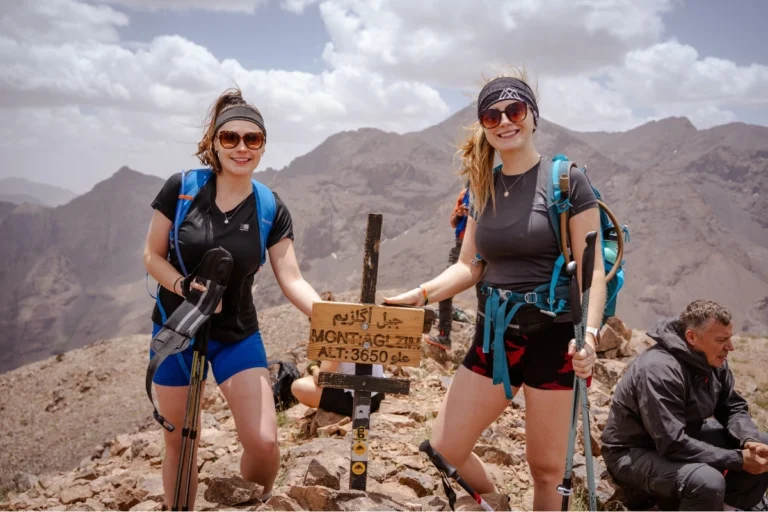
And then you’re there. Standing on the summit of Toubkal at 4,167 meters. The highest point in North Africa.
The view is expansive in a way that defies easy description. To the south, the peaks of the High Atlas stretch toward the Sahara—layer upon layer of ridgelines fading into haze. To the north, the Marrakesh Plain spreads out like a carpet, green and flat and impossibly distant. And in every direction, mountains. Red rock. Snow. Sky.
This is what you came for. Not just the summit, but the perspective it provides. The understanding that you’re standing in a place where geology, climate, and human history intersect in ways that create something unique.

Berber Hospitality: The Human Element in a Wild Landscape
What separates Toubkal from many other mountain expeditions is the cultural dimension. This isn’t a wilderness trek where you’re isolated from human contact. The High Atlas is home to the Berber people—indigenous North Africans who have lived in these mountains for thousands of years.
On the descent from Toubkal, we spend the night in Aremd, staying in a traditional Berber village house. The accommodation is simple—shared sleeping platforms, communal dining areas, basic facilities—but the hospitality is genuine. We’re served tagine cooked over an open fire, mint tea sweetened with sugar, fresh bread baked in a clay oven.
The Berber approach to guests is rooted in centuries of mountain culture where survival depended on cooperation and mutual support. Travelers were welcomed not as customers but as temporary members of the community. That tradition persists. The people we meet aren’t performing for tourists. They’re sharing their lives, their food, their stories, because that’s what you do when someone arrives at your door.
This cultural immersion isn’t incidental to the Toubkal experience. It’s central. You’re not just passing through a landscape. You’re entering a world where people have built lives in terrain that would challenge most modern societies. Where agriculture happens on terraces carved into mountainsides. Where water is carried from distant springs. Where the rhythms of life are dictated by weather, season, and altitude.
It’s a reminder that mountains aren’t empty spaces. They’re places where human culture and natural environment have shaped each other over millennia. And that relationship—visible in every stone wall, every irrigation channel, every village perched on an impossible slope—is part of what makes Toubkal so compelling.
After the Mountain: Marrakesh and the Contrast of the City
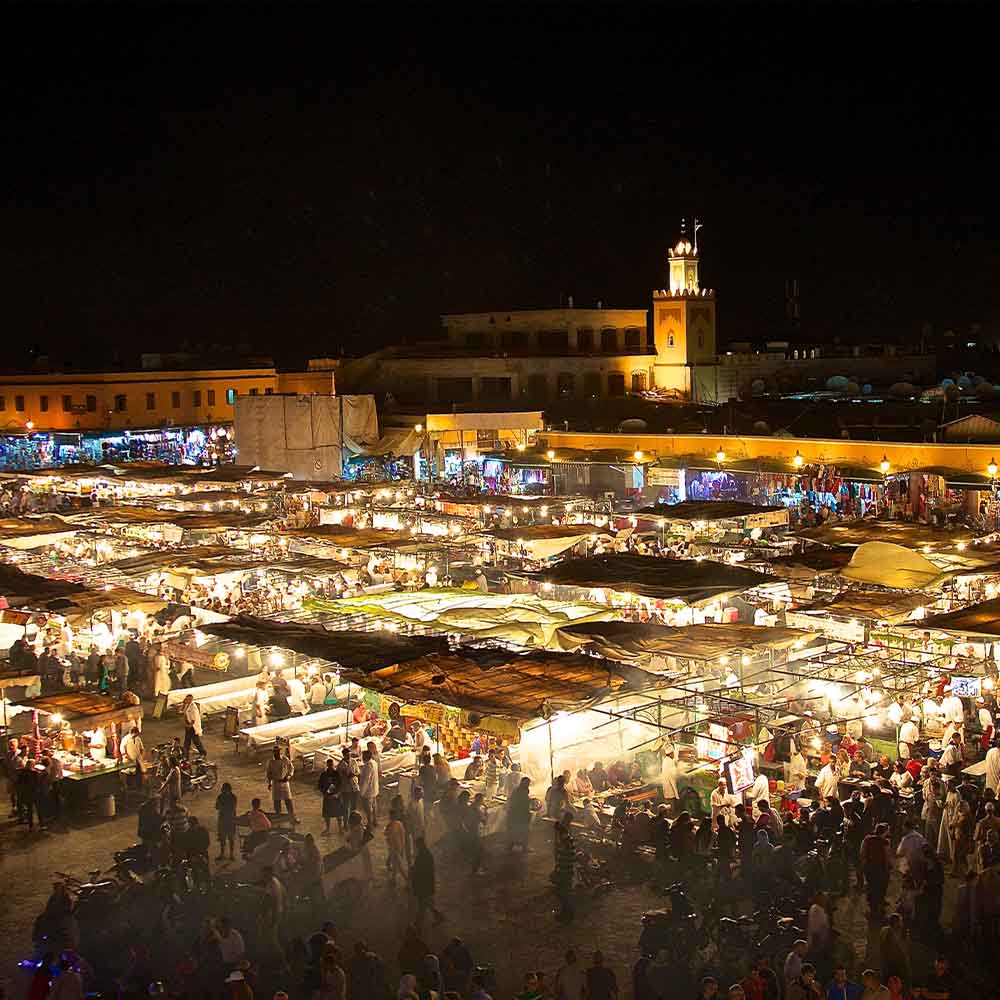
We return to Marrakesh on day four, and the transition is jarring. From the silence of the mountains to the chaos of Jemaa el-Fna, the main square in the Medina. From cold thin air to heat and humidity. From rock and snow to the smell of spices, grilled meat, and mint tea.
Marrakesh is overwhelming in the best possible way. The souks are a maze of narrow passages lined with stalls selling everything from carpets to ceramics to spices you’ve never heard of. The medina is a UNESCO World Heritage site where medieval architecture and modern life coexist without friction. The Koutoubia Mosque dominates the skyline, its minaret visible from almost anywhere in the old city.
This contrast—mountain to city, silence to noise, simplicity to complexity—is deliberate. Toubkal isn’t just about the summit. It’s about the full arc of the experience. The physical challenge. The cultural immersion. The visual spectacle. And the return to civilization, where you can reflect on what you’ve just done while eating dinner in a rooftop restaurant overlooking the Medina at sunset.
It’s a complete journey. And that’s rare in modern mountaineering, where most expeditions are laser-focused on the summit and nothing else.
Why Toubkal Remains Morocco’s Best-Kept Secret
Toubkal doesn’t get the attention it deserves for a few reasons. It’s not the highest. It’s not the most technical. It’s not in a region that most people associate with serious mountaineering.
But those are exactly the reasons it’s worth your time.
Toubkal offers something that many higher, harder peaks don’t: accessibility without compromise. You don’t need months of training or years of technical experience. You don’t need to spend tens of thousands of dollars on permits and logistics. You don’t need to risk your life crossing icefalls or navigating crevasse fields.
What you need is reasonable fitness, mental resilience, and the willingness to engage with a mountain on its own terms.
And what you get in return is a complete mountain experience. Five days that take you from the chaos of Marrakesh to the summit of North Africa’s highest peak, through landscapes that shift from desert to alpine in the span of a morning’s trek, past villages where life moves at the pace it has for centuries.
You get exposure to Berber culture that isn’t staged or sanitized. You get the visual drama of red rock and white snow existing side by side. You get the satisfaction of earning a summit that demands respect but doesn’t require you to be a technical climber.
And you get to do it all in a place that hasn’t been overrun by commercial tourism. Where the trails aren’t clogged with hundreds of trekkers. Where the refuges aren’t booked solid a year in advance. Where you can still experience mountains the way they’re meant to be experienced—as wild places that challenge you, change you, and remind you what it feels like to be small in the face of something vast.
The Practical Reality: What Toubkal Demands from You
Let me be clear about what this expedition involves. Toubkal at 4,167 meters isn’t Everest, but it’s high enough that altitude will be a factor. You’ll be trekking 6 to 8 hours daily across terrain that ranges from mule tracks to scree fields to snowfields. The summit day is 10 to 11 hours of sustained effort with 960 meters of ascent and over 2,200 meters of descent.
You need to be fit. Not elite-athlete fit, but capable of hiking for long days on consecutive days while carrying a daypack and managing your own hydration and nutrition. If you’re struggling on 4-hour hikes at home, you’re not ready for Toubkal.
You need to be mentally prepared for discomfort. The refuge accommodation is basic. Cold showers. Shared sleeping platforms. Limited heating. Meals that are simple and repetitive. This isn’t a luxury trek. It’s a real mountain expedition where comfort takes a back seat to logistics and safety.
You need to respect the altitude. Acute Mountain Sickness is a real risk above 2,500 meters. Headaches, nausea, dizziness—these aren’t just inconveniences. They’re warning signs that your body isn’t adapting to the thin air. If you ignore them, you put yourself and the team at risk.
And you need to follow the training plan. We provide a 12-week program that builds your aerobic capacity, strengthens your joints, and develops the mental resilience required for sustained effort at altitude. If you skip the training, you’ll suffer. And worse, you’ll hold back the group.
This is non-negotiable. We maintain high standards because the mountains demand it. And if our goal is to get you safely to the summit and back, we can’t compromise on preparation.
Who Should Climb Toubkal (And Who Shouldn’t)
Toubkal is accessible, but accessible doesn’t mean easy. And it doesn’t mean it’s for everyone.
You should climb Toubkal if:
- You’re looking for a real mountain experience without the technical demands of alpine climbing
- You want cultural immersion alongside physical challenge
- You value visual beauty and landscape diversity
- You’re willing to put in the training required to succeed
- You’re comfortable with basic accommodation and simple logistics
- You want to test yourself at altitude without committing to an 8,000-meter peak
You shouldn’t climb Toubkal if:
- You expect luxury accommodation and gourmet meals
- You’re not willing to train seriously for 12 weeks before departure
- You need constant external motivation to push through discomfort
- You’re looking for a guided tour where everything is done for you
- You have pre-existing medical conditions that make altitude dangerous
This isn’t about gatekeeping. It’s about honesty. Toubkal rewards people who show up prepared, who respect the mountain, and who understand that the value of the experience comes from the challenge, not from checking a box on a list.

The Five-Day Journey: What to Expect
Day 1: Marrakesh to Toubkal Refuge
We leave Marrakesh early and drive south to Imlil. From there, we trek through the Mizane Valley, past Aremd and the shrine of Sidi Chamarouch, climbing 1,460 meters over 6 to 7 hours to reach the refuge at 3,206 meters. You’ll feel the altitude. Your legs will be tired. But the views—red valleys dropping away below, Toubkal rising above—make it worth every step.
Day 2: Summit Day
We start before dawn. The route crosses the south cirque—steep scree and rock—to the Tizi n’Toubkal saddle at 3,975 meters. From there, it’s a final push across boulders and snow to the summit at 4,167 meters. The views stretch from the Sahara to the Atlantic. After summiting, we descend all the way to Aremd—2,200 meters of descent over 10 to 11 hours total. This is the hardest day. It tests everything.
Day 3: Aremd to Marrakesh
Recovery day. We descend to Imlil (45 minutes), drive back to Marrakesh, and spend the afternoon exploring the souks and the Medina. That evening, we have a celebration dinner—traditional Moroccan food, music, and a chance to reflect on what we’ve accomplished.
Day 4: Departure
Airport transfer and flights home. Or, if you’re staying longer, optional activities like a hot air balloon ride over Marrakesh, a hammam experience, or a private cultural tour with a local guide.
Key Takeaways: Why Toubkal Matters
Mount Toubkal isn’t famous. It’s not on most people’s radar. And that’s exactly why it matters.
In a mountaineering world dominated by commercial Everest expeditions, overcrowded alpine routes, and Instagram-driven peak-bagging, Toubkal represents something different. It’s a mountain where the journey matters as much as the summit. Where cultural immersion is part of the experience, not a marketing add-on. Where the landscape is so visually dramatic that you’re constantly stopping to take in the view, not because you need a break, but because you genuinely can’t believe what you’re seeing.
It’s a place where you can challenge yourself without risking your life. Where you can experience altitude without needing supplemental oxygen. Where you can immerse yourself in a culture that still feels authentic.
And it’s a reminder that the best mountain experiences don’t always happen on the highest peaks. Sometimes, they happen in places most people have never heard of. Places where red desert rock meets snow-capped summits. Places where ancient villages cling to mountainsides. Places where the silence is so profound that you can hear your own heartbeat.
That’s Toubkal. And it’s waiting.