The Question Every Climber Asks
There comes a moment in every serious trekker’s journey when the question shifts. It stops being “Can I handle a long day in the mountains?” and becomes “Can I handle altitude?”
That question matters because altitude is where the rules change. Fitness alone does not carry you. Experience on lower peaks does not translate directly. The air gets thin, your body responds in ways you cannot predict, and the mountain starts teaching lessons you only learn by being there.
Mount Toubkal at 4,167 metres in Morocco’s High Atlas is where that education begins.
It is the highest point in North Africa. It requires no technical climbing skills. No ropes, no ice axes, no crampons unless winter conditions demand them. But it sits well above the 2,500 metre threshold where Acute Mountain Sickness becomes a genuine concern, and the summit day is a full commitment that separates people who prepared from people who assumed.
If you are a serious trekker ready to step into altitude, an athlete training for bigger objectives like Kilimanjaro or Aconcagua, or a professional who values structure, safety, and small team dynamics, Toubkal is the mountain that shows you what you are made of without putting you in situations that require technical expertise you do not yet have.
This is the perfect first 4,000 metre peak. Here is why.
Altitude: Real Exposure Without Technical Commitment
The beauty of Mount Toubkal as a training ground is that it delivers real altitude exposure without requiring you to learn technical mountaineering skills first.
At 4,167 metres, you are solidly in the zone where your body must acclimatise. You will feel the thin air. Your breathing will deepen. Your pace will slow. If you push too hard too fast, the headache will come, the nausea will follow, and the mountain will make its position very clear: respect the altitude or descend.
This is exactly the education you need before stepping onto higher peaks.
On Kilimanjaro at 5,895 metres, the altitude hits harder and the summit push is longer. On Aconcagua at 6,961 metres, you are dealing with extreme altitude and weather systems that can turn in minutes. But on both of those mountains, the skill set is still non technical trekking at altitude. Toubkal is the proving ground. It teaches you how your body responds to reduced oxygen, how to pace yourself over long days above 3,000 metres, and how to recognise the early signs of altitude sickness before they become serious.
The Black Mountaineering approach on Toubkal is built around staged acclimatisation. You trek from Imlil at 1,740 metres to the Toubkal Refuge at 3,206 metres on Day 2, spending the night at altitude to let your body begin adjusting. The summit push on Day 3 takes you through the south cirque and up to 4,167 metres, with 6 to 8 hours of sustained effort and a total elevation gain of 960 metres from the refuge.
By the time you stand on the summit, you have learned something critical: how you handle altitude. And that knowledge is worth everything when you start planning the next peak.
Terrain: Challenging Without Being Technical
The second reason Toubkal works so well as a first high altitude peak is the terrain. It is physically demanding without crossing into technical climbing.
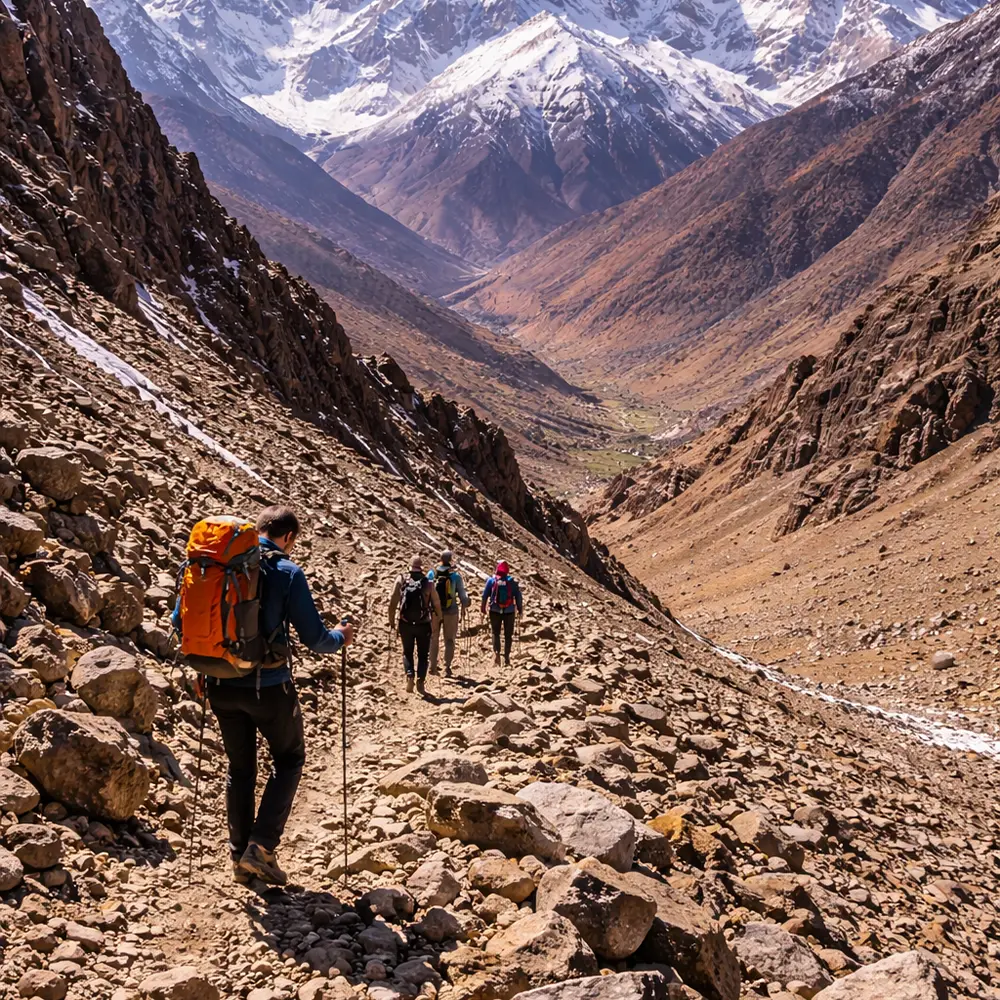
The route from Imlil follows the Mizane Valley through Berber villages and up past the shrine of Sidi Chamrouche at 2,300 metres. The trail is well established, the gradient is steady, and you are moving through terrain that rewards fitness and endurance but does not require rope skills or specialised equipment.
From the refuge at 3,206 metres, the south cirque route to the summit is where the mountain shows its character. Scree fields that shift under every step. Boulder carpets that demand focus and balance. Steep sections where your legs are working hard and your lungs are working harder. The Tizi n’Toubkal saddle at 3,975 metres is the psychological crux, a narrow passage with the summit just above and the valley falling away below.
None of this is technical. But all of it is real. You cannot bluff your way through bad preparation on Toubkal. The mountain will expose weak cardio fitness, insufficient leg strength, and poor pacing decisions. It rewards the climbers who did the 12 week training programme. It rewards the ones who showed up with trekking poles, proper boots, layered clothing systems, and respect for what 4,167 metres actually means.
And that is exactly what makes it perfect preparation for bigger peaks. Kilimanjaro and Aconcagua both involve long summit days over similar terrain at higher altitude. If you can move efficiently on Toubkal, manage your energy across 10 to 11 hours of trekking, and keep your mind focused when your body is tired, you have built the foundation for those climbs.
The terrain on Toubkal teaches you mountain movement without the added complexity of technical skills. That is a gift.
Summit Day Reality: What 4,167 Metres Actually Feels Like
Let’s be very clear about summit day on Toubkal because this is where the mountain separates preparation from assumption.
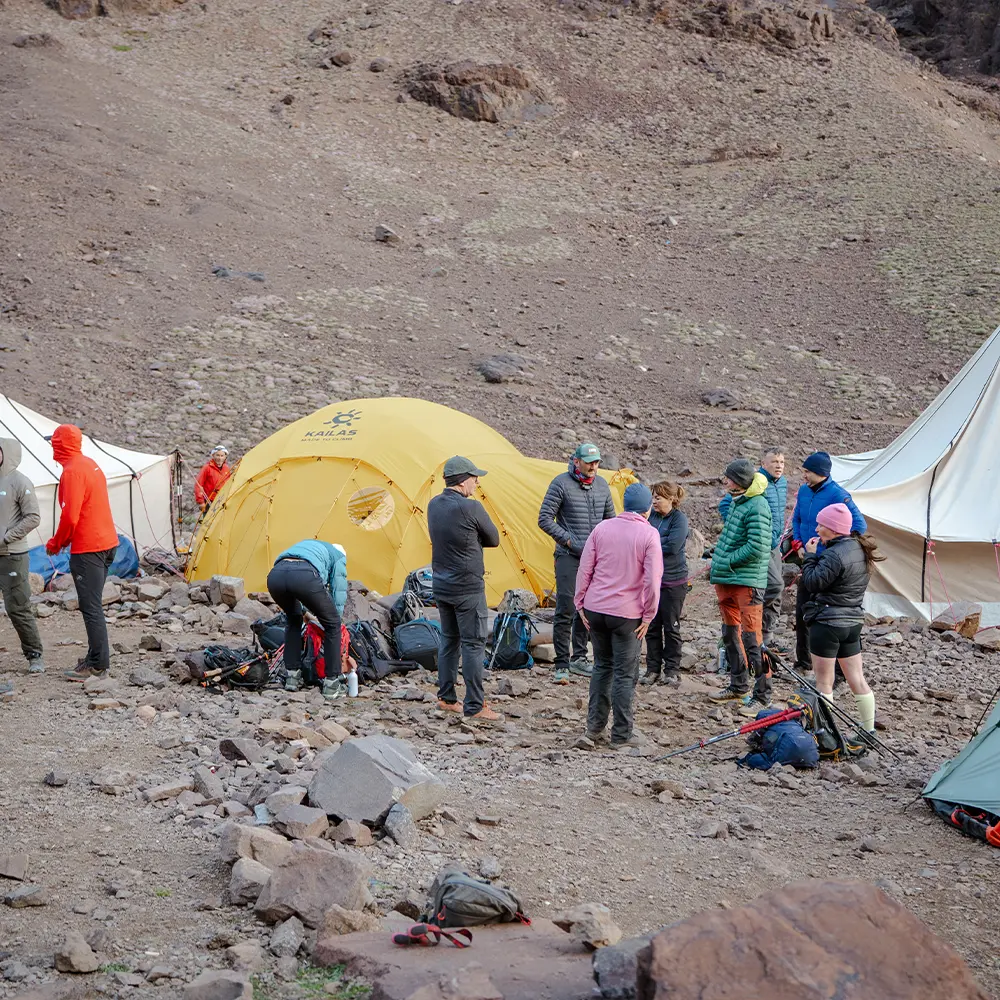
You wake in darkness at the refuge. The temperature is cold. The air is thin. You layer up, check your headlamp, fill your water bottles, and move out into the pre dawn quiet with the rest of the team.
The first hour is steady climbing through boulder fields with the beam of your headlamp showing you just enough to pick your line. As the sky begins to lighten, you can see the south cirque opening up around you, a massive amphitheatre of rock and scree with the saddle visible above.
This is where the altitude makes itself known. Your breath is shorter. Your legs feel heavier than they should. The pace that felt comfortable at 2,000 metres now feels like work, and you are only halfway to the summit.
The climb to the Tizi n’Toubkal saddle at 3,975 metres is relentless. Loose scree gives way under your boots. Every step forward feels like half a step earned. Your guide sets the pace, steady and deliberate, and the team moves as one. If someone is struggling, the pace adjusts. If someone needs a longer break, the team waits. This is not a race. It is a summit attempt built on sustainable effort.
From the saddle, the final push to the summit is short but steep. And then you are there. 4,167 metres. The highest point in North Africa. On a clear day, the panorama stretches from the Marrakesh Plain across the full sweep of the High Atlas and south toward the edge of the Sahara.
The descent retraces the south cirque and continues all the way to Aremd at 1,900 metres. By the time you arrive, you have been moving for 10 to 11 hours. Your legs are tired. Your lungs have worked harder than they have in months. And you know, without question, whether you are ready for the next altitude challenge.
That is the value of Toubkal. It does not lie to you. It shows you exactly where you stand.
Who This Mountain Is For
Mount Toubkal is not for everyone. It is for specific types of climbers at specific points in their progression.
For serious trekkers ready to step into altitude: If you have done multi day treks at lower elevations and you are ready to see what real altitude feels like, Toubkal is the next logical step. It bridges the gap between valley trekking and high altitude mountaineering without requiring you to learn technical skills first.
For athletes training for bigger objectives: If Kilimanjaro, Aconcagua, Elbrus, or any of the Seven Summits are on your list, Toubkal is the training ground. It teaches you how your body acclimatises, how to pace yourself over long summit days, how to manage energy and hydration at altitude, and how to move efficiently on scree and rock. These are the exact skills you will need on higher peaks, and Toubkal lets you develop them in a controlled, guided environment with a team that has decades of high altitude experience.
For professionals who want structure, safety, and small teams: The Black Mountaineering approach is built for people who value quality over scale. Maximum group size of ten. Expert leadership from Jason Black, who has summited Everest and guided climbers on the world’s biggest peaks. Daily gear checks. Conservative summit strategy. Proven acclimatisation protocols. If you are the kind of person who does not cut corners in your professional life, you will appreciate the same standard applied to your mountain pursuits.
Toubkal is also for the climber who wants cultural immersion alongside the physical challenge. The trek through the Mizane Valley passes through centuries old Berber villages. You share mint tea in mountain homes. You visit the shrine of Sidi Chamrouche. You walk through landscapes where the rhythm of life has not changed in generations. And after the summit, Marrakesh is waiting with its medinas, souks, and the vibrant chaos of Jemaa el-Fna.
This is not a transactional peak bagging exercise. It is a full mountain experience that respects both the altitude and the culture.
What You Need to Know Before You Go
If Toubkal is the right mountain for you, here is what the commitment looks like.
Fitness requirement: You need a solid aerobic base and leg strength built through consistent training. The Black Mountaineering 12 week training programme is designed specifically for this climb and includes Zone 2 runs, hill repeats, strength sessions, HIIT intervals, and weekend mountain trekking. If you follow the programme, you arrive at the mountain prepared. If you do not, the south cirque will make that very obvious.
No technical skills required: You do not need rope skills, ice axe skills, or crampon experience for the standard summer season climb. You need good hiking boots, trekking poles, a layered clothing system for variable mountain weather, and the ability to move efficiently over uneven terrain for extended periods.
Altitude is the variable: Fitness will carry you a long way, but altitude is the unknown until you experience it. Some people acclimatise easily. Some struggle. The only way to know is to go to altitude and see how your body responds. The staged ascent on Toubkal gives you the best possible acclimatisation window within a 5 day expedition, but you must still listen to your body and communicate honestly with your guide.
Small team advantage: With a maximum group size of ten, the guide to client ratio is significantly better than commercial trekking operations running groups of 15 or 20. Every climber is seen. Every climber is monitored. If someone needs to slow down, the pace adjusts. If someone needs to descend due to altitude symptoms, that decision gets made without hesitation. Safety is the priority. The summit is the goal only if it can be achieved safely.
Expedition cost: The 5 day Toubkal expedition is €799 per person and includes Marrakesh accommodation with breakfast, all meals on the mountain, qualified Black Mountaineering guides, cultural experiences in the Atlas villages, and all transport between destinations.
Travel requirements: You need a valid passport with at least 6 months validity. Most nationalities receive visa on arrival in Morocco. Mandatory travel insurance must cover hillwalking and scrambling at altitudes up to 4,200 metres, including medical and helicopter evacuation cover. Consult your doctor before departure and discuss Diamox as a potential acclimatisation aid.
Key Takeaways: Why Toubkal Works
Here is what makes Mount Toubkal the ideal first high altitude peak:
Real altitude without technical barriers. At 4,167 metres, you get genuine altitude exposure and acclimatisation training without needing rope skills or ice climbing experience.
Perfect training for higher objectives. The terrain, the daily distances, the summit day structure, and the altitude profile mirror what you will face on Kilimanjaro, Aconcagua, and other non technical high peaks.
Honest feedback on your readiness. Toubkal does not lie. If you are not prepared, the mountain will tell you. If you are ready for the next level, you will know that too.
Structure and safety built in. Small teams of ten maximum. Expert leadership. Conservative summit strategy. Proven acclimatisation protocols. Daily safety checks. This is mountaineering done properly.
Cultural dimension adds depth. The trek through Berber villages, the shrine visit, the post summit celebration in Marrakesh — this is not just altitude training. It is a complete mountain experience in one of the world’s most culturally rich environments.
Accessible without being easy. You can fly into Marrakesh, drive to Imlil, and be at the refuge the same day you arrive in Morocco. But the summit still demands preparation, respect, and sustained effort at altitude. The mountain remains a genuine achievement.
If you are serious about altitude, Toubkal is where you start.
Conclusion: Your First 4,000 Metre Peak Starts Here
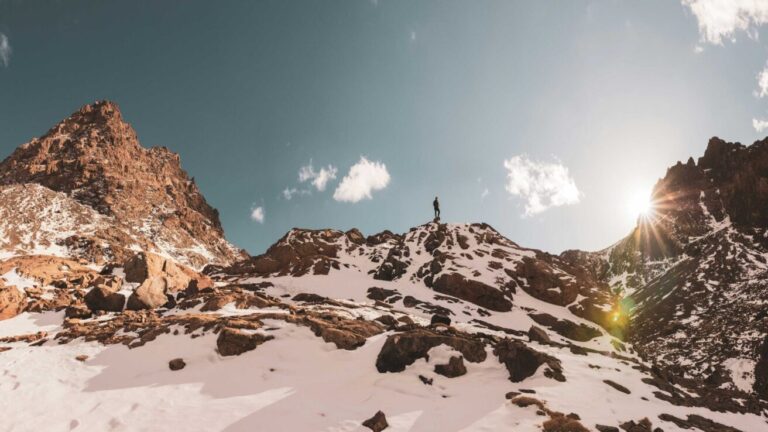
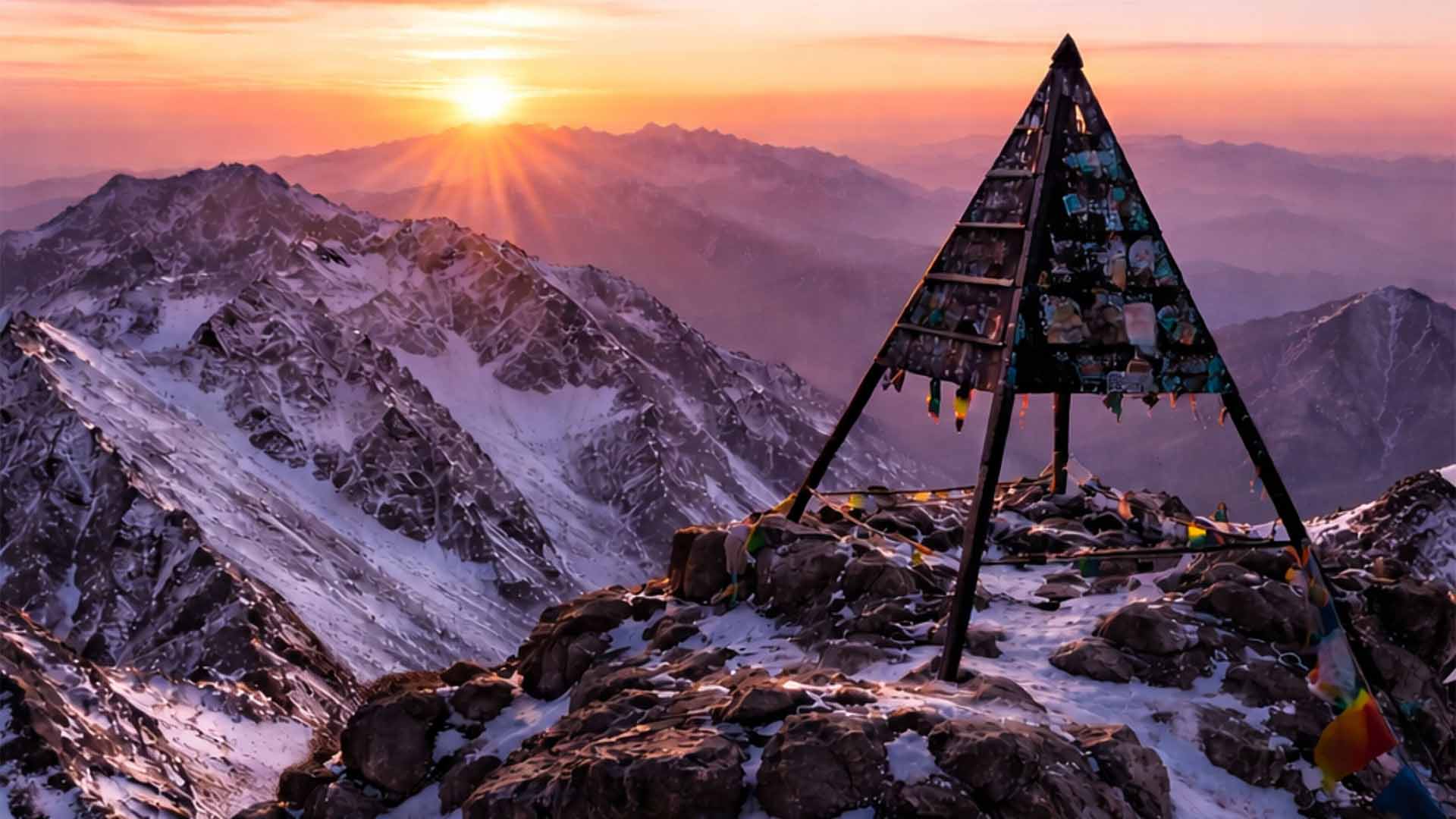
The south face of Jebel Toubkal at first light, when the scree turns amber and the High Atlas stretches away in every direction and the air is so thin that every breath feels deliberate — that view is earned.
You earn it through 12 weeks of hill repeats and Zone 2 runs and strength sessions. You earn it through the trek up the Mizane Valley and the night at the refuge where sleep does not come easily at 3,206 metres. You earn it through the pre dawn start and the relentless climb through the south cirque and the final push to the saddle and the summit beyond.
And when you stand at 4,167 metres with North Africa below you, you know something about yourself that you did not know before. You know how your body handles altitude. You know if bigger peaks are in your future. You know if the preparation you did was enough or if you need to go deeper for the next objective.
Mount Toubkal is the perfect first high altitude expedition because it asks real questions and gives honest answers. It teaches without breaking you. It challenges without requiring skills you have not yet developed. It rewards preparation and punishes assumptions.
If you are ready to step into altitude, this is the mountain that shows you the way.