
— Expeditions
Norway 7 Summits
One Wild Nordic Journey.
Challenging
7 Days
7 Summits
Price
€2299
Per Person
Overview
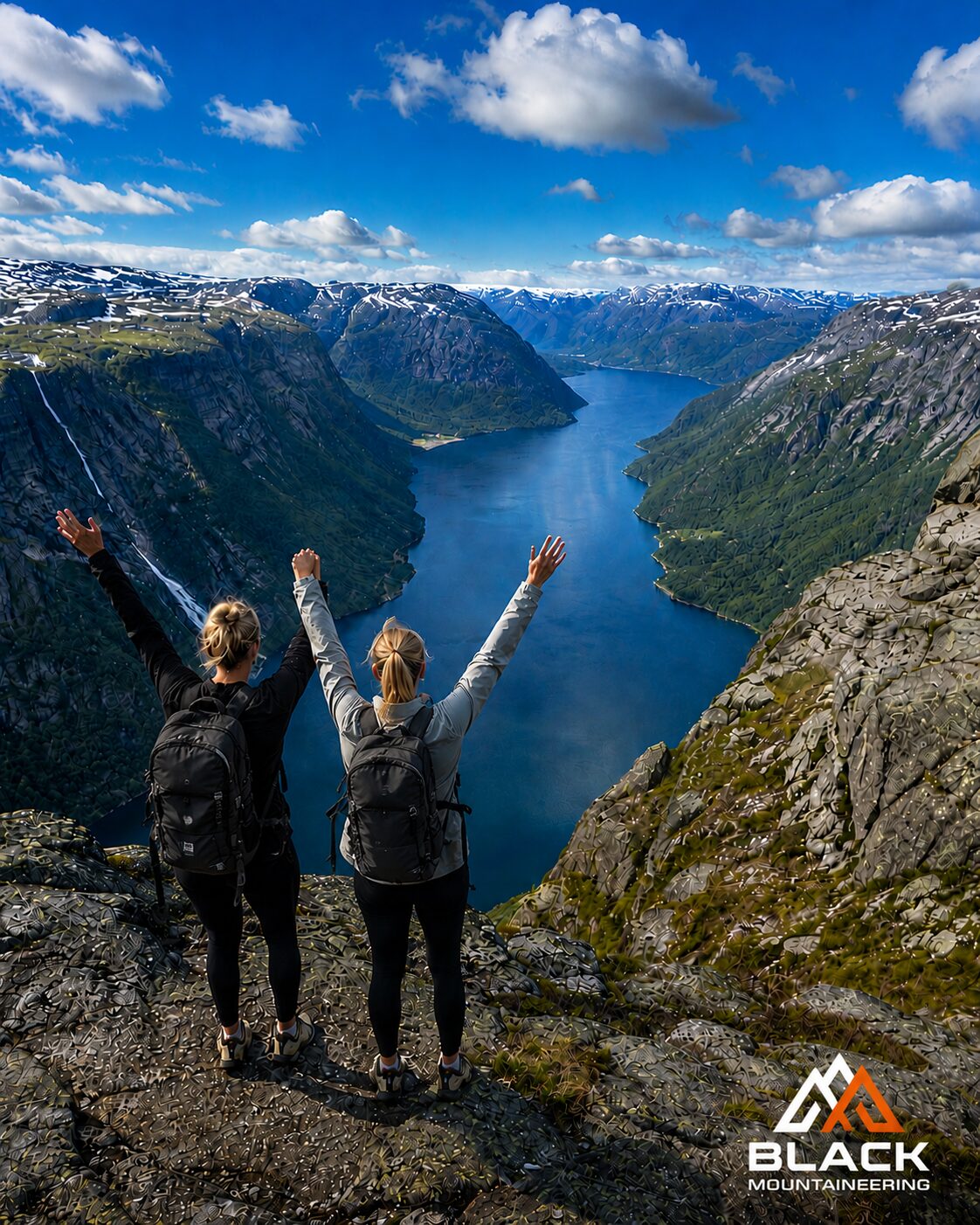
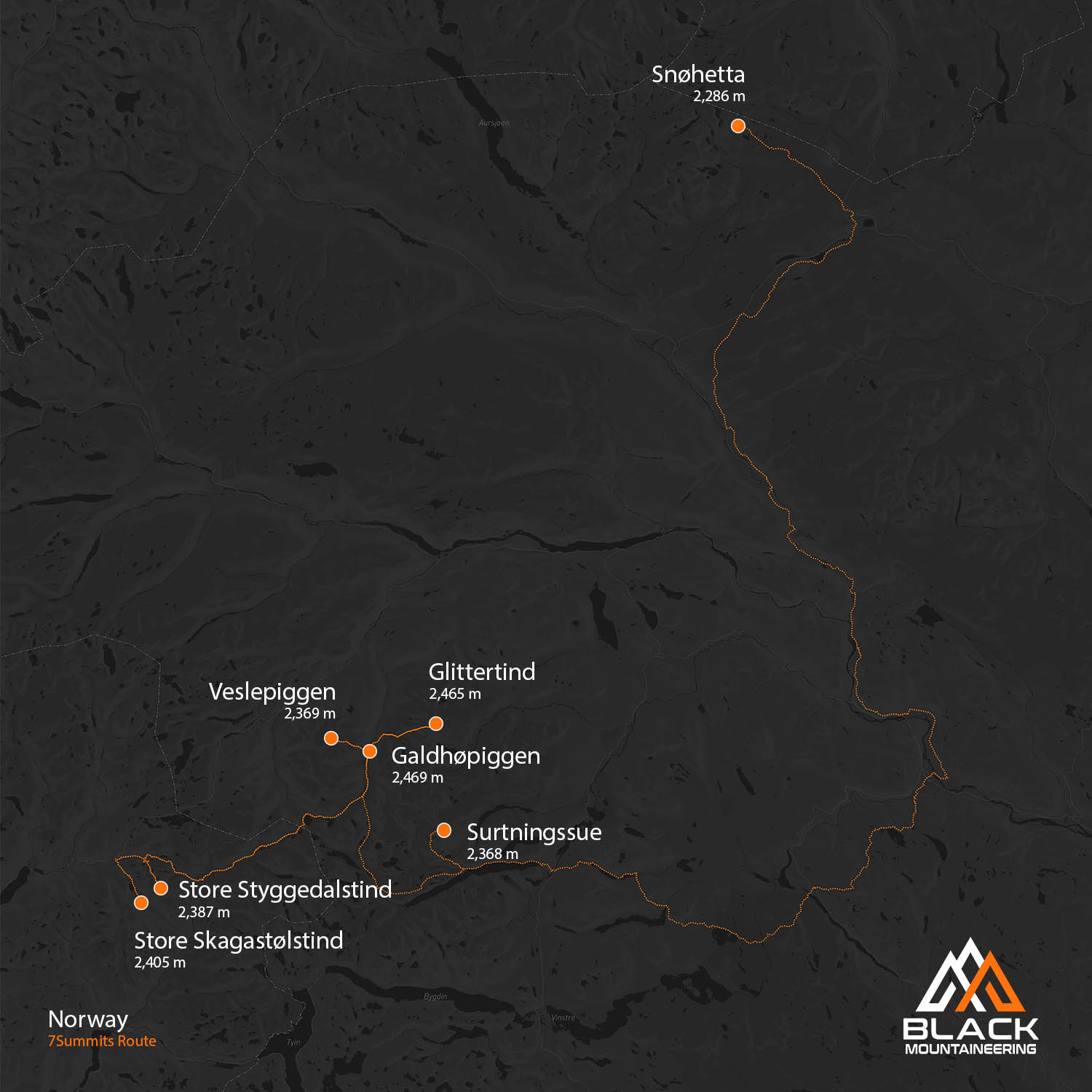
Norway 7 Summits is part of the new Global Seven Summits Series—a spectacular hut-to-hut expedition across Norway’s highest and most iconic mountains. From the glacier-covered summit of Galdhøpiggen to the legendary Store Skagastølstind, this unforgettable journey combines breathtaking alpine scenery, remote mountain huts, glacier crossings, you’ll experience Norway at its wildest.
- Galdhøpiggen (2,469 m)
- Glittertind (2,465 m)
- Skagastølstind (2,405 m)
- Styggedalstind (2,387 m)
- Veslepiggen (2,369 m)
- Surtningssue (2,368 m)
- Snøhetta (2,286 m)
Location
Norway
Duration
7 Days
Route
Hut 2 Hut
Grade
Challenging
Altitude
7 Summits
Activity
8 Hours
itinerary
Day 1
→ Travel Day: Dublin to Oslo Gardermoen → Private bus Transfer to Juvasshytta
• Flight: Early Morning flight Dublin → Oslo Gardermoen (approx. 2h 10m)
• Private Transfer: Oslo Gardermoen Airport to Juvasshytta (~5hrs
hours by private bus, including short rest stop)
• Evening: Settle into Juvasshytta mountain lodge at 1840m;
briefing and gear check for glacier traverse.
• Overnight: Juvasshytta
– Private transfer
– Accomodation Juvasshytta
– 3 course dinner
Day 2
→ Morning Galdhøpiggen Traverse: Juvasshytta → Galdhøpiggen → Spiterstulen
• Distance: ~15 km
• Elevation: +650 m / -1400 m
• Overnight: Spiterstulen lodge
Highlights: Cross the Styggebreen glacier with rope & guide,
summit Galdhøpiggen (2469m) – Norway’s highest mountain – then descend
1400m into the dramatic Visdalen valley.
– Breakfast
– Packed lunch
– Accomodation
– 3 course dinner
Day 3
→ Morning Glittertind Traverse: Spiterstulen → Glittertind → Glitterheim
• Distance: ~17 km
• Elevation: +1200 m / -900 m
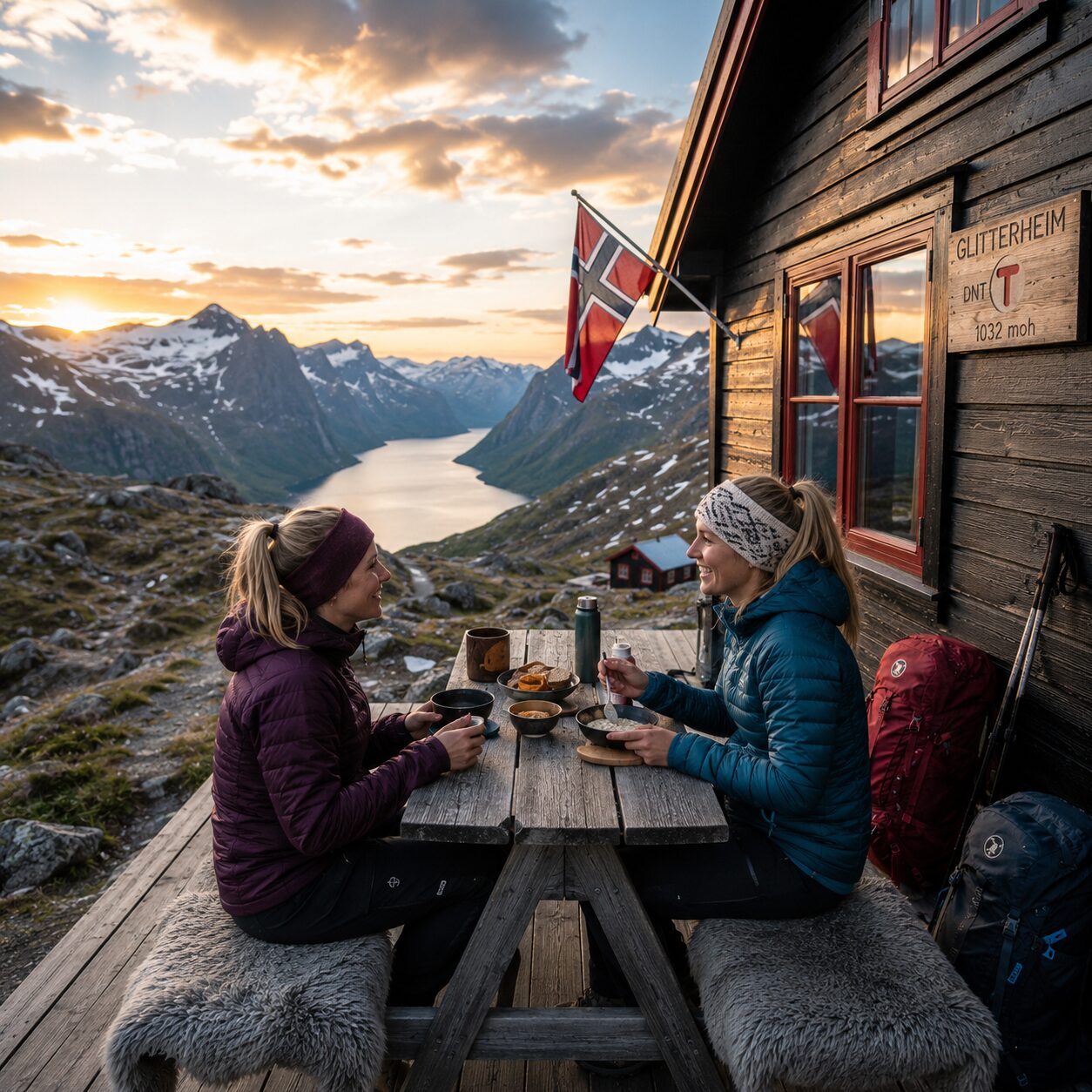
• Overnight: Glitterheim lodge
Highlights: Climb Glittertind (2452m), the second-highest
mountain in Norway, with snowy slopes and epic ridge views before
descending into Glitterheim’s peaceful basin.
– Breakfast
– packed lunch
– Accommodation Glitterheim
– 3 course dinner
Day 4
→ Traverse: Glitterheim → Naustgardstinden → Gjendesheim
• Distance: 24 km
• Elevation: 1100m-1500m
• Overnight: Gjendesheim
Highlights: Wild summit of Naustgardstinden (2253m), a rugged,
less-traveled peak with amazing ridge lines and views into Jotunheimen.
– Breakfast
– packed lunch
– Accommodation
– 3 course dinner
Day 5
Gjendesheim → Memurubu and hike back to Bessheim
- Distance: ~13 km
- Elevation: ~1300 m
- Overnight: Bessheim
The legendary Besseggen Ridge – one of Norway’s most famous hikes – a bucket-list journey with emerald and sapphire lakes on either side.
– Breakfast
– packed lunch
– Accommodation
– 3 course dinner
Day 6
→ Morning transfer from Gjendesheim → Oslo (5hrs)
Overnight Olso & celebration meal.
– Breakfast
– Private transport to Oslo
– Oslo hotel
– Celebration meal and drinks at clients own costs.
Trip finishes here.
Day 7
→ Flight Oslo → Dublin
As everyone may have different dates and flight times.
Clients arrange own taxi ride to airport to meet their own departure times.
Included
Included:
4-beds shared rooms at the cabins.
2-beds shared room at the hotel.
Single room option is not available on this trip.
JBM Elite expert guiding
Preparation training plan
All Accommodation
In country transport during the expedition
Meals as per the itinerary
Equipment glacier crossing to Galdhøpiggen
Seven Summit Series Norway Medallion and presentation box
Excluded:
Personal International flights
Personal hiking gear
Personal Insurance
Celebration meal and drinks in Oslo.
Taxi ride from Olso hotel to Airport.
Available Dates
How Fit Do You Need to Be to Complete the Norway 7 Summits Challenge?
The Norway 7 Summits Challenge is a fun hut to hut multi-day trekking challenge, carrying 15kg of all you own personal equipment, and requires a combination of cardio fitness, strength, and mental toughness.
📌 Physical Requirements for Norway 7 Summits Challenge
1. Endurance & Cardiovascular Fitness
- You’ll be trekking for multiple days, often 6–10 hours per day.
- You’ll be carrying a 15kg backpack
- Some routes involve long ascents of 1,000m+ in a single day.
✅ Training Recommendations:
- Hike 15–25 km (6-8hrs) with a 15 kg pack at least once a week.
- Stair climbing (45 min with a 10-15 kg pack).
- Running, cycling, or swimming (3–4 times a week, 45–60 min per session).
- Hyrox or Some form of high intensity fitness gym class
2. Strength & Load-Carrying Ability
- Expect to carry a 10–15 kg backpack for multiple days.
- Some summits involve steep, rocky ascents requiring strong legs & core stability.
- You may need to navigate boulder fields and exposed ridges.
✅ Training Recommendations:
- Squats, lunges, deadlifts (for leg power).
- Step-ups (50 cm box) with a weighted pack.
- Farmer’s carry (15 kg per hand) for grip & pack strength.
- Planks & core exercises (for stability on uneven terrain).
✅ Preparation Recommendations:
- Follow our 12 week training plan
- Join local training classes
- Increase exposure to long days on the hills
3. Technical Skills & Terrain Adaptation
✅ Uphill Technique
- Pacing & Breathing: Adopt a slow, “all-day” pace that allows you to breathe easily through your nose. If you are working too hard, implement the Rest Step by momentarily locking your trailing leg to shift your weight onto your bone structure rather than your thigh muscles.
- Switchbacking: On very steep grades, use switchbacks (zigzagging) to lower the gradient rather than attacking straight up.
- Pole Adjustment: Shorten your poles by 5-10 cm so your elbows don’t overreach, keeping your forearms parallel to the ground to maintain proper balance.
✅ Downhill Technique
- Posture & Impact: Many injuries happen on the descent. Loosen your hip belt slightly and bend your knees to absorb shock. Keep your weight centered directly over your feet, leaning slightly backward if the slope is dangerously steep.
- Pole Adjustment: Lengthen your poles by 5-10 cm to reduce strain on your knees and thighs, providing two extra points of contact ahead of your body.
- Foot Placement: Take short, light, and quick steps to reduce impact and maintain agility. Avoid the temptation to take long, leaping strides.
✅ Technical Terrain Adaptation
- River Crossings: Sometimes we may just need to cross low lever rivers. Keep your boots on to protect your feet from submerged branches or rocks. Unclip your backpack’s hip and chest straps so you can easily escape your pack if you fall. Face upstream and use poles to plant wide and create a stable triangle.
- Scree & Boulders: Step flat-footed to maximize your boot’s rubber traction. If dealing with loose scree, aim for embedded rocks rather than the loose gravel. Test each rock before shifting your full weight onto it.
- Scrambling: Maintain three points of contact at all times (e.g., two feet and one hand, or two hands and one foot). Move deliberately, one limb at a time, and keep your center of gravity low and close to the rock face.
4. Mental Toughness
- Some summits will push you into exhaustion and cold conditions.
- The multi-day aspect makes recovery crucial—fatigue builds up over time.
- Expect early morning summit pushes (3 AM starts) and long descents.
✅ Mental Training:
- Train in harsh conditions (rain, wind, extreme cold).
- Hike back-to-back long days (to simulate multi-day fatigue).
- Train early mornings to prepare for pre-dawn summit attempts.
📍 Minimum Fitness Benchmarks for Norway 7 Summits Challenge
You should be able to handle :
✅ Hike 1,000m+ elevation gain with a 15 kg pack (6–8 hrs).
✅ Run 10 km in 60 minutes (optional).
✅ Climb stairs for 45 min with a 10-15 kg pack.
✅ Handle 6–10 hrs trekking days back-to-back .
⛏ Who Should NOT Attempt the Challenge?
🚫 If you have an Injuries-knees, back, foot.
🚫 If you can not carry 10-15kg for 6-8hrs
🚫 If you cannot walk uphill moderate pace for 6-8hrs.
🚫 If you lack mental resilience for extreme weather and exhaustion.
Final Thoughts
The Norway 7Summits Challenge is a fun trip.
If you are fit and have solid endurance with strong legs, a great smile and energy, you’ll be well-prepared.
12-Week Training Plan for the Norway 7 Summits Challenge
This structured training plan is designed to prepare you for multi-day endurance trekking, high-altitude climbing, and challenging terrain. The focus is on cardiovascular fitness, strength, stamina, altitude adaptation, and mental resilience.
📌 Weekly Training Schedule Overview
|
Day |
Activity |
|
Monday |
Strength Training + Stair Climb with Pack |
|
Tuesday |
Cardio (Running/Cycling) + Core |
|
Wednesday |
Weighted Hike (12–18 km) |
|
Thursday |
Strength + Endurance (Step-ups, Scrambling Practice) |
|
Friday |
Rest or Light Recovery (Yoga, Stretching) |
|
Saturday |
Long Hike (15–25 km, 1,000–1,500m ascent) |
|
Sunday |
Technical Skills + Active Recovery (Swimming, Cycling) |
🏋️♂️ Phase 1 (Weeks 1–4): Building a Strong Base
Goal: Develop cardio endurance, leg strength, and hiking ability.
✅ Hiking & Trekking
- 10–12 km (6–8 miles) with a 5–10 kg pack.
- 600–800m elevation gain.
- 3–5 hours duration.
- Train slow and steady pacing (important for multi-day treks).
✅ Strength Training (2x per week)
- Squats – 3 sets of 12 reps.
- Lunges – 3 sets of 10 reps per leg.
- Step-ups (50 cm box) – 3 sets of 12 reps per leg with a weighted pack.
- Planks – 3 x 1 min (for core strength & balance).
- Pull-ups – 3 sets of 6 (for scrambling & upper body endurance).
✅ Cardio Training
- 45–60 min runs or cycling/swimming at a moderate pace.
- Stair climbing (30 min with a 5 kg pack).
- Rowing (for upper body endurance and lung capacity).
✅ Technical Skills & Terrain Familiarisation
- If possible, hike on rocky, uneven terrain.
- Practice scrambling movements (use hands on rocky terrain).
- Use trekking poles efficiently.
🏔 Phase 2 (Weeks 5–8): Strength, Altitude & Endurance Boost
Goal: Increase hiking difficulty, endurance, and pack weight.
✅ Hiking & Trekking
- 12–18 km (7–11 miles) with a 10–12 kg pack.
- 800–1,200m elevation gain.
- 6+ hours duration.
- Back-to-back hikes on weekends to simulate fatigue.
✅ Strength & Stability (2x per week)
- Step-ups (50 cm box) with a 12 kg pack – 3 sets of 15 reps per leg.
- Deadlifts – 3 sets of 8 reps (for lower back strength).
- Farmer’s Carry (15 kg per hand) – 3 sets of 30m (for grip & backpack strength).
- Planks & Hanging Leg Raises (for core & stability).
✅ Cardio & Endurance
- 60 min continuous run, cycling, or swimming.
- Interval running (5x 3 min fast, 3 min slow).
- Rowing or stair climbing for 40 min with 8 kg pack.
🏆 Phase 3 (Weeks 9–12): Peak Performance & Multi-Day Trek Simulation
Goal: Simulate multi-day trekking, maximise endurance, and test gear & nutrition strategies.
✅ Hiking (Most Important)
- 15–25 km (10–15 miles) with a 12–15 kg pack.
- 1,200–1,500m elevation gain.
- Back-to-back hikes (Saturday & Sunday) – 8+ hours each day.
- Summit a local peak if possible (to simulate fatigue & altitude).
✅ Final Strength & Endurance Training
- Stair Climbing (45–60 min with 12 kg pack).
- Bulgarian Split Squats – 3 sets of 12 per leg.
- Planks & Hanging Leg Raises – 3 sets of 1 min.
✅ Technical & Mental Training
- Scrambling on rocky terrain (if possible).
- Long hikes starting at 3 AM to simulate early summit starts.
- Train in extreme conditions (cold, wind, rain, altitude exposure).
✅ Recovery & Injury Prevention
- Cold showers & ice baths to prepare for extreme temperatures.
- Stretching & foam rolling to prevent muscle tightness.
📍Final 2 Weeks (Taper & Recovery)
🔹 Reduce heavy training (Taper).
🔹 Focus on mobility, stretching, and rest.
🔹 Test your full gear & pack during a light hike.
🔹 Hydration & nutrition strategy practice.
💡 Key Training Tips
✔ Train in your boots & backpack early (no last-minute surprises).
✔ Use trekking poles to protect knees on long descents.
✔ Practice slow, steady breathing at altitude.
✔ Train with varied terrain (loose rock, scree, snow if possible).
✔ Hydration & nutrition practice – Know what fuels you best.
✔ Recovery matters! – Foam roll, stretch, and prioritise sleep.
🚀 Are You Ready for the Norway 7 Summits Challenge?
✅ Can you hike 1,500m+ with a 12–15 kg pack?
✅ Can you handle 8–10 hour hikes back-to-back?
✅ Have you trained in cold, high-wind conditions?
✅ Are you comfortable with scrambling & rocky terrain?
Bags
80 litre Trekking Duffle Bag
60-65 litre Back-pack.
2 x 35 litre Lightweight dry bag
(Inside packpack to keep clothes dry)
Clothing
3 x Underwear
2 x Short Sleeve t-shirt
1 x Fleece.
1 x Hiking Shorts
1 x Hiking Trousers.
1 x Lite weight puff Jacket.
1 x Waterproof Shell Jacket
1 x Waterproof Shell Trousers.
Headwear
1 x Ball cap
1 x Woollen hat
1 x Sunglasses.
1 x Head torch & charging lead
Hands
1x Fleece gloves
Footwear
3 x Trekking socks.
1 x Hiking boots.
1 x Sliders / sandals.
Hut Sleeping
Bunk bed, mattress and pillow is provided.
There is no bedding or no towel provided
1 x Sleeping liner or summer sleeping bag
1 x Pillow case
– Hut Clothing
• 1 x Tracksuit / Shorts
• 1 x Sliders / sandals.
• Swimwear for hot pools
Eating/Drinking
4 x Energy Bars (backup)
1 x tube Hydration tabs
2 x 1-litre drink bottles
Electrical
Power is available in the Refuge
Power Bank (sos)
Phone
Country relevant plug
Charging cables
Other
Passport
Cash \ visa
Insurance details
Trekking poles
Ear plugs
Sunscreen and lip balm.
Toiletries, including toilet paper.
Small trekking Towel.
Small Lock for your Duffle Bag.
Antibacterial hand gel.
Personal Medicines
Paracetamol (Headache)
Ibuprofen (Joint pain)
Course of Antibiotics (ears throat Chest)
Domerid (Anti sickness)
Imodium (Diorea)
Dulcolax (Constipation)
Antiseptic Wipes
Adhesive Plasters
Blister Packs (Compeed)
Insect Repellent
Personal first aid kit
See more about our payment policy Here
On Booking your expedition our returns policy can be viewed here

Participants must have travel insurance that covers:
- Medical Expenses €10,000,000
- Baggage (optional) €3,000
- Trip Cancellation €9,000
- Personal Liability €2,000,000
- Trekking up to 3,000 metres
Bring your policy details in the event required.
We strongly recommend True Traveler.