
— Expeditions
Mt Kazbek
Eastern Georgia’s highest mountain
Intermediate
7 Days
5,054 m
Price
€2499
Per Person
Overview
Mount Kazbek, standing at 5,054 metres, is the highest mountain in Eastern Georgia. Located in the spectacular Greater Caucasus Mountains, it rises above the dramatic landscapes of Kazbegi National Park. This magnificent glacier-covered summit offers an unforgettable high-altitude mountaineering experience.
- Summit the highest mountain in Eastern Georgia
- No Prior climbing experience required
- Fully guided by Jason Black
- Proven acclimatisation programme
- Winter skill training throughout the expedition
- Small expedition teams
- Excellent guide-to-client ratios
- Three climbers per guide
- Modern mountain accommodation
- Spectacular panoramic views
- Official Mount Kazbek Summit Certificate
Location
Georgia
Duration
7 Days
Route
South Side
Grade
Intermediate
Altitude
5,054 m
Activity
Approx 8hrs
itinerary
Day 1 – Arrival in Georgia | Tbilisi – Mtskheta
- Leg 1: Dublin (DUB) to Turkey (Istanbul)
-
- Direct flights run regularly from Dublin Airport (DUB) to Istanbul (IST)
-
- Leg 2: Turkey to Tbilisi International Airport (TBS)
- Direct flights operate daily from Istanbul (IST) to Tbilisi International Airport (TBS)
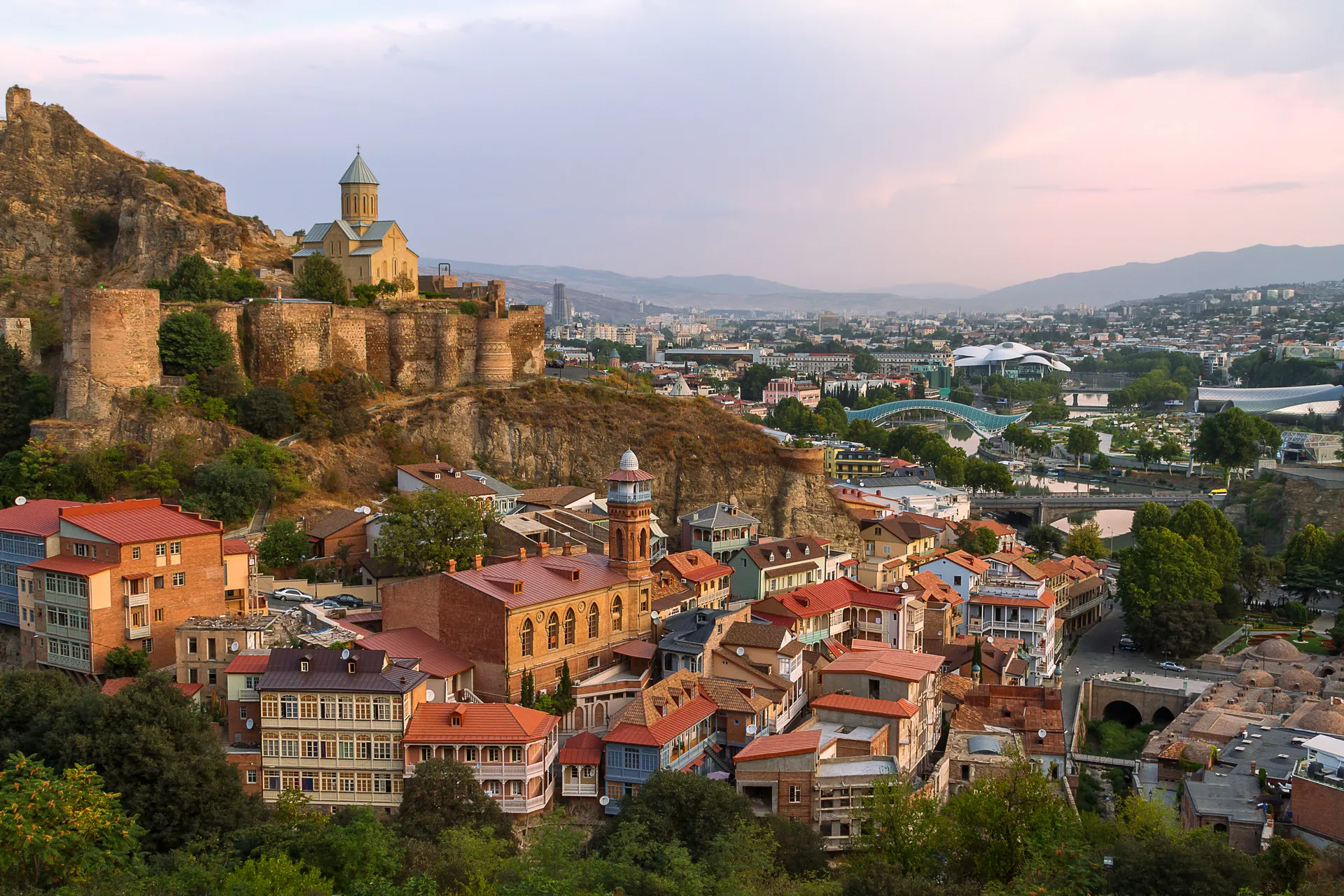
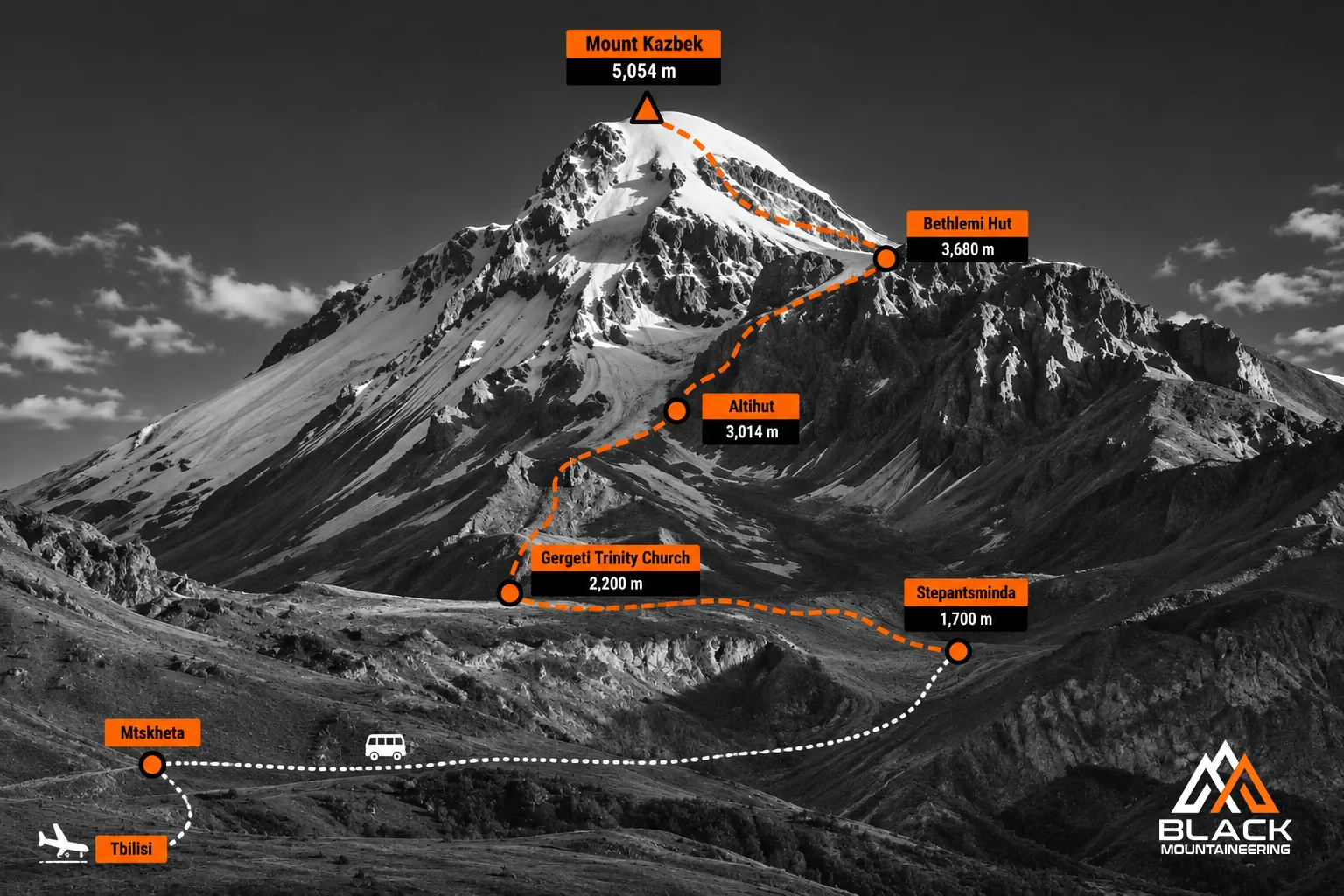
Arrive at Tbilisi International Airport, where we transfer to the historic town of Mtskheta (1.5hr), one of Georgia’s oldest settlements.
After checking into our hotel, we meet to discuss the expedition programme and complete an initial equipment gear check.
Accommodation: Hotel in Mtskheta.
Day 2 – Journey to the Caucasus | Stepantsminda (1,700 m)
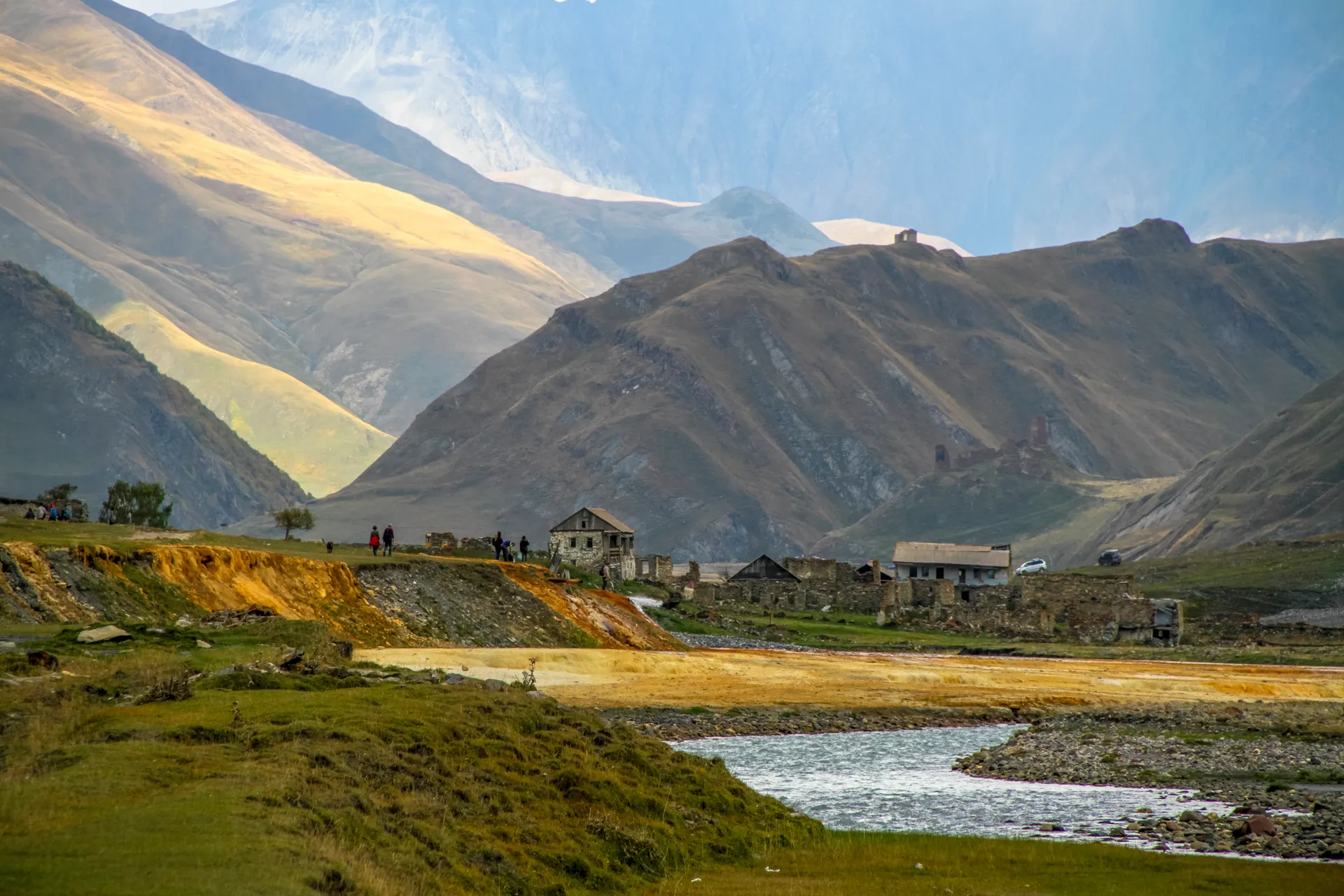
After breakfast we travel north into the Greater Caucasus Mountains towards Stepantsminda, the gateway to Mount Kazbek.
The journey takes approximately three hours, following the famous Georgian Military Highway through dramatic mountain landscapes.
On arrival, we settle into our accommodation and prepare for the following day’s ascent into the mountains.
Accommodation: Guesthouse or hotel in Stepantsminda.
Day 3 – Acclimatisation Trek | Altihut (3,014 m) & Gergeti Glacier (3,500 m)
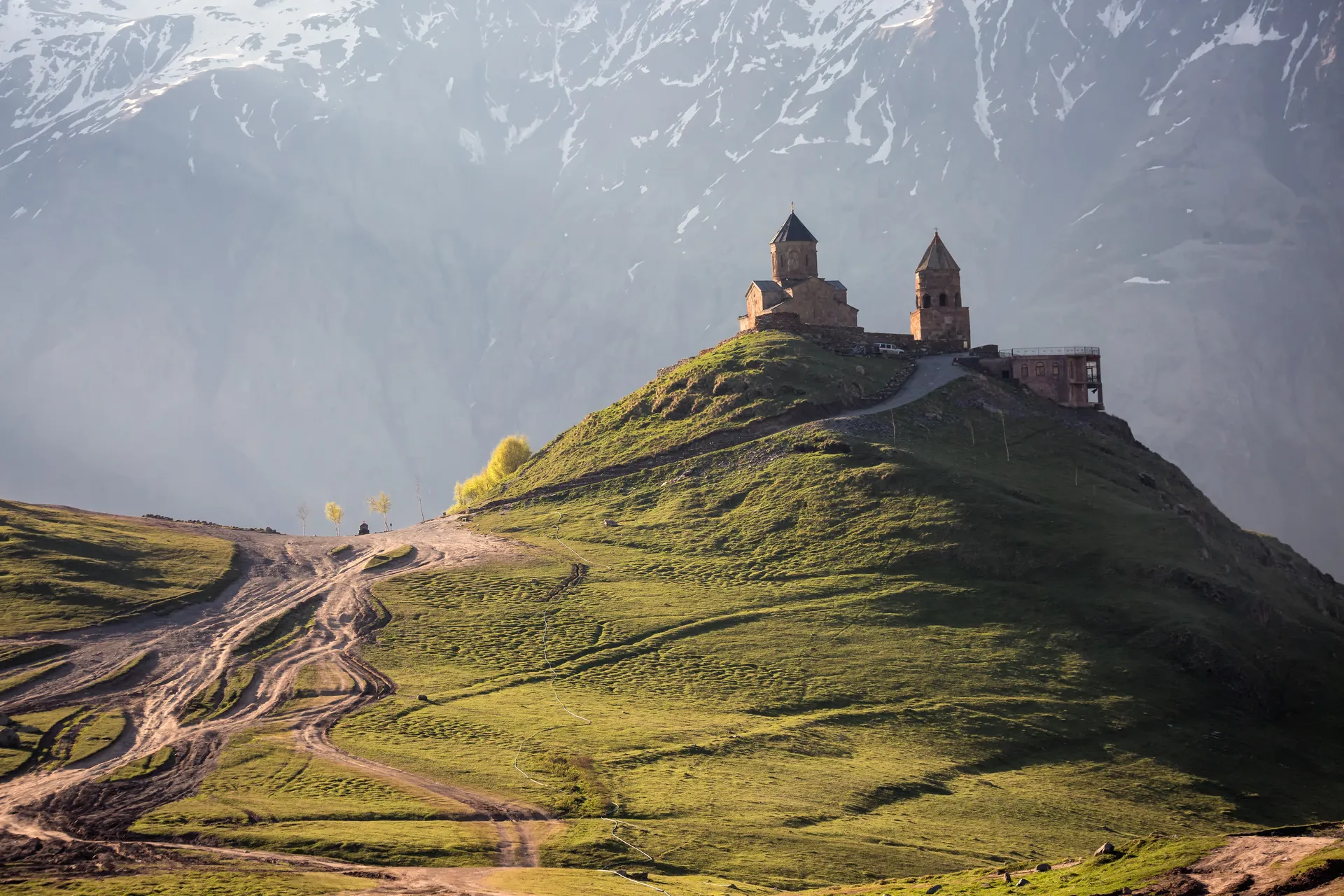
Our mountain expedition begins with a transfer to Gergeti Trinity Church at approximately 2,200 m.
From here, we continue on foot towards Sabertse Pass (approximately 3,000 m), before reaching Altihut at 3,014 m.
After a short rest, we continue our acclimatisation programme with a hike towards the lower Gergeti Glacier, reaching approximately 3,500 m.
We descend to Altihut for the evening, allowing our bodies to begin adapting to the increasing altitude.
Accommodation: Altihut (3,014 m).
Day 4 – Acclimatisation & Equipment Carry | 4,000 m
Today we carry some equipment to the Bethlemi hut at 3680 m. Then hike up to 4000m and descend back to the Altihut.
Accommodation: Altihut (3,014 m).
Day 5 – Move to High Camp | Bethlemi Hut (3,680 m)
Following breakfast, we leave Altihut and ascend to Bethlemi Hut, our high mountain base for the summit attempt.
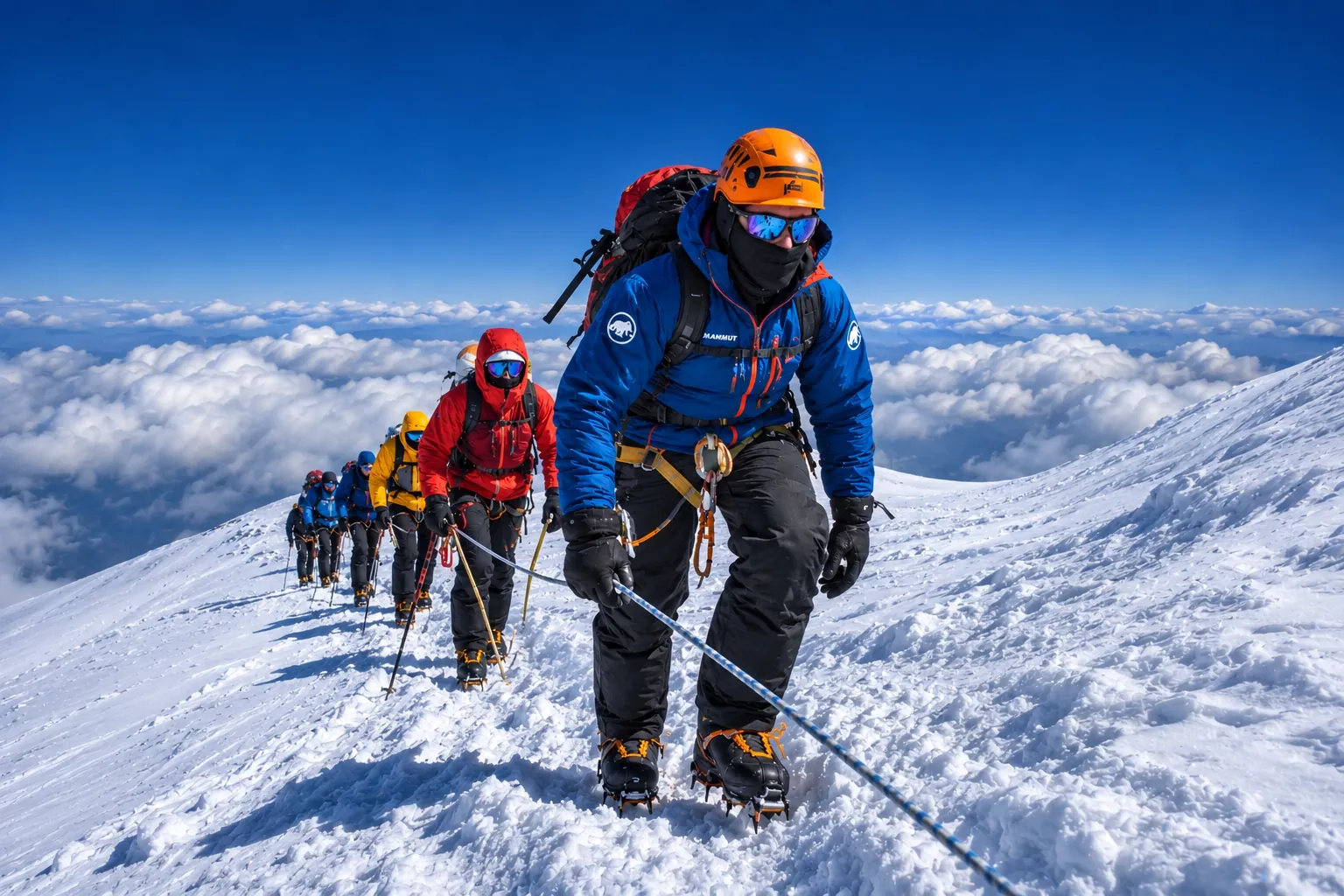
The afternoon focuses on essential technical mountaineering skills, including:
-
Crampon techniques and efficient movement on snow and ice.
-
Correct ice axe use and self-arrest.
-
Rope management and glacier travel procedures.
-
Summit-day preparation and safety briefings.
Black Mountaineering guides assess the team’s readiness, review equipment and discuss the weather conditions and summit strategy.
Accom: Bethlemi Hut (3,680 m).
Day 6 – Summit Day | Mount Kazbek (5,054 m)
An early alpine start marks the beginning of our summit attempt.
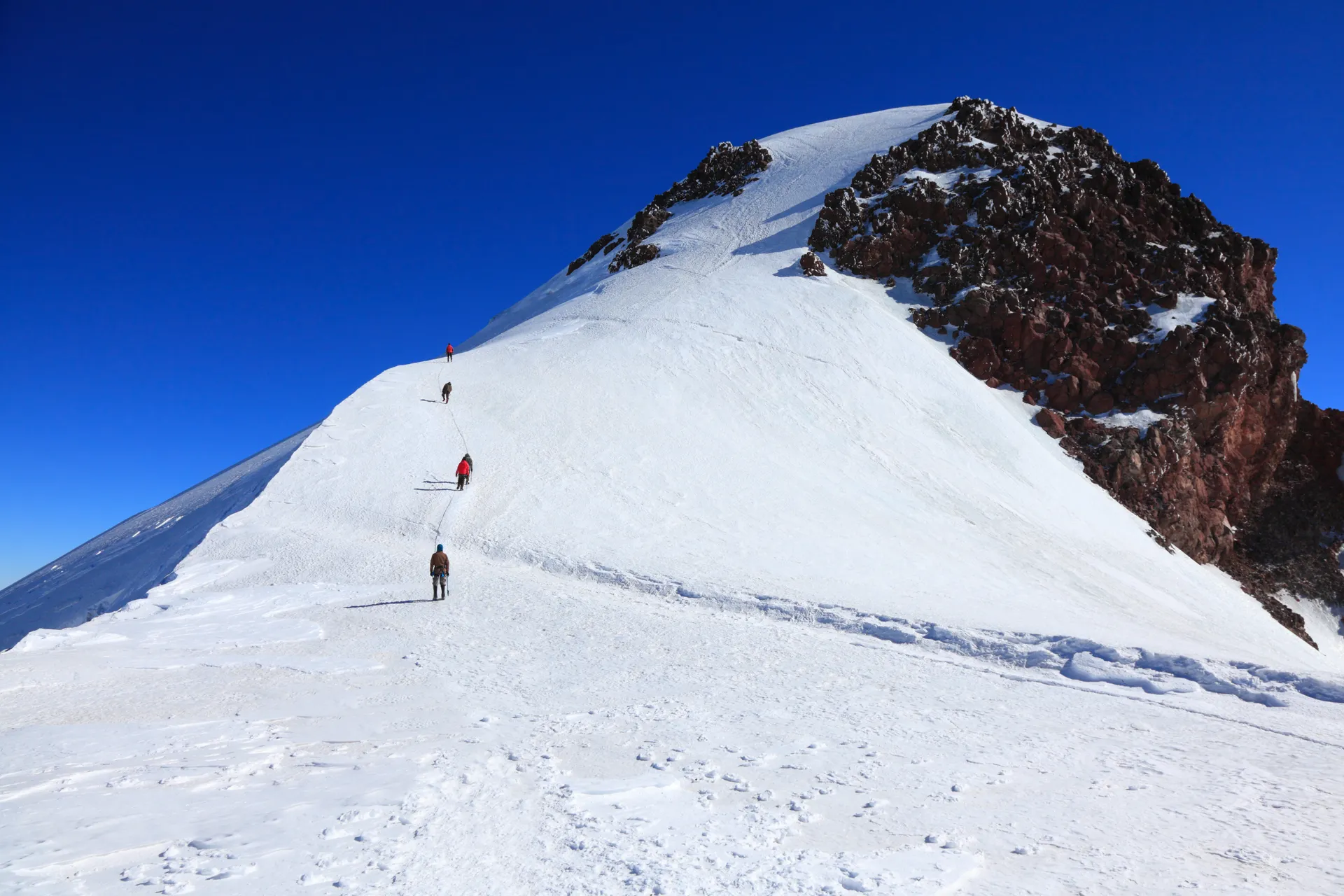
Climbing by headtorch, we move across glaciated terrain, navigating snow slopes and the upper mountain towards the summit of Mount Kazbek.
The final approach requires careful movement, sound rope techniques and disciplined teamwork.
Reaching the summit rewards us with remarkable views across the Greater Caucasus, stretching towards neighbouring Russia.
Following our summit attempt, we descend towards Bethlemi Hut and, if conditions and team strength permit, continue down to Altihut.
Estimated climbing time: 11–12 hours, potentially longer depending on conditions and descent logistics.
Accommodation: Altihut.
Day 7 – Weather Contingency / Return to Mtskheta
This day provides flexibility within our expedition programme.
If poor weather prevents our planned summit attempt on Day 6, we may use this day as an alternative summit opportunity, subject to safety considerations and the remaining descent and travel requirements.
Under the standard programme, we descend from the mountain, return to Stepantsminda and transfer to Mtskheta for a celebration evening together.
Accommodation: Hotel in Mtskheta, subject to the final mountain schedule.
Day 8 – Departure | Tbilisi International Airport
After breakfast, we transfer to Tbilisi International Airport for our return flights.
Our Mount Kazbek expedition comes to an end after seven days of mountain exploration, technical learning and high-altitude climbing in the Caucasus.
Included
What’s Included
- All transport throughout Georgia.
- Black Mountaineering 80ltr expedition bag
- All accommodation as outlined in the itinerary
- All meals as specified in the itinerary.
- Professional Black Mountaineering expedition leader
- International mountain guides.
- 1:3 guide-to-client ratio on summit day.
- One full summit attempt
- Official Mount Kazbek Summit Certificate.
- Accommodation on shared bases
Mtskheta – Georgia
Stepantsminda – Kazbegi
Altihut – 3,014 m
Bethlemi Hut – 3,680 m
What’s Excluded
- International flights to and from Tbilisi International Airport (TBS)
- Personal mountaineering equipment
- Any item not specifically listed under What’s Included
Available Dates
How Fit Do You Need to Be to Climb Mount Kazbek 5,054m
Climbing Mount Kazbek 5,054m requires high-altitude endurance, strength, and stamina, but it is not technically difficult. It is higher than Island Peak, but has a longer and more gradual ascent, making it more of an endurance challenge rather than a technical climb.
📌 Physical Requirements for Mount Kazbek
1. Endurance & Cardiovascular Fitness
- Summit day is 12+ hours, covering 1,000m+ vertical ascent at altitude.
- A strong cardio base is crucial to handle multi day at high altitude.
✅ Training Recommendations:
- Hike 15–20 km (9–12 miles) with a 12 kg pack at least once a week.
- Stair climbing (45 min with a 10 kg pack).
- Running (5–10 km, 3–4 times a week).
2. Strength & Load-Carrying Ability
- Expect to carry a 10–15 kg backpack for multiple days.
- Terrain includes steep ascents, snowfields, and glaciers.
- The final summit push is steep and energy-draining, requiring strong legs, core, and back.
✅ Training Recommendations:
- Squats, lunges, deadlifts (for leg power).
- Step-ups (50 cm box) with a weighted pack.
- Farmer’s carry (15 kg per hand) for grip and pack strength.
- Planks & hanging leg raises (for core stability).
3. High-Altitude Acclimatisation
- Mount Kazbek is the highest peak in Europe, and altitude sickness is a real risk.
- Many climbers experience AMS (Acute Mountain Sickness) due to rapid ascent.
- You must be prepared for low oxygen levels, exhaustion, and extreme cold.
✅ Preparation Recommendations:
- If possible, train at altitude (above 3,500m) before your trip.
- Use a hypoxic training mask or altitude tent for simulation.
- Spend extra rest days at high altitudes before the summit push.
4. Technical Skills & Ice Travel
- No technical climbing required, but the final summit push is on a 35-40° ice slope.
- You must walk in crampons on snow/ice and use an ice axe.
✅ Skills to Practice:
- Walking in crampons on mixed terrain (hills, snow, loose rock).
- Using an ice axe for balance & self-arrest techniques.
- Basic fixed rope travel
5. Mental Toughness
- You’ll be trekking for nearly two weeks before the summit attempt (physically exhausting).
- Expect cold temperatures (-20°C) and high winds.
- The final 800m climb on summit day is slow, exhausting, and mentally tough.
✅ Mental Training:
- Train in bad weather (rain, wind, cold).
- Push through exhaustion with long back-to-back training hikes.
- Simulate long days in the mountains (cold early morning hikes).
📍 Minimum Fitness Benchmarks for Mount Kazbek
You should be able to:
✅ Hike 1,200m+ elevation gain with a 12 kg pack (6–8 hrs).
✅ Run 10 km in under 55 minutes (for cardio endurance).
✅ Climb stairs for 45 min with a 10 kg pack.
✅ Carry a 15 kg pack for multiple days.
⛏ Who Should NOT Attempt Mount Kazbek
🚫 If you have no trekking or high-altitude experience.
🚫 If you cannot hike 6–8 hours a day for multiple days.
🚫 If you struggle with cold weather and altitude sickness.
16-Week Mount Kazbek Training Plan (Intermediate to Advanced)
Build the endurance, leg strength, load-carrying ability and recovery habits needed to climb Mount Kazbek (5,054 m) in Georgia.
Please consult your doctor before commencing any training programme.
What Kazbek Asks of You
Kazbek is a long, cold, glaciated climb. A typical itinerary starts in Stepantsminda (about 1,740 m), with a loaded climb of roughly 1,300 m to Altihut (3,014 m), then a summit day of roughly 2,000 m on snow and glacier in crampons to the top (5,054 m), followed by the descent. Expect:
- A sustained loaded climb to the hut, then an early alpine start for summit day
A long summit day of around 7-10 hours at altitude, often in wind and cold
Roped glacier travel, crampons and ice axe use
Back-to-back big days, so recovery matters as much as fitness - This plan trains the engine, legs and recovery habits behind all of that. Your exact itinerary and kit list will be confirmed by your guide, as schedules can change with conditions.
Weekly Schedule Overview
| Day | Activity |
|---|---|
| Monday | Strength or aerobic session |
| Tuesday | Strength or aerobic session |
| Wednesday | Rest |
| Thursday | Hill session, loaded climb or uphill intervals |
| Friday | Recovery walk, easy bike or rest |
| Saturday | Long hill or mountain day |
| Sunday | Easy walk, rest or back-to-back day 2 |
Measuring Your Effort
Use the talk test. Heart-rate figures can help, but terrain, fatigue, heat, cold and altitude all affect the number.
- Recovery (very easy): Full conversation. Cool down and recover.
- Easy (comfortable): Conversational pace. Builds your aerobic base.
- Steady (working): Short sentences. Sustainable effort.
- Threshold (hard): Only a few words at a time. Controlled discomfort.
On Kazbek, slow and steady wins. Practise a pace you could hold for hours, because altitude will punish anything faster.
Phase 1: Foundation (Weeks 1-4)
Goal: Build an aerobic base and gym strength.
Long hill day
- 2 to 3.5 hours
- 5-9 miles / 8-14.5 km
- 400-800 m vertical gain
- 5-6 kg pack
Midweek hills
- Hill walk or hill session of 75 minutes, 300-500 m, 5-6 kg
- Uphill intervals: 6 x 2 min, progressing to 5 x 3 min
Strength (2 sessions per week)
- Strength A: squat or leg press, Romanian deadlift, step-up, row, calf raise, loaded carry
- Strength B: split squat, hip hinge, step-up, pulldown, calf raise, carry
- 2-3 sets each, finishing with good form, not failure
Cardio
- 40-50 minute aerobic sessions on the bike, incline treadmill or flat walking
- Recovery walks of 30 minutes
Phase 2: Build (Weeks 5-8)
Goal: Increase strength and vertical volume.
Long hill day
- 4 to 5.5 hours
- 9-13 miles / 14.5-21 km
- 800-1,200 m vertical gain
- 6-8 kg pack
Loaded hills
- 90 minutes to 1 hour 45 minutes
- 500-700 m vertical gain
- 6-8 kg pack
Intervals
- Uphill intervals: 6 x 3 min, progressing to 5 x 4 min
- Jog or hike recovery between efforts
Strength
- Continue Strength A/B with progressive resistance
- Keep most aerobic work conversational
- Long hill days are for efficient movement, fuelling, footwear and pack practice, not racing
Kazbek skills
- Start practising with trekking poles on every hill session
- Begin using your mountaineering boots on long days so they are broken in well before the trip
Phase 3: Specific (Weeks 9-12)
Goal: Train load carriage and perform on tired legs.
Long mountain days
- 6 to 7 hours
- 12-16 miles / 19-26 km
- 1,200-1,500 m vertical gain
- 8-10 kg pack
Back-to-back days
- Day 1: 4-5 hours, 650-950 m, 9-10 kg (a loaded approach day)
- Day 2: 5-6 hours, 750-1,050 m, 9-10 kg (practises performing on tired legs)
- These teach you to recover and perform again on tired legs
Loaded climbs
- 90 minutes to 2 hours
- 500-800 m vertical gain
- 8-10 kg pack
Strength
- Shift to muscular endurance: weighted step-ups, walking lunges, calf work and loaded carries
- Uphill intervals of 6 x 4 min, strong but controlled
Kazbek skills
- Book a winter skills or glacier course if you are new to crampons, ice axe, self-arrest and roped travel
- Practise layering and eating in cold, windy conditions
Phase 4: Peak and Taper (Weeks 13-16)
Goal: Simulate the expedition, then arrive fresh.
Weeks 13-14: Peak block
- Peak mountain day: 7-8 hours, 16-18 miles / 26-29 km, 1,500-1,800 m, 10-12 kg. This is your closest match to summit day, so use a route with a long, sustained climb
- Simulation weekend: 6 hours on day 1 and 7 hours on day 2, 950-1,350 m per day, 10-12 kg. Start day 2 early, in the dark, with a head torch
- Loaded hills midweek at 600-700 m with 10-12 kg
Weeks 15-16: Taper
- Reduced volume so fitness is retained while fatigue falls
- Reduced hill day of 4-5 hours, then easy hills, mobility and a short shake-out walk
- Do not add missed sessions or extra hard work during the taper
Altitude on Kazbek
No training plan can replicate altitude, and fitness does not protect you from altitude sickness. What helps most is:
- A slow, steady pace on the mountain
- Following your guide’s acclimatisation schedule
- Drinking and eating well, and sleeping as much as you can
- Telling your guide early if you feel unwell (headache, nausea, dizziness)
- Speaking to your doctor before the trip about altitude and any medication
10 Steps to Prepare
- Start walking now. Build regular time on your feet and progress gradually.
- Make leg-based cardio a habit. Cycling, swimming and stair work support your walking base.
- Take the stairs. Strengthen glutes, quads and calves in everyday life.
- Analyse how you move. Good posture, efficient stride and controlled descending reduce wasted energy.
- Train on different terrain. Hills and rough ground prepare feet and ankles.
- Train in bad weather. Kazbek weather changes fast, so test layers, waterproofs and your ability to stay organised.
- Practise with walking poles. Develop a natural rhythm uphill and downhill.
- Train with your expedition kit. Use your boots and progressively load your pack.
- Fuel and hydrate. Practise eating and drinking little and often until it becomes automatic.
- Look after your feet. Test socks, lacing and blister prevention before the expedition.
Key Training Tips
- Test everything in training. Kazbek is not the place to discover that your boots rub or your food strategy does not work.
- Do not leave equipment testing until the final weeks.
- Consistency is more valuable than one heroic session.
- Recovery matters. Prioritise sleep, mobility, nutrition and hydration.
- The goal is not to finish every session exhausted. It is to build a body that can work for hours, recover, and do it again the next day.
Are You Ready for Kazbek?
- Can you carry 10-12 kg for 7-8 hours with 1,500 m or more of climbing?
- Can you perform on consecutive long days, including an early start?
- Have you trained in cold, windy and wet conditions with your full kit?
- Are you comfortable with crampons and an ice axe, or booked on a skills course?
- Do you have a fuelling and footwear routine that works?
If you can tick every box, you are ready. Arrive prepared. Move with confidence. Finish proud.
See it. Believe it. Achieve it.
Bags
Large 80ltr Duffel Bag – we supply
Expedition Backpack 40L
Documents
Passport 6mts Valid
Debit/Credit Cards Insurance
Papers Photocopy of passport
Base Layers
Merino Wool Underwear (4 pcs)
Merino long sleeve base layer (1 pcs)
Merino long pants base layer (1 pcs)
Short Sleeve T Shirt (2 pcs)
Mid Layers
Fleece (1pcs)
Mid weight Hiking Pants (1pcs)
Windproof/Rain Layers
Hard Shell Jacket (1pcs)
Hard Shell Pants (1pcs)
Insulation Layers
800+gram Goose Down Jacket with hood
Insulated Pants
Lite puffer jacket
Headwear
Warm Hat (1pcs)
Balaclava (1pcs)
Baseball Cap (1pcs)
Buff (1pcs)
Eyewear
Cat 4 Glacier Glasses
Gloves
Lightweight Liner Gloves
Shell Guide Glove with Insulated Liner 7000m
Expedition Mitts
Footwear
Wool or Synthetic Socks (3 pairs)
Double Skin Mountaineering Boots 6000 (Kailas / Lasportiva / Millet)
Trekking Approach Shoes
Refuge Shoes – crocs or sandals.
Sleeping Equipment
Sleeping Bag -20°C
Earplugs
Mountaineering Gear
Helmet – can rent
Crampons – can rent
Climbing Harness – can rent
Headlight 500-700 Lumens (2pcs)
– batteries or charing leads
Travel Items
Travel Clothes
Cash
Visa Card
ATM card
Hut Clothing
• 1 x Tracksuit
• 1 x Sliders / sandals.
Additional Food Items
Salty-sweet bars
Medical/First Aid
Personal First-aid kit
Compeed blister packs
Sutures & steri strips
Ibuprofen
Paracetamol
250mg Diamox 5 days
Medicated throat lozenges
Medicated throat spray
Antibiotic Azithromycin 500mg
Laxatives
Imodium
Mosquito repellent
Menstrual products
Electrolytes
Nail cutter
Duct tape – Repair Kit
Hand & Feet chemical warmers
Toiletries (Personal)
Toilet Paper
Toothpaste &Toothbrush
Bio Baby wipes (2pcs)
Soap
Shampoo
Shaver
Towel
Small nail-brush
Sunscreen: SPF 50
Lip Screen: SPF 30
Aftersun
Additional Item
Trekking poles
Water Bottles 1- liter (2pcs)
Pee Bottle 1- litre
Female Urination Device (FUD)
Optional Electronics
Country-appropriate plug adapters
Power Bank
Phone
Charging leads
See more about our payment policy Here
On Booking your expedition our returns policy can be viewed here

Participants must have travel insurance that covers:
- Medical Expenses €10,000,000
- Baggage (optional) €3,000
- Trip Cancellation €9,000
- Personal Liability €2,000,000
- Trekking up to 5,000 metres
Bring your policy details in the event required.
We strongly recommend True Traveler.