Every mountain has a version of itself that the tourism industry prefers you to see.
For Kilimanjaro, that version has a nickname. The Coca-Cola Route. Wooden huts. Well-worn paths. A shorter itinerary. The infrastructure of a mountain that has been made as commercially accessible as possible for the largest possible volume of paying customers.
Then there is the other version. The Whiskey Route. Tent camping on exposed slopes. A longer, steeper, more physically demanding ascent. Five complete ecosystems traversed on foot rather than passed through on a managed trail. A summit experience built on genuine acclimatisation rather than commercial optimism.
These are both routes to Uhuru Peak at 5,895 m. They are not the same journey.
At Black Mountaineering we use the Machame Route. Every expedition. Without exception. The reason is straightforward and it is the same reason every Kilimanjaro guide with genuine high-altitude experience will give you if you ask them directly.
The Whiskey Route gives you the best possible chance of actually reaching the summit.
Here is the full picture of why.
What the Nicknames Actually Mean
The names are not marketing inventions. They emerged organically from the mountain culture around Kilimanjaro and they communicate something real about the character of each route.
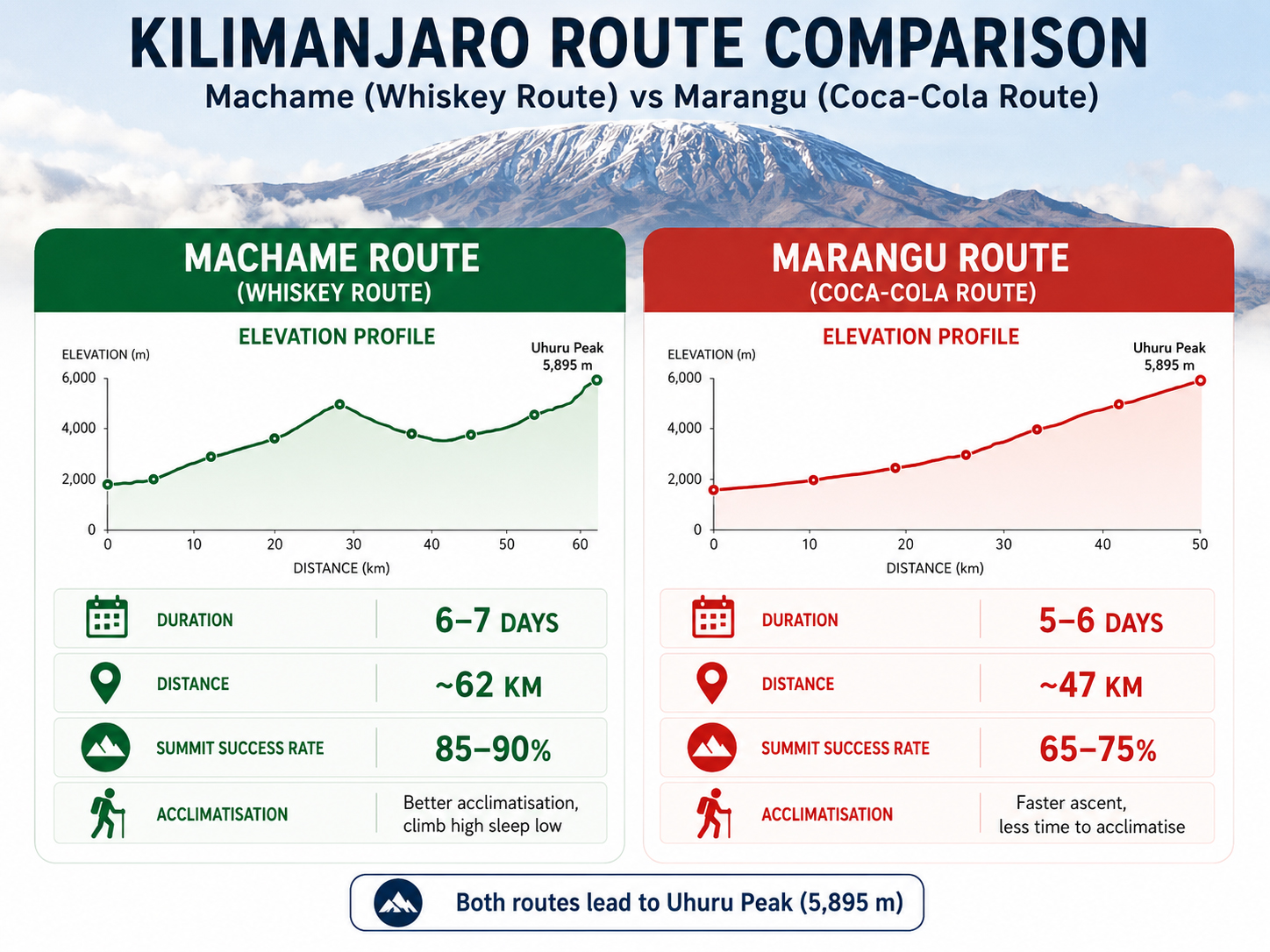
The Marangu Route earned the Coca-Cola nickname because of the mountain huts stationed along it where soft drinks, including Coca-Cola, were historically available for purchase. The infrastructure exists. The crowds are real. The conveyor belt quality of the experience is genuine.
The Machame Route earned the Whiskey nickname for its reputation as the harder, rougher, more demanding alternative. The terrain is more varied and more challenging. The camping is tent-based rather than hut-based. The route demands more of the climber physically and mentally.
But here is what the nicknames do not communicate.
The Whiskey Route does not just feel more like a real mountain expedition. It is more likely to produce a summit.
The Summit Success Rate Difference
The summit success rate on Kilimanjaro varies significantly by route. This is not a matter of opinion. It is a documented pattern across decades of expedition data.
The Marangu Route, despite or perhaps because of its commercial popularity, carries a lower overall summit success rate than the Machame Route. The reasons are structural and they are worth understanding before you choose.
The Marangu Route is typically completed in five to six days. That shorter duration compresses the acclimatisation schedule significantly. The body has less time to adapt to the progressive altitude gain before the summit push. Climbers who move through the altitude bands too quickly are more susceptible to Acute Mountain Sickness above 4,000 m and significantly more likely to turn back before Uhuru Peak.
The Machame Route is seven days on the mountain. The additional days are not comfort padding. They are acclimatisation architecture.
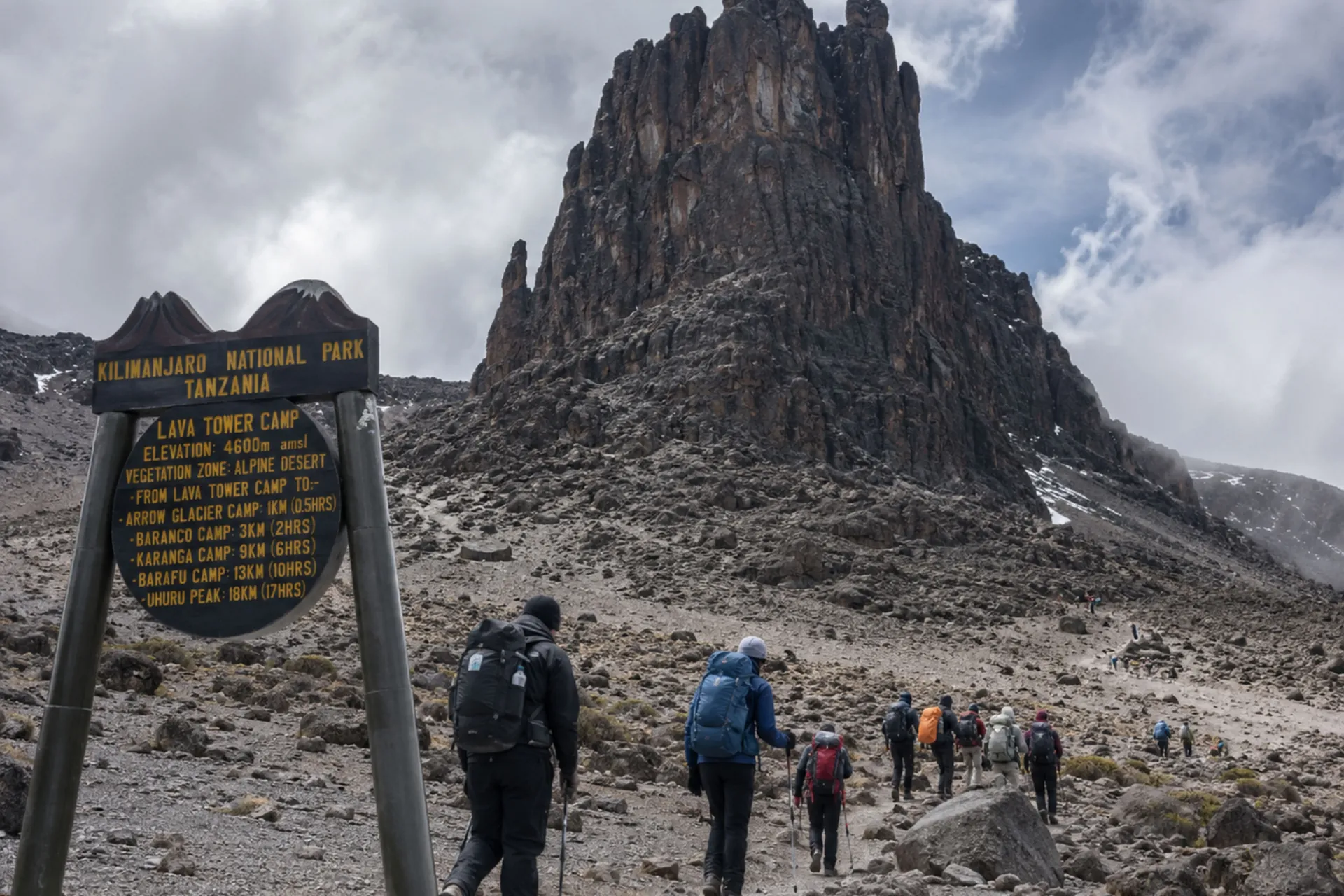
The most important of those additional days is Day 5. The route takes the team to Lava Tower at 4,600 m for the critical climb high sleep low stimulus before descending to Barranco Camp at 3,960 m to sleep. The body is pushed to a high altitude to stimulate red blood cell production. Then it descends to recover and consolidate those adaptations overnight.
This single day, designed into the Machame Route structure deliberately, does more for summit success on Kilimanjaro than any other element of the preparation. The Marangu Route does not include this acclimatisation architecture.
The summit success rate difference is the outcome of that structural advantage applied across seven days instead of five.
Tent Camping vs Mountain Huts: Why It Matters More Than Comfort
The accommodation difference between the two routes is frequently framed as a comfort preference. Huts versus tents. Beds versus sleeping mats. Social common areas versus personal expedition space.
This framing misses the more significant point.
The Marangu Route huts are communal. During peak season they are crowded, noisy, and shared with climbers from multiple operators moving on overlapping schedules. The concentrated foot traffic on the route and in the huts creates a logistical and atmospheric reality that has more in common with managed tourism infrastructure than with a mountain expedition.
The Machame Route tent camping experience is different in character at every level.
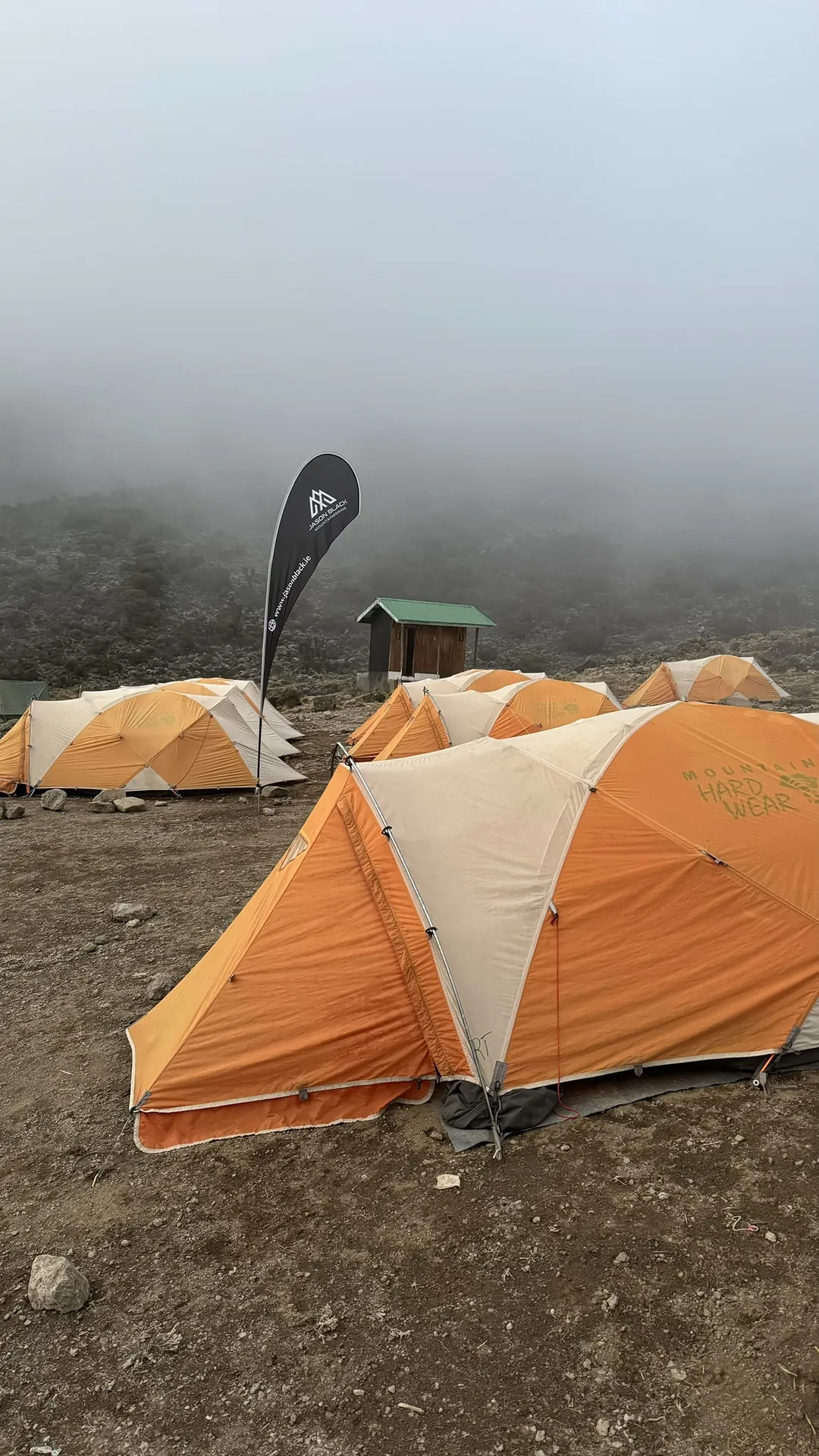
Your camp on the Machame Route is your team’s camp. The porters arrive before the climbing party, establish the camp, and have it ready when the team arrives. The kitchen tent, the sleeping tents, and the dining setup are yours for the duration. The group dynamic develops in an environment that belongs to the team rather than being shared with strangers from a dozen other operators.
At Black Mountaineering this matters for reasons beyond atmosphere. The guide to client ratio that makes daily altitude monitoring and individual health assessment possible is maintained throughout the expedition precisely because the small team structure is preserved from arrival to summit. A communal hut environment on a crowded route makes this level of individual attention significantly harder to deliver.
The tent camping is not a sacrifice of comfort for authenticity. It is the physical architecture of a properly led small group expedition.
The Five Ecosystems: What the Whiskey Route Actually Shows You
One of the defining characteristics of the Machame Route is the diversity of terrain it passes through.
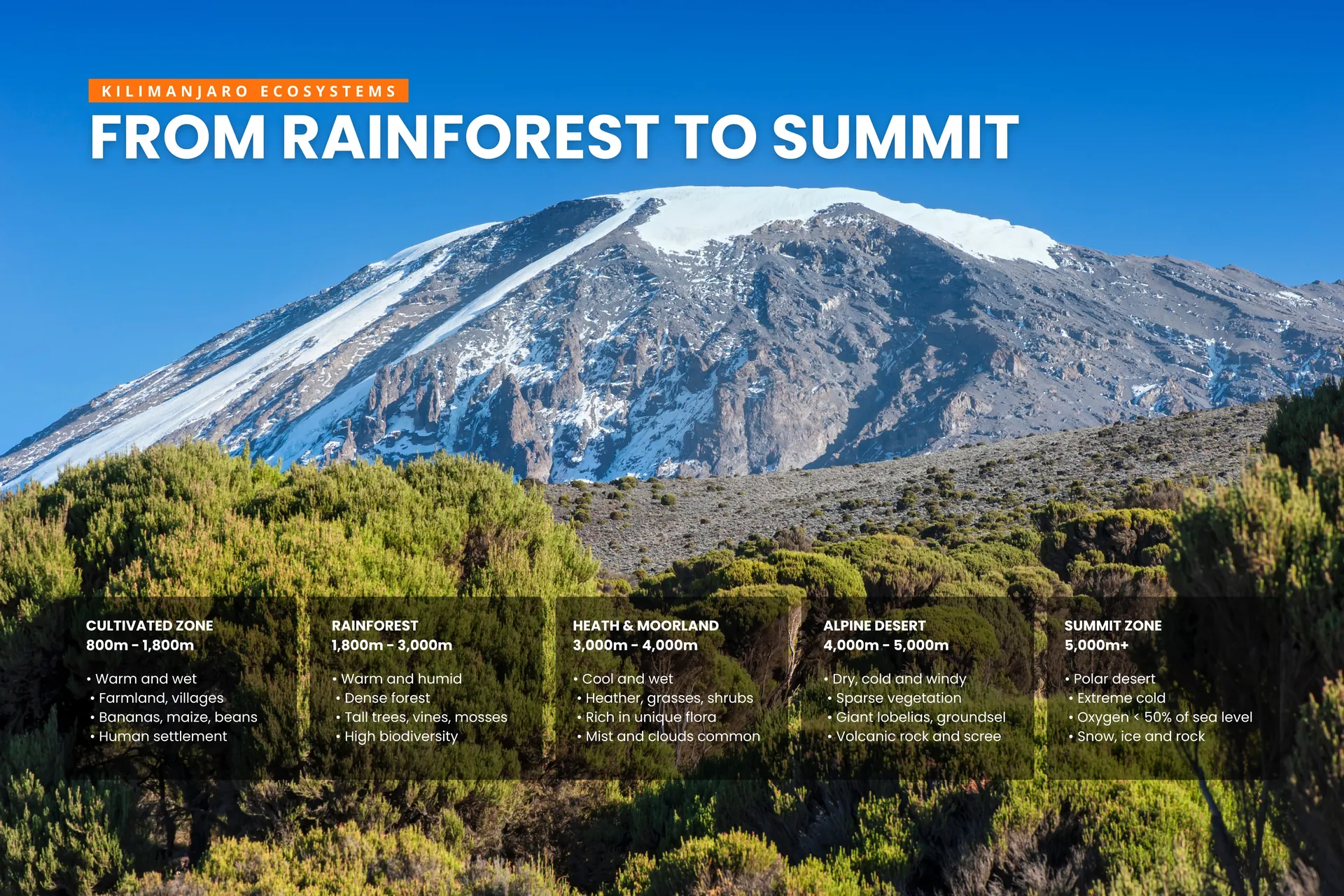
In seven days on the mountain, the team moves through five completely distinct ecosystems. This is not a gradual transition from one landscape to another. It is a series of genuinely different worlds, each with its own microclimate, vegetation, and atmosphere.
Day 1: Tropical Rainforest Machame Gate at 1,814 m opens into dense tropical rainforest. The humidity is high. The canopy is close overhead. Roots cross the trail constantly. Blue monkeys are visible in the upper branches. The air is warm and the pack is still fresh and the mood is one of excitement and arrival.
Day 2: Moorland and Heath The forest gives way on Day 2 to the vast Shira Plateau at 3,833 m. An ancient collapsed volcanic caldera formed roughly 100,000 years ago, the plateau is open, windswept, and covered in heather and protea vegetation that looks like nowhere else on Earth. The Kibo massif fills the sky ahead for the first time. The summit is visible. The scale becomes real.
Day 3 and 4: Alpine Desert Above 4,000 m the landscape shifts into alpine desert. The vegetation becomes sparse and strange. Giant groundsels, senecio trees that can grow to three metres, stand like frozen figures around Barranco Camp. The Lava Tower rises as a volcanic monolith at 4,600 m, solidified magma from eruptions millions of years past. The sky is a deeper blue than anything visible at sea level.
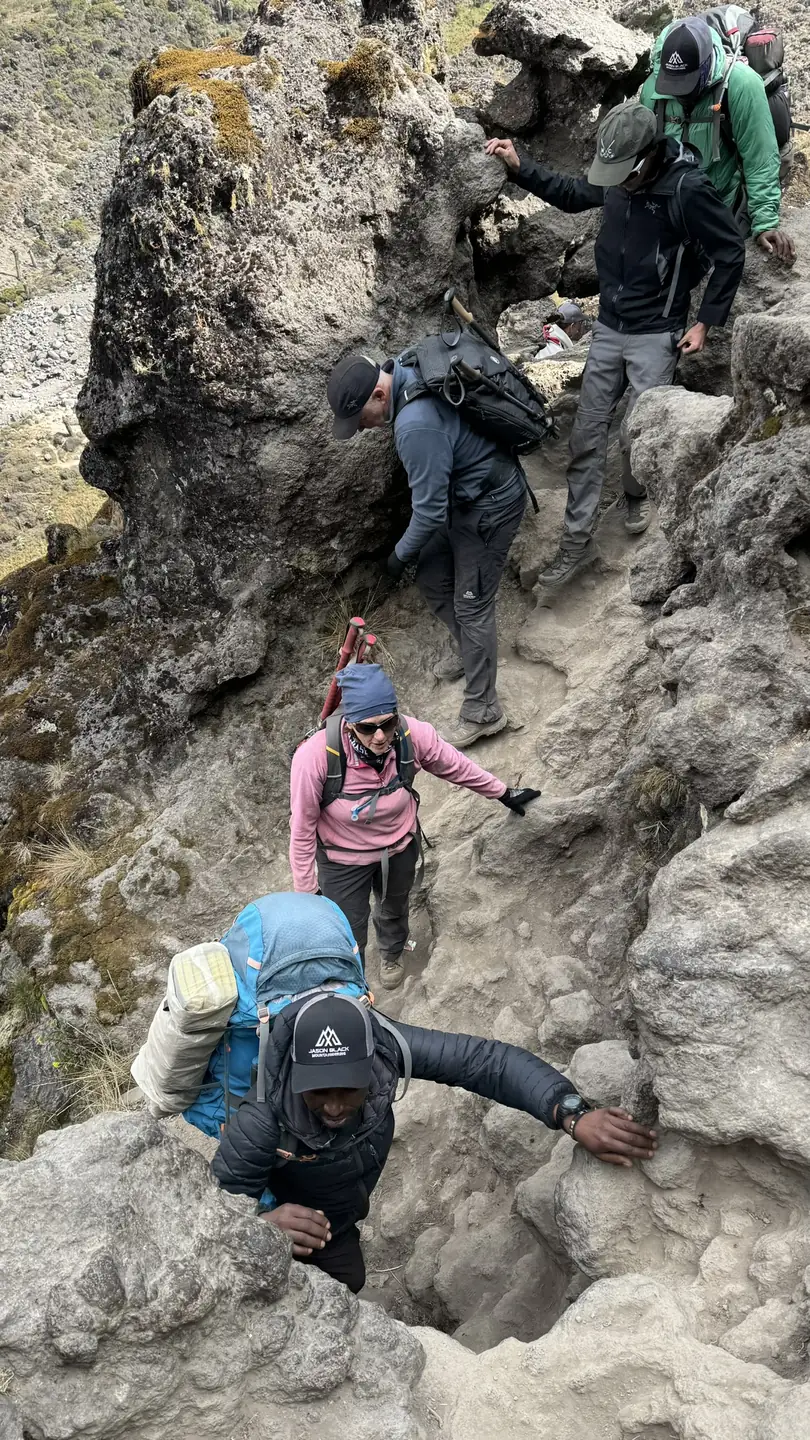
Day 5: The Barranco Wall and Beyond The Barranco Wall scramble on Day 6 is the single most visually intimidating section of the Machame Route and the most satisfying to complete. Hands and feet on solid volcanic rock, no ropes required, the team moves vertically through a section that looks impossible from Barranco Camp below and becomes straightforward once committed to. Above the wall the route continues through the upper highland desert toward Kosovo Camp.
Day 6 and 7: Arctic Summit Zone Above 5,000 m the world becomes arctic. The retreating glacier walls at Stella Point and the crater rim are the remains of ice fields that have existed for thousands of years and are now measurably disappearing. The air carries fifty percent of the oxygen available at sea level. The terrain is frozen scree and volcanic rock under a sky that is a shade of blue only visible at extreme altitude.
No other route on Kilimanjaro moves through this range of terrain with the same depth and duration at each ecosystem level. The Machame Route is not just a path to the summit. It is an immersive traverse of one of the most geologically and ecologically remarkable landscapes on the planet.
What the Barranco Wall Teaches Climbers That a Hut Route Cannot
The Barranco Wall is worth its own section because of what it does to a team that was not expecting it.
From Barranco Camp on the evening of Day 5, the wall looks vertical. Not steep. Not challenging. Vertical. A cliff face rising directly from the camp floor to a ridge that disappears above. Most climbers who see it for the first time have the same reaction. That is not a trek. That is a climb.
Then the morning comes and the team moves to the base and begins and within twenty minutes the reality reveals itself.
The Barranco Wall is a scramble. Hands and feet on solid, well-featured volcanic rock with holds everywhere. No ropes. No harnesses. No technical climbing skills required. The exposure is real but the security is genuine and the height gain is steady and the view from the top is the most dramatic on the entire route.
What the Barranco Wall teaches is specific and it happens to every climber who completes it regardless of their experience level.
The thing that looks impossible from the bottom is not impossible. It is just unfamiliar. The appropriate response to something unfamiliar and challenging is not retreat. It is committed, careful movement with proper guidance.
This lesson arrives at exactly the right moment in the expedition timeline. The day before Kosovo Camp. Two days before summit night. At the point where confidence in the ability to handle the unexpected is most valuable.
The Marangu Route has no equivalent. Its infrastructure removes the unexpected rather than preparing climbers to handle it.
Why Black Mountaineering Chooses the Whiskey Route
The decision is not aesthetic. It is strategic.
The Machame Route with the full seven-day structure, the Lava Tower acclimatisation day, the tent camping team dynamic, and the Kosovo Camp summit launch at 4,870 m creates the most complete foundation for summit success available on Kilimanjaro.
At Black Mountaineering we add the expertise of a guide who has stood on Everest and K2 to every decision made on that foundation. Jason Black holds the world record for the fastest double summit of Kilimanjaro in a single day. The altitude management system he has built around the Machame Route, including daily oxygen saturation monitoring, Wilderness First Responder trained guides, and oxygen carried on every climb, is the most comprehensive available on this mountain.
The Whiskey Route is the right route. The Black Mountaineering leadership system is why it produces the results it does.
What to Expect on the Ground: A Practical Comparison
Marangu Route at a glance: Five to six days on the mountain. Communal wooden hut accommodation. More crowded trails particularly during peak season. Lower summit success rate due to compressed acclimatisation schedule. Lower physical demand on individual days. Huts have basic amenities including mattresses and communal dining.
Machame Whiskey Route at a glance: Seven days on the mountain. Private tent camping throughout. Less crowded trails. Higher summit success rate due to extended acclimatisation including the Lava Tower climb high sleep low day. Greater physical demand reflecting the additional terrain and elevation. Camp meals prepared by dedicated cooks in a team kitchen tent.
The comfort calculation is closer than most people expect. The huts on the Marangu Route are basic and communal rather than comfortable and private. The tent camping on the Machame Route, at least on a properly led expedition, is an organised team environment where meals are prepared, camp is established before you arrive, and the expedition infrastructure functions around you rather than requiring you to manage it.
The experience difference is not huts versus tents. It is managed tourism versus genuine expedition.
Key Takeaways for Anyone Choosing Between the Routes
Choose the Machame Whiskey Route if: You want the highest possible summit success rate. You want a genuine camping expedition rather than a managed mountain tourism experience. You want the full five-ecosystem traverse. You are prepared to invest an additional two days on the mountain for a significantly better acclimatisation foundation. You want the Barranco Wall experience. You want a small group dynamic that the tent-based camp structure supports.
The Machame Route with Black Mountaineering adds: Expert leadership from an Everest and K2 summiteer. Kosovo Camp launch at 4,870 m instead of the standard lower Barafu Camp. Daily altitude monitoring. Oxygen on every climb. A ten-day expedition structure that begins with Tanzania before the mountain and ends with Jason’s personal cultural Day 10 after it.
What both routes share: Access to the same summit. The same permit system. The same Kilimanjaro National Park fee structure. The same ultimate goal at 5,895 m.
Where they diverge: The probability of reaching that goal. And the quality of the experience between the gate and the summit sign.
The Summit You Earn Is the Summit That Stays With You
There is a version of Kilimanjaro that is easier to reach. More comfortable on the approach. More supported by commercial infrastructure along the way.
And there is the version where you camp on exposed slopes above the clouds, scramble up a wall that looked vertical from below, move through five worlds in seven days, and arrive at Kosovo Camp the night before the summit push having earned every metre of the altitude beneath you.
That version asks more. It gives back more.
The summit at Uhuru Peak at 5,895 m means the same thing geographically regardless of which route you took to get there.
It does not feel the same.
The Whiskey Route earns the summit. That is why we run it.